
At a glance
- 2026 is a transition year for European packaging: Regulation (EU) 2025/40, known as the PPWR, applies generally from 12 August 2026, but implementation is phased and some secondary legislation is still being completed.
- The rules do not concern packaging manufacturers alone: a business that has packaging designed or manufactured under its own name or trade mark can itself fall within the PPWR definition of a “manufacturer”, with its own documentary obligations.
- The packaging trends that matter most are practical rather than cosmetic: right-sized formats, design for recycling assessed across the whole pack, reuse where a genuine system exists, and clearer information.
- Personalised packaging is not disappearing. The design sequence is changing: format and structure first, then artwork, print and finishes.
Which part of your packaging are you reviewing?
- Boxes, presentation boxes or bespoke packaging → personalised cardboard boxes
- Carrier bags for retail, events or deliveries → custom carrier bags
- Wrapping, labels, stickers and finishing details → packaging supplies
For years, packaging was discussed mainly as a branding issue: the right colour, a box that looks premium, a carrier bag that gets noticed. In 2026 a second layer has become just as important — how the packaging is designed, what it is made from and which documents support it.
The European context explains why. According to Eurostat, the EU generated 79.7 million tonnes of packaging waste in 2023, equal to 177.8 kg per inhabitant, with paper and cardboard representing the largest material share. That does not mean every pack should become minimal at any cost. It means reduction, recyclability and real-world functionality are becoming permanent criteria in the way businesses, distributors and customers assess packaging.
The useful question, therefore, is not which material will “win” in 2026. It is which combination of format, structure, material, print and actual use protects the product without adding unnecessary complexity — and what a business placing packaging or packaged goods on the EU market should now check.
Why 2026 is a transition year for packaging in Europe
The biggest change compared with the previous framework is the legal form of the rules. Packaging was previously governed by a directive, which each Member State implemented through national legislation. The PPWR is a regulation, so it applies directly across the EU under the same legal text. For businesses selling or shipping across several EU markets, that reduces fragmentation, but it also removes some of the national variation that packaging supply chains were used to managing.
From 12 August 2026, the provisions without a later specific application date apply generally. For manufacturers, this includes the conformity assessment procedure, technical documentation and the EU declaration of conformity. The Commission’s August FAQs also clarify that, for packaging placed on the market after 12 August 2026, Article 15(5) and 15(6) apply: the packaging must be identifiable by type, batch, serial number or another suitable element, and the manufacturer’s details must be provided in accordance with the Regulation. On substances, the limits covering lead, cadmium, mercury and hexavalent chromium should be kept separate from the specific PFAS restrictions for food-contact packaging.
The PPWR framework for extended producer responsibility (EPR) also applies from 12 August 2026, but “manufacturer” and “producer” are not interchangeable terms under the Regulation. EPR obligations depend on the operator’s role, the Member State in which the packaging is expected to become waste and the relevant national system. The PPWR provides for national producer registers rather than one single EU-wide registration, and their full operation follows the timetable in Article 44 and the related implementing measures.
On 10 June 2026, the European Commission published a guidance document to support consistent application of the Regulation and clarify several points that had remained uncertain. It is an important source to monitor because the practical PPWR framework is still being completed.
Updated 13 August 2026: on 3 August the Commission published an updated edition of its PPWR FAQs, and on 11 August it confirmed that the Regulation would start applying from 12 August. The same announcement reiterated the phased timetable: harmonised packaging labelling from 2028, followed from 2030 — or later dates set by individual provisions — by measures covering recyclability, recycled content, empty space and certain single-use packaging formats. The Commission also confirmed that work on the necessary secondary legislation is continuing.
A note for UK businesses
The PPWR is EU law. It does not replace the packaging rules that apply to packaging placed only on the Great Britain market. It can, however, become relevant to a UK business when that business places packaging or packaged goods on the EU market. UK packaging EPR is a separate regime and should be assessed independently alongside any PPWR obligations arising from EU market activity.
Who is the “manufacturer” under the PPWR?
This is often the most surprising point for businesses buying branded packaging, and it is one of the first definitions worth checking. Under the PPWR, a “manufacturer” is not only the company that physically makes the packaging. The definition can also cover a person that has packaging designed or manufactured under its own name or trade mark, irrespective of whether another trade mark also appears on the pack. A retailer having its own printed carrier bags produced, or a business ordering branded boxes for its deliveries, should therefore check its position rather than assume that every obligation sits with the packaging supplier.
There is an important derogation for smaller businesses. Where the business having packaging made under its own brand qualifies as a microenterprise and the supplier is established in the same Member State, the supplier is treated as the manufacturer. Likewise, an importer or distributor that places packaging on the market under its own name or trade mark can take on the manufacturer’s obligations. The correct position depends on the facts of each supply chain.
Regulatory note: this article provides general business guidance and is not a substitute for legal or technical advice on a specific packaging product. Obligations can vary according to packaging function, material, sector, destination market and the role a business performs in the supply chain.
Key PPWR dates to keep separate
The PPWR timetable is progressive. Treating August 2026 and 2030 as if they were the same compliance deadline is one of the easiest mistakes to make. Several requirements that receive a great deal of attention — including recyclability performance classes, recycled-content targets and limits on empty space — do not all start in August 2026, and some dates depend on implementing acts.
| When | What applies | Businesses most directly affected |
|---|---|---|
| 12 August 2026 | General application of the Regulation: conformity assessment, technical documentation and EU declaration of conformity; packaging identification and manufacturer details under Article 15(5) and 15(6); substance requirements, including PFAS restrictions for food-contact packaging; EPR framework, with registration, reporting and financial obligations to be checked according to role and Member State | Manufacturers, importers, distributors and businesses placing own-brand packaging on the EU market |
| 12 February 2027 | In the hospitality and takeaway sector, systems enabling customers to bring their own container for hot or cold drinks and ready-prepared food sold for takeaway | Cafés, restaurants, takeaway operators and hospitality businesses |
| 12 February 2028 | Industrial compostability requirements for the packaging types specified by the Regulation and for sticky labels on fruit and vegetables; adoption of the methodology for calculating empty space; for sales packaging, reduction of empty space to the minimum necessary for functionality and product protection | Food businesses, roasters, fresh-produce operators and businesses filling sales packaging |
| 12 August 2028 | Harmonised EU packaging labelling: from 12 August 2028 or 24 months after the relevant implementing acts enter into force, if that is later. During the transition, businesses still need to follow the national labelling rules applicable in each market they serve | Businesses printing consumer-facing packaging and labels |
| 1 January 2030 or later dates linked to implementing measures |
Harmonised design-for-recycling criteria and performance grades A, B and C; minimum recycled content in plastic packaging; a maximum 50% empty-space ratio for grouped, transport and e-commerce packaging; restrictions on certain single-use formats listed in Annex V | The wider packaging supply chain |
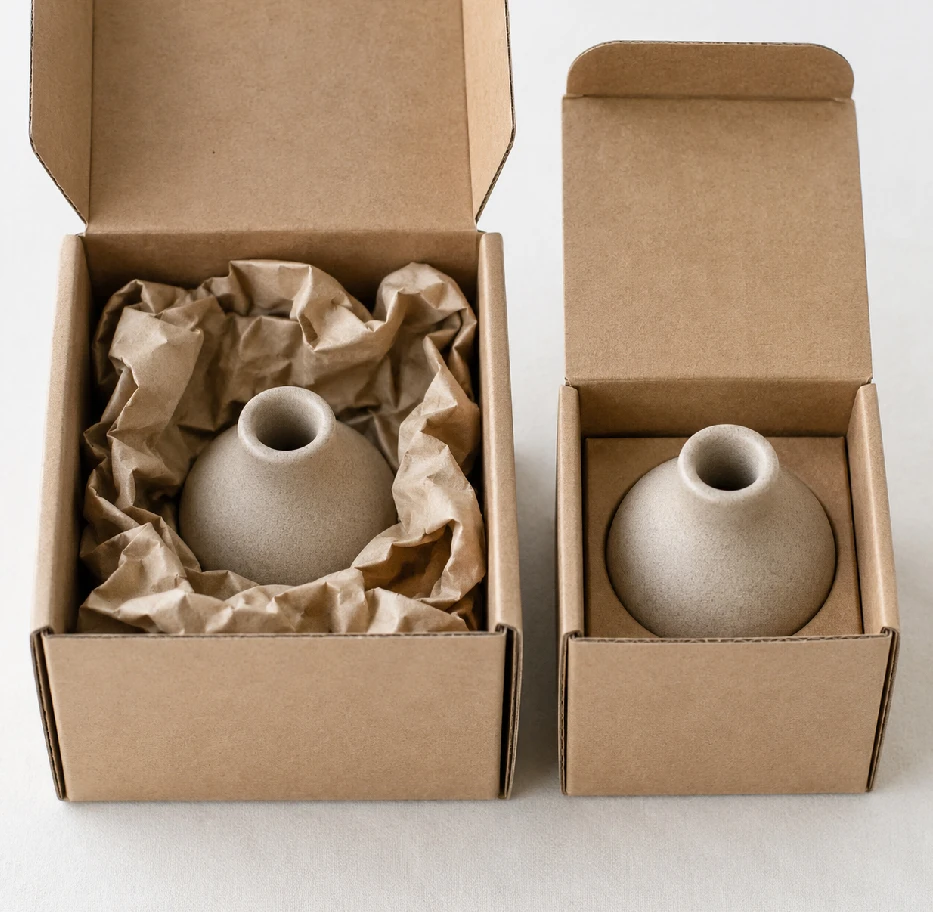
One detail about the empty-space limit is easy to miss: void-fill materials — including air pillows, loose fill and crumpled paper — are counted as empty space rather than as product content. Filling an oversized box does not solve the right-sizing problem; it simply moves it elsewhere in the pack.
The packaging trends in 2026 that matter most to businesses
Useful packaging trends are not fashions to apply to every product. They are directions that support better decisions on cost, logistics, compliance and brand perception — including for businesses that are not directly caught by every PPWR obligation.
1. Cut excess packaging without reducing protection
The first direction is right-sizing: packaging proportionate to the product, without unnecessary volume or void fill. In e-commerce, that means choosing shipping boxes closer to the dimensions of the product and its genuine protection needs. In retail, it means avoiding double packaging that adds neither protection nor value. In gift packaging, it means distinguishing deliberate presentation space from volume that is simply empty.
Businesses already have a commercial reason to do this, even before regulation is considered: carriers have long used volumetric weight to penalise inefficient parcels. The practical rule is simple — define the format first, then decide how to brand and finish it.
2. Design for recycling, rather than relying on the material name
Calling a box “paper” or “cardboard” does not, by itself, explain how the complete pack will behave at end of use. The full structure matters: laminates, coatings, adhesives, windows, plastic films, inserts, closures and whether different components can be separated.
Reducing the number of materials or designing easily separable components can support collection and recycling, but it does not automatically make a pack recyclable. Even apparently mono-material packaging can include coatings, barrier treatments, inks or non-separable components. Recyclability therefore needs to be considered across the whole packaging unit and against the collection and recycling system available in the market where the pack is used. Harmonised technical criteria will arrive progressively; in the meantime, the prudent approach is to avoid unnecessary material combinations and ask for clear information about the pack’s composition.
3. Reuse only where there is a credible system behind it
Reuse has a stronger role in European packaging policy, but a sturdy pack does not become “reusable” simply because it can survive more than one trip. A genuine reuse model needs a credible next use, appropriate durability and, where the model is structured, practical arrangements for collection, return, cleaning and recirculation.
For many SMEs, the immediate effect is as much about purchasing discipline as formal compliance: single-use packaging still has a function where hygiene, protection or presentation require it, but it should no longer be the automatic default. One of the simplest forms of practical reuse is a durable carrier bag that customers use repeatedly — the same principle discussed in our guide to choosing the right carrier bag and paper bag size for retail.
4. Clearer information and packaging labels in transition
This is an area where procurement teams need to be cautious. During the transition, businesses must continue to follow the national packaging-labelling rules that apply in each market they serve. The PPWR provides for harmonised EU packaging labels showing material-composition information from 12 August 2028, or 24 months after the relevant implementing acts enter into force if that date is later. As of 13 August 2026, the Commission was still working on the secondary legislation needed to complete the system. In practical purchasing terms, businesses reprinting packaging or labels intended to remain in use beyond 2028 should allow for future updates rather than locking themselves into unnecessarily large stocks.
The language used in environmental claims matters too. Broad statements such as “100% green” or “completely eco-friendly” are difficult to defend unless there is verifiable evidence for the entire pack. More specific information — material composition, verified recycled content, certification, separation instructions or a measured reduction — is more useful to customers and more robust from a compliance perspective.
5. Connected packaging: use QR codes where they add value
A QR code can extend packaging beyond the physical print area: sorting instructions, technical sheets, traceability, authentication, multilingual content, customer support and information that can be updated without reprinting the pack. The PPWR includes harmonised labels and digital data carriers in specific cases and according to specific timetables, but there is no general 2026 requirement for every pack to carry a QR code.
It is still sensible for businesses to build a clearer information hierarchy. Keep the brand, essential information and immediate instructions on the pack; use a QR code for longer, dynamic or multilingual information; and make sure the linked page is current, mobile-friendly and specific to the product. A QR code that leads only to a generic homepage rarely adds much value. One that explains how to separate components, provides current technical documentation or supports product authentication performs a real function.
What changes for printing, finishes and different packaging uses
For printing, the most useful trend for businesses is managerial rather than technological. Shorter runs and multiple artwork versions are increasingly accessible, reducing the risk of holding large stocks of packaging with obsolete information or seasonal graphics. This is especially useful for campaigns, product ranges that change frequently and limited-edition packaging. The right print method still depends on quantity, substrate, colour requirements and finish; our guide to logo printing techniques explains how to compare the main options.
In premium packaging, the strongest direction is more restrained: accurate construction, clean opening, controlled print quality and a small number of carefully chosen finishes, assessed for both compatibility with the substrate and end-of-use handling. In 2026, perceived value comes increasingly from correct proportions and execution rather than from adding layers for their own sake.
For food packaging, one principle comes before every visual trend: safety, documented suitability for the intended food-contact use and function take priority over graphics, and claims need to be supported by the relevant documentation. Food-contact packaging has its own regulatory framework, so this article does not attempt to cover every requirement. For a sector-specific example, see our guide to personalised bakery packaging with boxes, paper and sticker seals.
Common mistakes during this transition
- Treating 12 August 2026 as the date when every PPWR requirement becomes mandatory, then rushing into unnecessary packaging changes.
- Assuming all obligations sit with the packaging supplier without checking whether your business falls within the PPWR definition of a manufacturer.
- Switching materials simply because one is perceived as more sustainable, without checking protection, full pack composition and end-of-use handling.
- Reducing packaging dimensions without testing the product, packing process and transport conditions.
- Refreshing packaging artwork now without allowing for the future harmonised EU labelling timetable.
- Using “recyclable”, “recycled”, “compostable” and “reusable” as if they meant the same thing.
How to update business packaging step by step
You do not need to replace every packaging format at once. A more effective review starts with the formats used most often, or with the points where waste, damage, excess stock or inconsistency are already visible.
- Map the packaging you actually use. List boxes, carrier bags, paper bags, labels, wrapping, inserts and void fill, together with annual volumes, distinguishing sales packaging, transport packaging, e-commerce packaging and presentation or gift packaging.
- Clarify your role and ask for documentation. Check whether your business may be treated as a manufacturer because the packaging carries your name or trade mark, and ask suppliers which documents they can provide for the packaging you buy.
- Check format and full pack composition. Review empty space, weight, laminates or combined materials, whether components can be separated and whether the complete pack is suitable for the product and distribution route.
- Choose the print method around real order volumes. Compare techniques based on quantity, number of artwork variants, reorder frequency, substrate and printable area.
- Design the system, not just one component. Align boxes, carrier bags, labels and wrapping around one brand logic while allowing each item to perform its own practical function.
What we have observed since 2006 in packaging supply
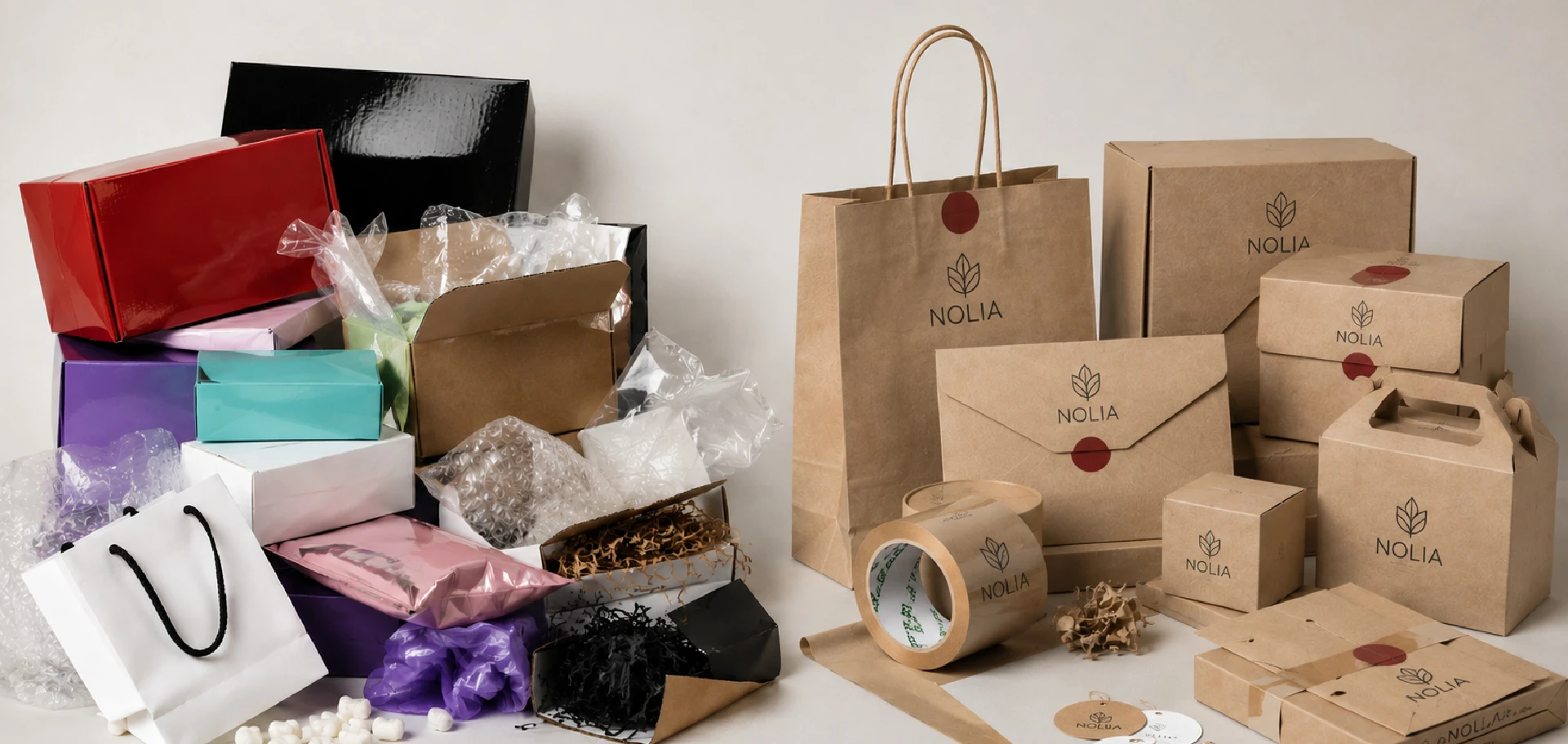
Whenever packaging rules change, we tend to see two opposite reactions: businesses that stop making decisions while waiting for complete certainty, and businesses that redesign everything as soon as the first announcement appears. In practice, the more resilient approach usually sits between those two extremes. Many packaging problems do not begin with the material itself; they begin because format, product, print and use are decided at different moments. A box can look right but be too large, a paper carrier bag can use a good substrate but be the wrong size, and a label can look attractive but be awkward to apply in production. The strongest projects start with the real workflow — what the packaging contains, who packs it, how it travels, what the customer sees and what happens after use. When those questions are answered before the artwork is finalised, personalisation tends to work better as well.
Questions to ask your packaging supplier before ordering
During a regulatory transition, the quality of a packaging supplier also shows in the questions it can answer before production begins. Six questions will reveal a great deal about how a project is being managed.
- Which structure and material weight are suitable for the product’s weight, shape and transport conditions?
- Which components make up the complete packaging unit, and which of them can be separated?
- Which technical or compliance documents are available for the packaging I am buying?
- Can the format be optimised to reduce empty space and unnecessary void fill?
- Do the selected finishes affect end-of-use handling or recyclability?
- Which environmental or material claims can I communicate, and what evidence supports them?
It is worth treating packaging as one coordinated supply rather than as a series of unrelated purchases. When boxes, carrier bags, personalised paper bags and finishing materials are selected together, it becomes easier to keep formats, substrates and artwork consistent. That is also how packaging continues to support brand communication, as discussed in our guides to packaging and unboxing and a coordinated branded range across promotional products, clothing and packaging. When demand is concentrated into a short seasonal window, the advantage of planning ahead becomes even clearer, as explained in our guide to festive packaging and when to plan it.
Shop for Shop is an Italian supplier established in 2006, providing personalised cardboard boxes, paper and carrier bags, labels, wrapping and packaging supplies for businesses, retailers, professionals and organisations in Italy and more than thirty European countries. The aim is to treat each packaging purchase not as an isolated item, but as part of a coherent branded supply system.
Official PPWR and packaging compliance sources
- Regulation (EU) 2025/40 on packaging and packaging waste — EUR-Lex, English version
- Commission Notice: Guidance document for Regulation (EU) 2025/40 — 10 June 2026
- Updated PPWR Frequently Asked Questions — European Commission, 3 August 2026
- New EU packaging rules start to apply — European Commission, 11 August 2026
- Packaging waste and PPWR implementation — European Commission
- EU packaging waste data for 2023 — Eurostat
- Extended producer responsibility for packaging — GOV.UK guidance for UK organisations
Frequently asked questions about packaging trends and the PPWR in 2026
What is the PPWR and when does it apply?
The PPWR is Regulation (EU) 2025/40 on packaging and packaging waste. It entered into force on 11 February 2025 and applies generally from 12 August 2026 across EU Member States without national transposition, replacing the previous Packaging and Packaging Waste Directive.
Does the PPWR apply to UK businesses?
The PPWR is EU law, so it does not apply simply because a business is based in the UK. It can become relevant when a UK business places packaging or packaged goods on the EU market, depending on its role in the supply chain. Packaging placed only on the Great Britain market is governed by UK packaging rules instead, including UK extended producer responsibility requirements where applicable.
Does the PPWR affect businesses that order personalised packaging with their own logo?
It can. The Regulation can treat as a “manufacturer” a person that has packaging designed or manufactured under its own name or trade mark. A derogation applies where the commissioning business is a microenterprise and the supplier is established in the same Member State. The correct position should be checked case by case.
What applies from 12 August 2026, and what comes later?
From 12 August 2026, provisions applying generally include conformity assessment with technical documentation and an EU declaration of conformity, packaging identification and manufacturer-information requirements under Article 15, substance restrictions and the EPR framework, depending on role and Member State. Harmonised design-for-recycling criteria, recycled-content requirements and the 50% empty-space limit for grouped, transport and e-commerce packaging apply from 1 January 2030 or later dates set by individual provisions. For sales packaging, the requirement to reduce empty space to the minimum necessary applies from 12 February 2028.
Do all existing packaging stocks have to be replaced because the PPWR now applies?
No. The Commission’s August FAQs clarify that packaging lawfully placed on the market before 12 August 2026, or before the application date of a particular provision, can generally remain on the market without being withdrawn or recalled. Transitional solutions also exist for some identification and manufacturer-information requirements affecting packaging already produced or held in stock but not yet placed on the market. Businesses still need to check the substantive requirements that apply when those stocks are later placed on the market, including PFAS restrictions for food-contact packaging.
Is mono-material packaging automatically recyclable?
No. Reducing the number of materials or making components easy to separate can help, but an apparently mono-material pack may still contain coatings, adhesives, barrier treatments or non-separable elements. Recyclability needs to be assessed across the complete packaging unit and against the collection and recycling systems available in the destination market.
What are the most important packaging trends for businesses in 2026?
The strongest practical trends are right-sized packaging, design for recycling assessed across the whole pack, reuse where a genuine system exists, clearer material and disposal information, more selective premium finishes and the targeted use of QR codes for useful digital information.
How can businesses reduce empty space in e-commerce packaging?
Start by measuring the product, the protection it genuinely needs and the distribution route, then choose a small number of well-proportioned box formats. Inserts and void fill should be used only where they protect the contents, because adding filler does not correct an oversized box. The quantitative 50% empty-space limit applies to grouped, transport and e-commerce packaging; sales packaging is instead subject to the minimum-necessary empty-space requirement from 12 February 2028.
Will QR codes be mandatory on every pack?
No. There is no general requirement in 2026 for every item of packaging to carry a QR code. The PPWR provides for harmonised labels and digital data carriers in specific cases and on specific timetables. A voluntary QR code is useful when it gives customers clear, current information that would otherwise be difficult to fit on the pack.
Leave a comment