

How to choose plastic carrier bags for professional use
A branded carrier bag must first fit the product and provide a suitable grip. The product pages refer to clothing and footwear shops, accessory and gift retailers, perfumeries, food businesses, hardware and automotive retailers, trade shows and events. These contexts are useful starting points, but they do not replace checks on dimensions, shape, weight, edges, transport conditions and any documentation required for the intended use.
Unlike paper, polyethylene film is not made from absorbent fibres, so moisture or condensation may be relevant when comparing materials. This does not amount to a universal promise of waterproofing, cold-store performance or identical behaviour across the range. Seals, handles, film composition and the contents must be assessed for the actual bag selected.
Measure the packed item, its orientation and carrying clearance
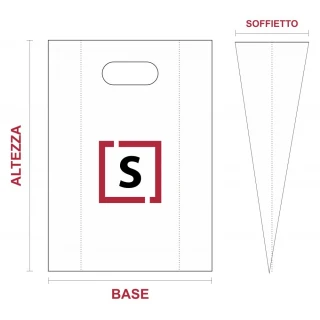
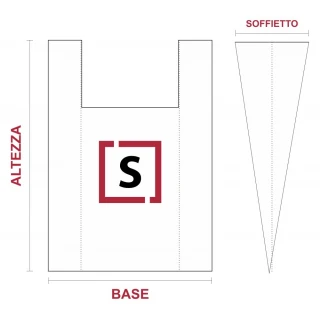
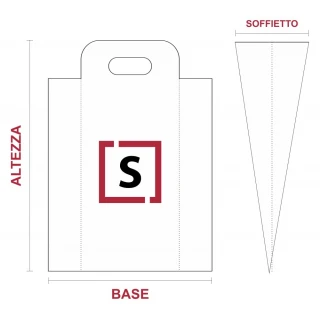
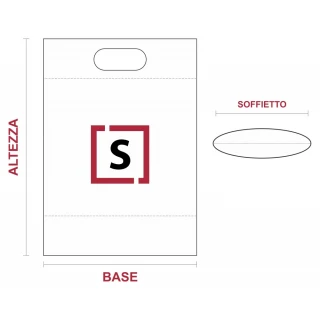
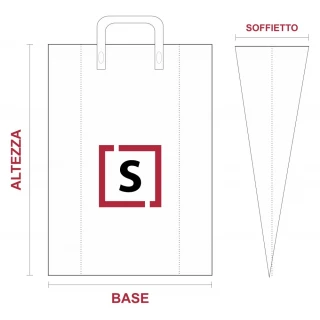
Measure the product in the position in which it will enter the bag, including boxes, sleeves and other outer packaging. Nominal width and height do not by themselves describe usable capacity: gussets, the base, seals and the handle area all affect the available space. Where shape, weight or edges are critical, test the real packed item and consider a sample. Do not derive a load rating in kilograms from dimensions or film thickness alone.
HDPE, LDPE and film thickness: how to read the specification
The product pages refer to HDPE and LDPE, meaning high-density and low-density polyethylene respectively; the cut-out handle model states HDPE only. In general technical terms, HDPE tends to have more linear chains and greater crystallinity, while LDPE has a more branched structure. These differences can influence density, rigidity and flexibility. On Shop for Shop product pages, models offering both are described as a more matt, rigid HDPE or a glossier, softer-feel LDPE.
These descriptions concern the material and finish stated for the relevant product; they do not establish an automatic end use. Formulation, additives, thickness, processing and the complete bag construction affect the result. The polymer abbreviation alone does not certify load capacity, food-contact suitability, print quality or bag performance.
Film thickness in micrometres (µm) measures the film; it is not a guaranteed load, service-life or reusability rating. Specific product pages state 100 µm and, for certain variants, 200 µm or 200 µm on request. Those values apply only to the products that state them. A proper assessment must also include size, base or bottom, gussets, seals, handle construction, the edges of the packed item and load distribution.
Extrusion, seals and stress distribution
Polyethylene films are generally made by extrusion and then converted by cutting and heat sealing to suit the bag construction. The bottom, side seals, folds and handle area work as one structure: a die-cut opening, vest shape and applied loop handle distribute stress differently. Within this catalogue, a heat-sealed bottom is expressly stated for the flexi-loop model. No seal type is attributed to another model unless its own product page states it.
Technical comparison of the five available models
The table summarises selections shown in the product configurators. Width, height and gusset are separate fields and do not imply that every theoretical combination is available. The configured product is the authoritative source for the final options and price.
| Model | Stated material and thickness | Width × height | Gusset / construction | Print and stated area | Available options |
|---|---|---|---|---|---|
| Die-cut handle plastic bag | HDPE or LDPE | Width 15–60 cm; height 30–100 cm | 0 cm or 8–30 cm, subject to the available selections | Flexographic printing from 1 to 4 colours; printing plate and set-up stated for artwork up to A4 | Sample subject to stock availability |
| Plastic vest carrier bag | HDPE or LDPE; the product page states 100 µm for non-food use and up to 200 µm for food applications. Request the documentation for the selected configuration where food use is involved. | Width 25–60 cm; height 35–100 cm, including handles | 16–30 cm, subject to the available selections | Flexographic printing from 1 to 4 colours on both sides; printing plate and set-up stated for artwork up to A4 | PDF, AI, EPS or high-resolution images; sample subject to stock availability |
| Plastic shopping bag with cut-out handles | HDPE; the product page states 100 µm for non-food use and 200 µm for food use on request. Request the documentation for the selected configuration where food use is involved. | Width 30–45 cm; height 40–100 cm | 0 cm or 8–20 cm, subject to the available selections | Flexographic printing from 1 to 3 colours, with order-weight thresholds | Sample subject to stock availability |
| Plastic shopping bags with bottom | HDPE or LDPE; 100 µm stated | Width 30–80 cm; height 30–60 cm | Base without a cardboard insert; dimensional field “Gussets” from 10 to 20 cm in the configurator | Flexographic printing from 1 to 4 colours; colour mode to be confirmed in the artwork proof | Sample subject to stock availability |
| Flexi-loop handle plastic bag | HDPE or LDPE; the product page states 100 µm for standard use and 200 µm for food applications. Request the documentation for the selected configuration where food use is involved. | Width 30–60 cm; height 35–100 cm | 0 cm or 10–30 cm; heat-sealed bottom; selectable handle colour | Flexographic printing from 1 to 4 colours; front, back and gussets stated; printing plate and set-up stated for artwork up to A4 | PDF, AI, EPS or high-resolution images; sample subject to stock availability |
All five configurators show “New” and “Reprint”, ordering in kg, a first order band of 60 kg and an indicative numerical conversion into bags. Materials, thicknesses and food-use wording in this table reproduce model-specific product information; they are not a category-wide certification. Check the selected configuration and its documentation before use.
Film colour and flexi-loop handle colour
The Plastic Colour field offers a broad model-specific palette spanning white, transparent, warm neutrals, yellows, oranges, pinks, reds, purples, browns, blues, greens, grey, black and metallic copper, silver and gold. Some colours can change the configured price. The exact live swatches, labels and availability in the selected model are authoritative.
On the Flexi-loop handle plastic bag only, the Flex Handle Colour field offers white, silver, black, orange, red, gold, fuchsia, transparent and blue. Film colour, handle colour and the colour specified for printing are separate decisions and should be assessed together on the artwork proof.
Flexographic printing, print colours and the artwork proof
All five products show flexographic printing. Their maximum number of print colours differs: the die-cut, vest, base and flexi-loop models offer up to four colours, while the cut-out handle model offers up to three. In the live configurators, a second colour becomes available from 100 kg, a third from 200 kg and a fourth, where offered, from 300 kg; one colour is available from the first 60 kg band.
The vest carrier bag product page states printing on both sides. The flexi-loop product page states front, back and gussets, subject to folds and margins. For other models, confirm the sides and printable area on the artwork template. Selecting one to four colours does not by itself establish CMYK process printing, universal Pantone® matching, full coverage or absolute colour fidelity. The appropriate method must be confirmed for the artwork and on the proof.
The die-cut, vest and flexi-loop product pages state that the displayed printing plate and set-up costs apply to artwork up to A4; larger artwork requires a separate quotation. The vest and flexi-loop pages prefer vector PDF, AI or EPS files and also accept high-resolution images. These conditions must not be extended automatically to the other models.
Flexographic print results depend on the film, artwork complexity, usable print area, folds and seals. The field used to communicate the requested print colour records the colour instruction, while the free digital artwork proof allows composition and positioning to be checked before production.
“New”, “Reprint” and artwork management
In the Type of Processing field, “New” identifies an order requiring a new printing plate and set-up for the chosen artwork. “Reprint” is for a repeat order using unchanged artwork. If the logo, colours, dimensions or position change, confirm the correct processing option before ordering.
Ordering by kg and the indicative number of bags
Plastic carrier bags in this category are ordered by total material weight in kilograms. This reflects film conversion from reels: the number of finished bags changes with the dimensions and production configuration. At the date of this audit, all five configurators begin at 60 kg and show subsequent bands of 100, 150, 200 and 300 kg.
After width, height, gusset and kg have been selected, the configurator displays an indicative numerical conversion into bags. This is an estimate for the current configuration, not a universal guaranteed quantity. The five product pages also warn that the delivered quantity may vary slightly from the amount ordered. Compare the estimate with forecast usage and read the terms of sale before confirming the order.
Requesting a sample before ordering
A sample can be requested for each of the five models to assess colour, material and construction. The service is limited to one unit per colour and to products currently available in stock. A sample does not replace a dimensional check using the packed item and does not certify the performance of a future custom configuration.
Checks to make before ordering
- The real packed item – Measure the product together with its packaging and consider orientation, edges and weight distribution.
- Handle and bottom construction – Compare die-cut, vest, integrated cut-out and applied flexi-loop handles; assess the dedicated base model separately.
- Size and usable volume – Review width, height and gusset or base together rather than choosing from a single dimension.
- Material and thickness – Use the model specification without turning HDPE, LDPE or µm into an automatic load rating.
- Artwork – Match the number of colours, logo size and detail to the printable area and configurator thresholds.
- Processing type – Select “New” for new artwork or a new printing plate; select “Reprint” only when the artwork is unchanged.
- Order quantity – Distinguish ordered kilograms from the estimated number of bags, allow for the stated variation and plan against actual usage.
- Regulated use – Where food, environmental claims or market-placement rules are involved, request model-specific documentation and check the intended use and destination.
Common mistakes to avoid
- Deriving load capacity from thickness – Performance depends on the complete construction and contents.
- Treating HDPE and LDPE as end-use certifications – The polymer abbreviation alone does not certify food contact, print result or product suitability.
- Confusing kilograms with bags – Kg is the commercial order unit; the estimated number of bags changes with the configuration.
- Assuming every model offers four print colours – The cut-out handle model offers up to three in its configurator.
- Equating four colours with CMYK – Process printing must be confirmed for the model and artwork.
- Extending A4 set-up terms and file formats across the range – These details are verified only on the stated product pages.
- Selecting “Reprint” after changing the artwork – Changes to the logo, colour, size or position may require a new printing plate and set-up.
- Ignoring folds, seals and the handle area – They can reduce usable capacity and affect the printable area.
- Using generic environmental claims – Recyclability, recycled content, biodegradability and compostability require product-specific evidence.
Regulation, food use and environmental information across European markets
Sale by a food retailer, carrying packaged food and direct food contact are different situations. A bag being used in a food shop, or to carry sealed packs, does not establish suitability for direct contact with food. Where direct contact or another regulated food use is intended, check the declaration, composition and documentation for the specific product and configuration.
The applicable carrier-bag rules depend on where the bags are placed on the market. For EU destinations, Directive (EU) 2015/720 established measures to reduce the consumption of certain lightweight plastic carrier bags, while Member States retained destination-specific measures. Regulation (EU) 2025/40 on packaging and packaging waste entered into force on 11 February 2025 and applies generally from 12 August 2026, with individual obligations and transitional dates set by the Regulation.
For the United Kingdom and other non-EU European destinations, national rules apply; within the UK, carrier-bag charging schemes and exemptions can also differ by nation. Check current official guidance for the destination and the role of the purchaser, importer, distributor or retailer. A catalogue filter, commercial handle name, polymer type or film thickness does not by itself prove legal classification or compliance in a particular market.
End-of-life instructions also depend on the configuration and local collection system. Polymer, handle components, additives, print, contamination and local rules can affect disposal guidance. Follow product-specific information and the local authority’s instructions. Do not apply recyclability, recycled-content, biodegradable or compostable claims to the range unless they are documented for the purchased configuration.
Brand continuity and coordinated supplies
A carrier bag proportioned to its contents can extend brand visibility beyond the point of sale. For consistent presentation, coordinate the logo, film colour, print colour and handle while protecting legibility around folds and seals. The artwork proof allows positioning to be checked against the template for the selected model; “Reprint” remains appropriate only where the artwork is unchanged.
Carrier bags can be coordinated with custom cardboard boxes and packaging supplies. For shops, trade shows and events, they can also share brand rules with promotional products and custom clothing. Each substrate still has its own print methods, areas and technical limits.
Plastic carrier bags or another category: where to continue
Stay in this category if you need a polyethylene-film carrier bag with one of the five available handle and base constructions. If the requirement concerns another material, counter service, takeaway packaging or a structured reusable shopping bag, continue in the dedicated category.
| Requirement | Correct category | Semantic boundary |
|---|---|---|
| Compare the full multi-material shopping-bag range | Bags | Multi-material overview for the principal carrier-bag and shopping-bag families. |
| Polyethylene-film body with die-cut, vest, integrated cut-out or applied flexi-loop handles, including a dedicated base model | Plastic Bags | This is the category described on the current page. |
| Handled carrier bags made from paper | Paper Bags | Paper stocks, weights, bases, handles and print methods specific to paper carrier bags. |
| Bags for restaurants, takeaway service and food delivery | Takeaway Bags | Food-service routing; product-specific documentation remains necessary for any regulated food use. |
| Lightweight paper bags for bread and counter service | Paper Bread Bags | Paper counter-service products, distinct from handled polyethylene-film carrier bags. |
| Cotton, non-woven, jute and other textile-style shopping bags | Tote Bags | Textile and textile-like materials, seams and decoration methods specific to the tote branch. |
| Structured shopping bags intended for repeated use in the materials offered by that range | Reusable Shopping Bags | Bags designed and sold within the dedicated reusable shopping-bag range. |
Useful guides to bag size, printing and coordinated branding
For more help with sizing, retail packaging, print methods and coordinated branded supplies, read:
- Carrier bags and paper bags: choosing the right size
- Retail packaging: how to choose the right size
- Logo printing techniques: how to choose
- Promotional products, clothing and packaging: how to create a coordinated branded range
Frequently asked questions about custom plastic carrier bags
Which custom plastic carrier bag models are available?
The category contains five models: a die-cut handle bag, a vest carrier bag, a bag with integrated cut-out handles, a bag with a dedicated base and a flexi-loop handle bag. Handle construction, sizes, gussets, stated materials and print options vary, so always check the selected product page and configurator.
How should I choose the size of a plastic carrier bag?
Measure the packed item in its loading position and allow for depth, edges and carrying clearance. Compare width, height and the gusset or base together: one dimension does not describe usable capacity and cannot establish a guaranteed load rating.
What does ordering in kg mean, and how many bags will I receive?
Kilograms are the commercial order unit, not a fixed number of bags. All five configurators currently begin at 60 kg, followed by 100, 150, 200 and 300 kg. The numerical conversion displayed after selecting width, height, gusset and kg is an estimate for that configuration, and the delivered quantity may vary slightly.
How many print colours and which print areas are available?
The die-cut, vest, base and flexi-loop models offer up to four colours; the integrated cut-out handle model offers up to three. A second colour starts at 100 kg, a third at 200 kg and a fourth, where available, at 300 kg. The vest page states both sides and the flexi-loop page states front, back and gussets; check the artwork template for other models. Four colours do not automatically mean CMYK process printing.
What is the difference between “New” and “Reprint”?
“New” identifies an order requiring a new printing plate and set-up for the selected artwork. “Reprint” is for a repeat order with unchanged artwork; if the logo, colours, dimensions or position change, confirm the correct processing type. In both cases, the free digital artwork proof allows the design to be checked before production.
Can I request a sample before placing my order?
A sample can be requested for all five models, limited to one unit per colour and to items available in stock. It helps assess the material and construction, but does not certify the performance of a future custom configuration.
What is the difference between HDPE and LDPE in this range?
HDPE and LDPE mean high-density and low-density polyethylene. The abbreviation alone does not determine rigidity, transparency, print result or end use: formulation, additives, thickness and the complete construction also matter. Check whether and how the material can be selected on the relevant product page.
Does thicker film guarantee greater load capacity or reusability?
No. Thickness in µm is one parameter and does not equal a guaranteed load, service life or reuse rating. Performance also depends on material, size, bottom, gussets, seals, handle, product edges and load distribution; do not derive a capacity in kg from film thickness alone.
Can plastic carrier bags be used with food?
Carrying packaged food is not the same as direct food contact. Use a bag for food contact only when the specific product and its documentation confirm suitability for the intended use; its presence in this category, polymer type or film thickness is not a certification.
Are these bags reusable, recyclable, biodegradable or compostable?
There is no category-wide answer. Use classification and end-of-life guidance depend on composition, thickness, handles, additives, print, contamination, documentation and the rules in the destination market. Follow the purchased product’s information and local authority guidance, and make environmental claims only where they are supported for that configuration.
When should I choose a category other than Plastic Bags?
Choose Paper Bags for handled paper carrier bags, Takeaway Bags for food-service and delivery formats, Paper Bread Bags for paper counter-service products, Tote Bags for cotton, non-woven, jute and related materials, or Reusable Shopping Bags for the dedicated repeat-use range. This category contains the five models with a polyethylene-film body.
Customise plastic carrier bags for your shop or business: compare the handle, size, gusset or base, film specification, order weight and number of print colours, then review the estimated number of bags and approve the artwork proof for the configured model.