




How to choose a foldable shopping bag for your business and distribution method
Intended use helps to narrow the search, but it does not replace product verification. The same foldable construction appears across different materials, sizes and closures; a bag handed out at a trade fair does not necessarily meet the same criteria as one included in a welcome pack or used for the weekly shop. Contents, quantity, folded size, handles, construction and artwork all need to be assessed together.
Trade fairs, conferences, events and promotional distribution
Where distribution is concentrated, the key considerations are quantity, storage space, speed of hand-out and the proportion between the bag and the material being carried. The folded size can make it easier to estimate the logistics, while the open size must suit the actual contents. The usable branding area and the available method depend on the individual model.
Retail, shops, welcome packs and e-commerce shipments
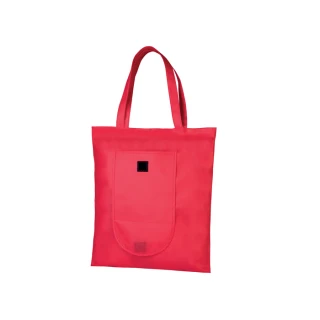
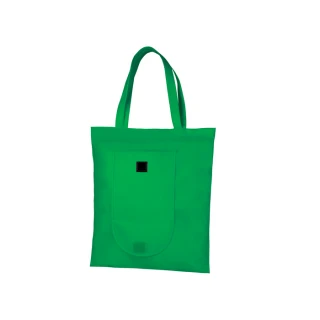
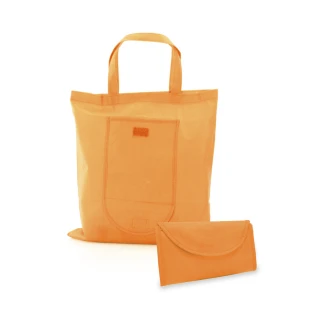
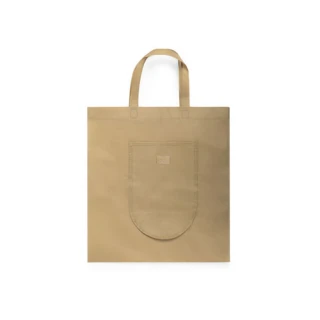
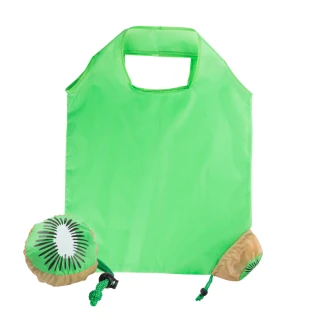
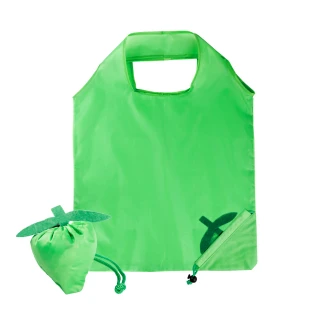
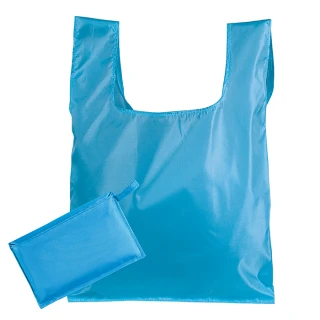
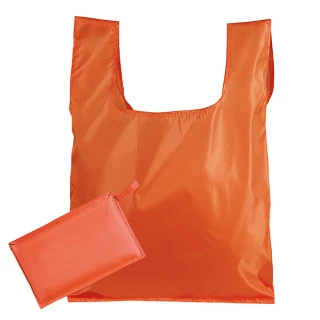
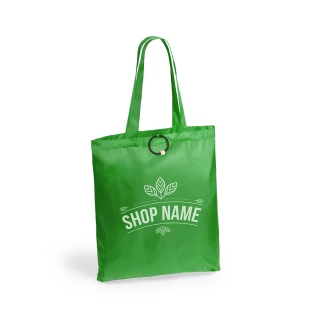
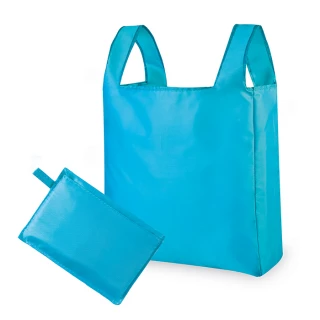
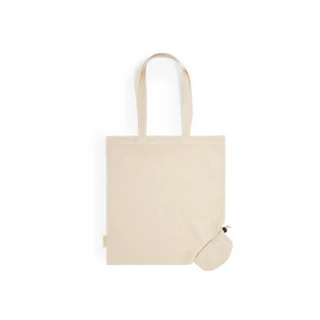
At the point of sale a foldable bag can be handed to the customer in a compact format; in corporate packs and shipments, the reduced storage space when folded can make it easier to include. Check the folded size, any accessories or rigid parts, the way the bag is reopened and the logo position in the open configuration. Where the model has a pocket or pouch that can be branded, any second branding area must be shown on the product page and in the configurator.
Grocery shopping and everyday use
Some models in this category are designed to be kept to hand and opened when needed. Compare the open size, any gusset, the handles and the closure system against the expected load. Being usable for the weekly shop does not make these models equivalent to the structured bags in the dedicated category: where the main criterion is the grocery-shopping and repeat-carrying function — including structured models and shopping trolleys — see Reusable Shopping Bags. Foldable Shopping Bags keeps the construction criterion, Reusable Shopping Bags the function.
Public bodies, associations and awareness campaigns
For public events and campaign distribution, quantity, colours, ease of hand-out and the availability of unbranded stock may all be relevant. Environmental requirements, material declarations or conditions set by a tender must be checked against the documentation for the specific supply and against the rules of the destination market, without extending to the category an attribute that belongs to one product.
What defines a foldable shopping bag: construction, materials and closures
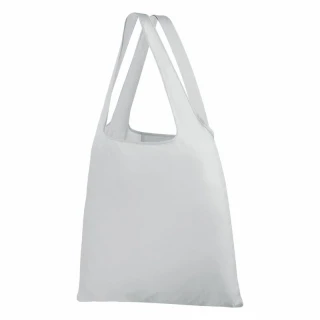
Foldable construction describes the way the bag packs down, not a single material and not a uniform level of performance. The category therefore includes different substrates: the range currently covers non-woven fabric, polyester, RPET and cotton, and individual products state textile specifications or organic attributes of their own. The effective composition is the one shown on the product page: the product title, colour, lightweight feel or appearance of the fabric do not replace the technical data.
| Material stated | What appears in the current range | What to check | What it does not establish on its own |
|---|---|---|---|
| Non-woven fabric | Foldable non-woven models with stated weights, heat-sealed or stitched construction and, on some products, a gusset. | Fabric weight, joins, gusset, handles, folding method, closure and branding area. | Carrying capacity, working life, water resistance or suitability for a specific use. |
| Polyester | Models that state polyester, including textile specifications such as 190T or 210D on the products that publish them. | The specification stated by the model, open and folded dimensions, handles, closure and configurable branding method. | That every polyester bag shares the same specification, strength, finish or branding method. |
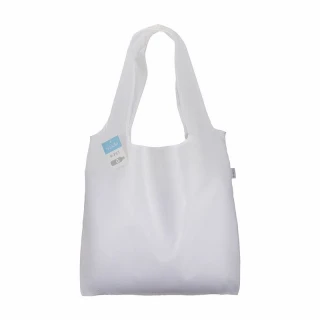
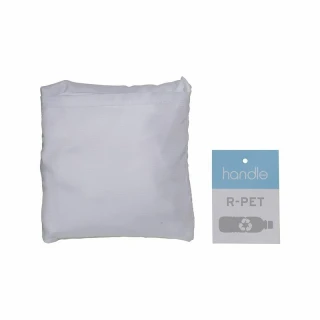
| RPET | Products that state RPET, also written R-pet on some pages, with specifications such as 190T or 210T. | Composition, recycled percentage, certifications, dimensions, joins, handles and end-of-life information. | Recycled percentage, traceability, certification, recyclability or lower overall impact of the finished bag. |
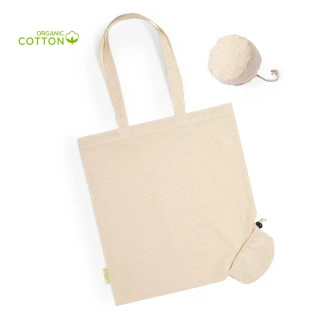
| Cotton | Foldable cotton models, including a product stated as 100% organic cotton with its own fabric weight. | Fibre percentage, organic attributes where stated, fabric weight, stitching, handles and branding method. | That every model is 100% cotton, organic, or suitable for the same load and reuse frequency. |
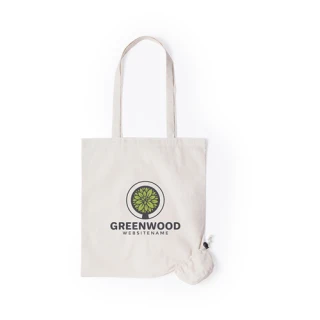
A foldable bag in cotton may appear both in Foldable Shopping Bags, for its construction, and in Cotton Tote Bags, for its composition. Appearing in both paths does not make the two categories equivalent: the first answers the need for the smallest possible folded size, the second the comparison of the fibre, the material weights and the documented characteristics of cotton.
Folding and closure systems available in the range
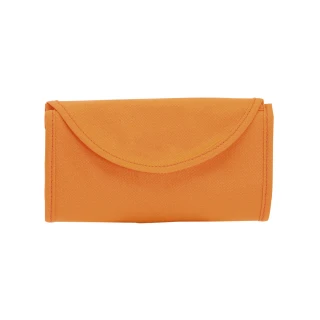
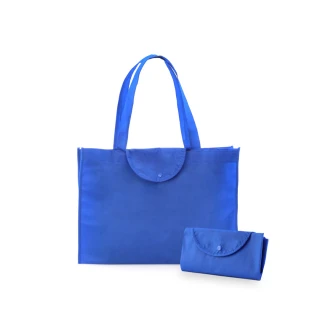
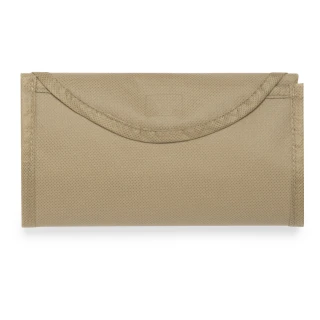
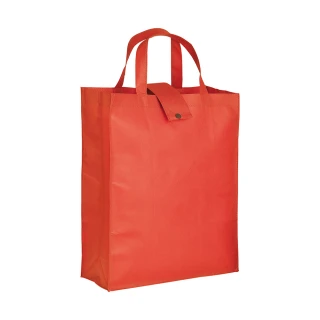
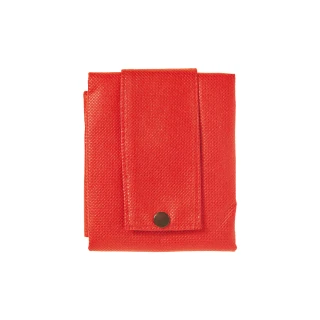
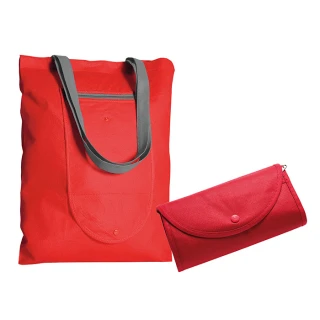
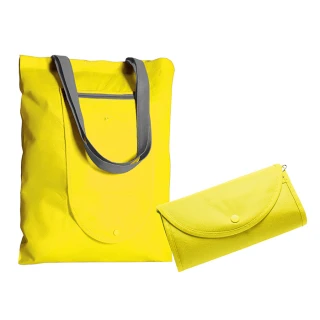
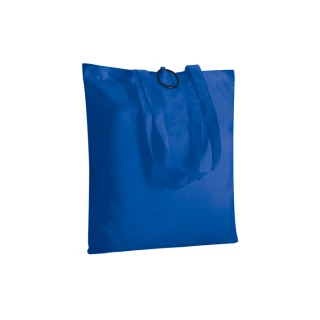
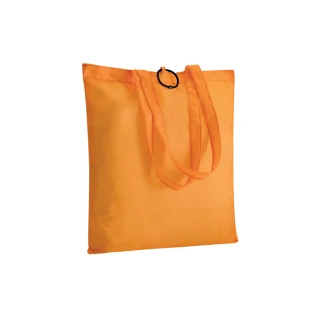
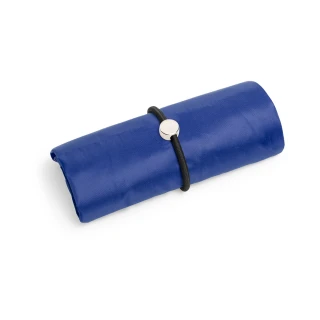
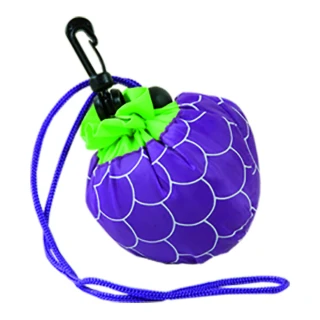
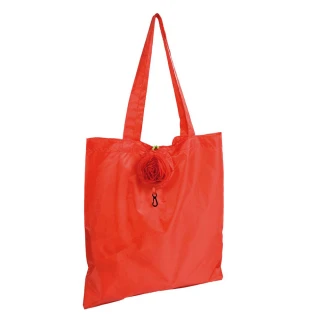
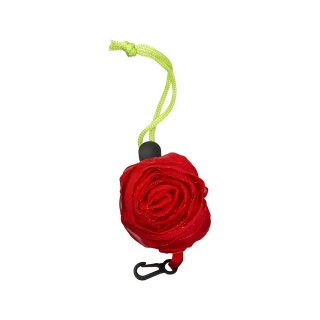
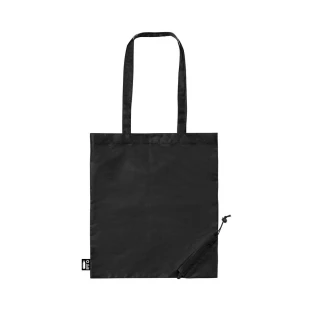
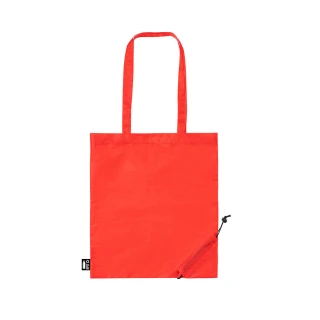
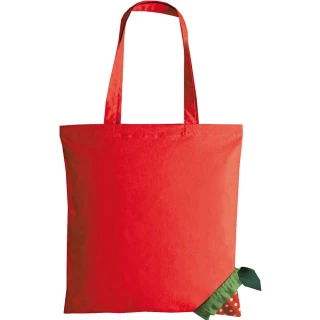
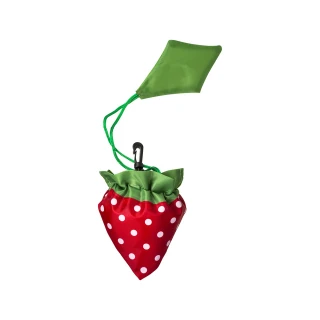
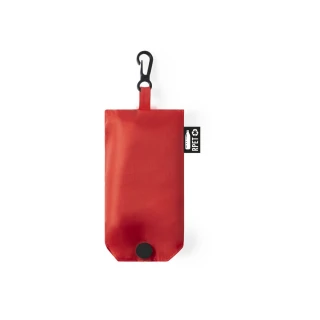
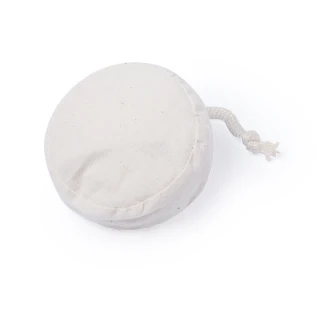
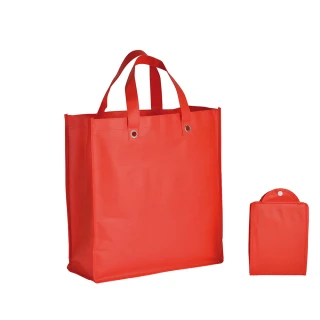
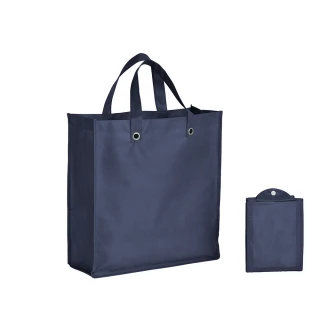
An integrated pouch, hook-and-loop fastening, press stud, elastic band, drawcord, zip and snap hook are features of individual products, not category-wide filters. Some models have no dedicated closure and are simply folded to shape. The choice affects opening speed, folded size, the presence of separable components and how easily the bag can be folded correctly again after use.
| System stated by the product | Function | What to check | What it does not establish on its own |
|---|---|---|---|
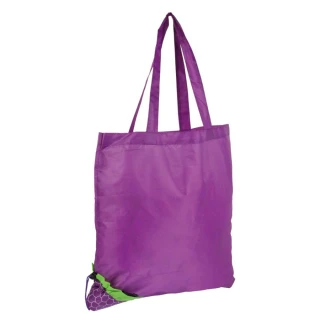
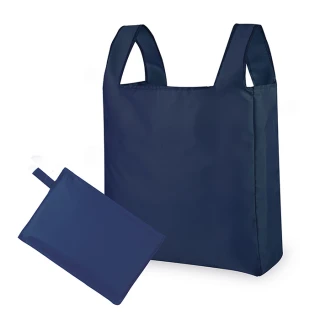
| Integrated pouch or purse-style pocket | The bag folds into a pocket or pouch forming part of the product. | Whether it is integrated or separate, folded dimensions, attachment and any brandable area. | Identical folded size across models, or that a separate pouch cannot be mislaid. |
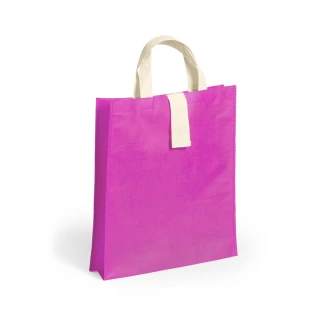
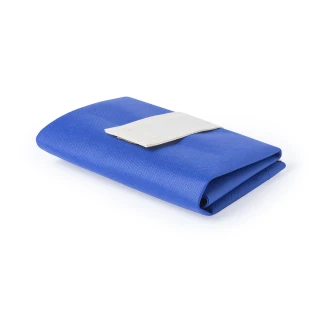
| Hook-and-loop fastening | Holds the folded bag closed by means of a flap or fastening strip. | Position, folded dimensions, stitching and any interference with the branding area. | Retained holding strength across models or across frequencies of use. |
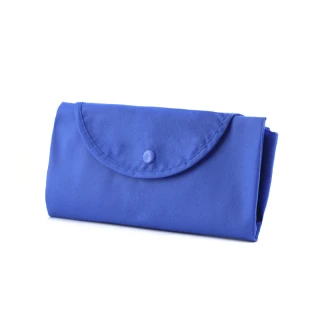
| Press stud or button flap | A mechanical fastening that keeps the bag in its folded format. | Number and position of the studs, reinforcement, opening and final folded size. | Equal durability of the fastening on every model or at any frequency of use. |
| Elastic band | Wraps around or holds the folded bag. | Position of the band, folding method, folded dimensions and compatibility with the logo area. | Compactness equal to models with a pouch or a zip. |
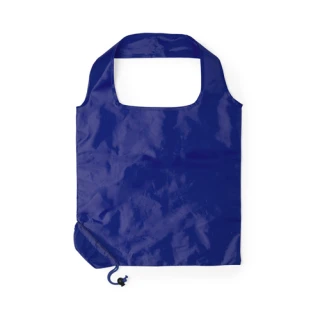
| Drawcord | Gathers and closes the model by means of a cord or adjuster. | Position, components, folded dimensions and how the bag is reopened. | Protection of the contents in use, or a uniform folded size. |
| Zip | Closes a pocket, pouch or folding compartment provided by the product. | What is being closed, position of the zip, folded dimensions and component materials. | Water resistance or protection of the contents while the bag is open and in use. |
| Snap hook | Allows the folded bag to be attached to a bag, backpack or belt. | Presence on the model, attachment point, material and folded size. | Suitability of the attachment to support the bag while loaded. |
| No dedicated closure | The bag is simply folded to the shape provided by its construction. | Stability when folded, storage method and the actual size after folding. | That the folded size matches models fitted with a closure. |
Fabric weights from 60 to 120 gsm: using the filter without treating it as a load rating
The fabric weight filter currently exposes six values: 60, 80, 90, 100, 105 and 120 gsm. These are options present in the range, shown for the products that state this parameter, and they are neither a continuous scale nor specifications available on every material, colour or model. Use the filter once the construction has been identified.
| Information published | How to read it | What it does not prove |
|---|---|---|
| Fabric weight in gsm | Mass per unit area for the substrate stated by the product. | Carrying capacity in kilograms, working life, resistance to folding, number of uses or environmental performance. |
| A lower or higher value | Helps compare the substance of technically compatible models within the same context. | That a heavier bag is always more resistant to folding, or better suited to every use. |
| Textile specifications such as 190T, 210T or 210D | Specifications published by some polyester and RPET models, to be read alongside the page that states them. | A direct comparison with gsm, or equivalent performance between products carrying different specifications. |
| A load rating in kilograms | A figure stated by an individual product page for one construction, size and handle configuration. | A capacity that holds for the whole category, or one that can be derived from fabric weight alone. |
Two bags with the same fabric weight may differ in substrate, size, gusset, joins, closure and handles. In the same way, a textile specification published by one product page does not replace verification of the composition, construction and conditions of use of that product.
Open and folded dimensions: assessing real compactness
The open size describes the space available in use; the folded size describes how much room the bag takes up when carried or stored. Not every product publishes both configurations, and where a folded size is absent it should not be reconstructed by analogy with a similar model. The following pairs are examples published by individual products in the current range, not standard formats for the category.
| Open size stated | Folded size stated | What to check on the model |
|---|---|---|
| Approx. 38 × 42 cm | Approx. 18 × 11 cm | Hook-and-loop fastening, handle length and stitched construction. |
| Approx. 32 × 42 × 16 cm | Approx. 15 × 13 cm | Gusset, purse-style folding and the closure provided. |
| Approx. 40 × 57 × 7.5 cm | Approx. 16 × 15 cm | Pouch, depth and the orientation of the contents. |
| Approx. 38 × 40 cm | Approx. 14 × 11 cm | Folding method and whether a closure or accessory is fitted. |
Before ordering, measure the real contents and check the handles, any gusset, protruding parts and the clearance needed to fold the bag correctly.
Foldable Shopping Bags or Non-Woven Bags: boundaries based on the catalogue
The two categories are neighbours but not interchangeable. Foldable Shopping Bags is defined by foldable construction and includes models in different materials; Non-Woven Bags is defined by the bonded non-woven substrate and also includes fixed-structure models. A foldable non-woven bag belongs to the foldable construction and keeps its relationship with the material: the two paths stay distinct and exist to guide the correct comparison, without turning construction or material into a performance hierarchy.
| Criterion | Foldable Shopping Bags | Non-Woven Bags |
|---|---|---|
| What defines the category | Foldable construction stated by the model. | The bonded non-woven substrate stated by the model. |
| Materials | Non-woven fabric, polyester, RPET and cotton, according to the composition stated by each product. | Non-woven fabric, with the fibre or polymer to be checked per product. |
| Fabric weights in the filter | 60 to 120 gsm, on the models that state this parameter. | 45 to 120 gsm. |
| Distinguishing filters and attributes | Folding and closure systems, open and folded dimensions, Colour and fabric weight filters. | Takeaway, Pizza bag and Bottle holder; heat-sealed, stitched or laminated constructions. |
Size, gusset, handles, colour and branding area
- Real contents – measure the largest item together with its packaging, including orientation, sharp edges and the number of units.
- Open size – assess width and height together with any depth or gusset; one dimension does not describe usable volume.
- Folded size – compare the folded size against the space available in packs, displays, shipping cartons, bags or backpacks.
- Handles – length, width, reinforcement and attachment points vary by product and govern hand or shoulder carrying; capacity cannot be inferred from handle style alone.
- Joins – stitching, heat sealing, piping and reinforcement belong only to the models that state them.
- Colour – the available shade depends on the model and affects perceived contrast and the coverage the logo requires; a fluorescent shade is not in itself a high-visibility or safety characteristic.
- Branding area – folds, gussets, seams, pockets, zips, studs, elastic bands and pouches may reduce or interrupt the usable surface.
Branding methods and logo placement
The method must be chosen for the configured product, not from the word foldable. Material, colour, finish, fold lines and available area all change the outcome.
| Method | When it may be considered | What to verify on the model |
|---|---|---|
| Screen printing | Spot-colour logos and repeat production on compatible models. | Colour count, coverage on the substrate colour, branding area, minimum detail, front or reverse and quantity. |
| Other methods | Only where the product page or configurator states the relevant process for that model. | Material and finish, substrate colour, usable area, fine-detail reproduction and interference from folds, seams, pockets or the closure. |
A method offered on one model must not be extended to every material or size in the category. The configurator shows the options that actually apply, and the free artwork proof allows the layout and the position — including in relation to the fold lines — to be checked before production. Artwork placed exactly on the main fold is subject to concentrated mechanical stress.
Unbranded stock, samples, minimum order and quotation
Several models may offer a choice between unbranded stock and personalised production and, where stated on the product page, a sample from the items held in stock. A sample allows the material, colour and construction of that item to be assessed, but it does not replace verification of the contents and does not guarantee the performance of a different configuration.
There is therefore no minimum order, price or branding method that holds for the whole category. Minimum quantity, multiples, price breaks, colours, sides printed, lead times and price depend on the selected product; the configurator shows the conditions and the quotation for the bag chosen.
Common mistakes to avoid before ordering
- Treating “foldable” as a material – the category is defined by construction and includes non-woven fabric, polyester, RPET and cotton.
- Stopping at the product title – composition and technical characteristics must be checked in the product description and documentation.
- Turning “foldable” into a promise of durability – resistance to folding and reuse frequency depend on material, load and conditions of use.
- Treating fabric weight as carrying capacity – gsm does not state how many kilograms the bag will carry.
- Confusing gsm with 190T, 210T or 210D – these are different specifications and are not directly interchangeable.
- Assuming a folded size – it should be used only where published for the product.
- Applying one closure system to the whole range – pouches, hook-and-loop fastenings, press studs, elastic bands, drawcords, zips and snap hooks belong to specific models, and some products have none.
- Ignoring logo placement in relation to the fold lines – checking the artwork proof prevents the issue before production.
- Applying one branding method to every product – process, colours, area, sides and quantity change with the model.
- Using generic environmental claims – reusable, eco-friendly, sustainable, recycled, recyclable, biodegradable or compostable require information tied to the specific supply.
Fibre composition, labelling and environmental statements across European English-language markets
The category name does not replace the composition of the product. For products placed on the market in the European Union or the EEA, textile fibre names and composition labelling are governed by Regulation (EU) No 1007/2011. In Great Britain, textile labelling guidance requires fibre content to be stated, with manufacturers and retailers responsible for compliance. Destination-specific rules should be checked for the United Kingdom, Ireland, Malta and any other market of supply. Body, handles, stitching, pouches, elastic bands and other components may have different compositions.
Where a bag is classified and placed on the market as reusable packaging, material identification, component separation and end-of-life information must relate to the complete configuration. Regulation (EU) 2025/40 on packaging and packaging waste applies generally from 12 August 2026 in EU Member States. For organisations within scope in the United Kingdom, packaging EPR obligations must be checked separately according to the organisation's role, activities and the product configuration. Any labelling requirements should be verified under the rules in force for the destination market.
Foldable construction can support reuse, but it does not in itself establish recyclability, biodegradability or a lower overall impact for the finished bag, and it does not guarantee a uniform number of uses. RPET content, organic cotton and any other environmental attribute must be documented for the specific supply. Follow the product information and the collection rules of the destination market; for public procurement, compare the product evidence with the exact tender specification rather than assuming category-wide compliance.
When a personalised foldable bag strengthens the brand
A bag that can be stowed in very little space may stay with the person who receives it well beyond the moment of hand-out, bringing the logo, colours and message back into view during later use. On models where the pouch or pocket can be branded, the mark may remain visible in the folded configuration as well. Effectiveness does not depend on compactness alone: size, substrate colour, logo position, handles, folds and viewing distance all need to be assessed together. High-volume distribution may call for a simple, legible mark; packs and retail projects may support more detailed artwork where the model allows. Actual frequency of use depends on the product, the contents and the habits of the user, and cannot be guaranteed by the word foldable.
Foldable shopping bags within a coordinated branded range
Foldable bags can share logo, colours and design rules with custom cardboard boxes, packaging supplies, promotional products and personalised clothing. Each substrate keeps its own materials, branding areas and production constraints; consistency comes from adapting the same visual system to the real characteristics of every product. For the wider approach, see the guide to a coordinated range of promotional products, clothing and packaging.
Foldable Shopping Bags or another category: where to continue your search
Stay in this category when the priority is a bag designed to be folded away and carried in a smaller size. When the main criterion is a specific material, the grocery-shopping function or a comparison of the whole textile branch, continue to the relevant category.
| Main requirement | Correct category | Semantic boundary |
|---|---|---|
| Compare cotton, non-woven, jute and foldable constructions | Tote Bags | Specialist hub for the materials and constructions of the textile branch. |
| A bag designed to be folded away after use, in a smaller size | Foldable Shopping Bags | The specialist subject of this page, independent of any single fibre. |
| Models that state cotton within the composition | Cotton Tote Bags | Category defined by the fibre, with its own weights, certifications and branding methods. |
| Non-woven models, including fixed-structure bags | Non-Woven Bags | Category defined by the substrate, with its own weights, joins and finishes. |
| Products that state jute, including mixed-material constructions | Jute Bags | Category defined by the presence of jute and the related constructions. |
| Routine grocery shopping, structured reusable models, shopping trolleys or bottle carriers | Reusable Shopping Bags | Category organised around the grocery-shopping and repeat-carrying function, not around folding. |
| Compare paper, plastic, textile and other shopping-bag materials | Custom Shopping Bags and Carrier Bags | General multi-material parent category, holding the broad intent. |
Useful guides for choosing foldable shopping bags
For commercial specifications, environmental characteristics, available methods and purchasing conditions, the product page for the selected bag always prevails.
- Carrier bags and paper bags: choosing the right size – sizing a bag against real retail contents and purchasing patterns.
- Logo printing techniques: how to choose the right one – a cross-material guide to the compatibility between substrate, artwork and process.
- Promotional products, clothing and packaging: creating a coordinated range – connecting bags with the wider visual identity of the organisation.
Frequently asked questions about personalised foldable shopping bags
What does the Foldable Shopping Bags category include?
The category brings together models designed to be folded down into a compact format after use. It is defined by foldable construction rather than by a single fibre, so it can include different materials. Composition, open and folded dimensions, closure system, handles, colour and compatible branding methods vary by product and must be checked on the relevant product page.
Which materials are available for personalised foldable shopping bags?
The current range includes non-woven fabric, polyester, RPET and cotton. Some products state textile specifications such as 190T, 210T or 210D, and individual models declare organic cotton. Composition, percentages, environmental attributes, finishes and components remain those documented on the individual product page: the product title does not replace the composition field.
Which fabric weights are available in the filter, and do they indicate how much the bag will carry?
The fabric weight filter contains six values: 60, 80, 90, 100, 105 and 120 gsm, shown for the products that state this parameter. Some product pages also give textile specifications such as 190T, 210T or 210D, which describe a different measurement and are not interchangeable with gsm. Neither figure equals a guaranteed carrying capacity: where a load rating in kilograms is published, it applies to that model only.
How should I read the open and folded dimensions?
The open dimensions describe the space available in use; the folded dimensions describe the space it takes up in transport and storage. Not every product publishes both. Where a folded size is not stated it should not be inferred from a similar model, but checked on the product page or requested before ordering.
Which folding and closure systems are available?
Depending on the model, the range includes an integrated pouch or purse-style pocket, a hook-and-loop fastening, a press stud or button flap, an elastic band, a drawcord, a zip, a snap hook, or no dedicated closure at all. These are features of individual products rather than category-wide filters: presence, folded dimensions and construction must be confirmed on the selected product page.
Does repeated folding shorten the life of the bag?
Folding concentrates stress along the fold lines, but the extent of the wear depends on material, construction, load and conditions of use. No material weight or material name amounts on its own to a guaranteed resistance to repeated flexing: the behaviour remains specific to the individual model.
Which branding methods are available and where should the logo be placed?
Screen printing is the method documented across products in this category. Other methods should be considered only where they appear on the product page or in the configurator. Colour count, branding area, front or reverse application, quantity and artwork requirements depend on the model, and the position of the artwork in relation to fold lines, seams, pockets and closures should be checked on the free artwork proof.
Can I order unbranded foldable shopping bags, and what is the minimum order?
Unbranded stock and, where offered on the product page, a sample may be available on several models. There is no category-wide minimum order or price: minimum quantity, multiples, price breaks, colours, branding method, lead times and price depend on the selected product and must be checked on the product page and in the configurator.
Are foldable shopping bags always reusable, recyclable or sustainable?
Foldable construction can make the bag easier to keep close at hand and use again, but working life and the number of uses depend on the model, the load and the conditions of use. Reusable, eco-friendly, sustainable, recycled, recyclable, biodegradable and compostable are not claims that hold for the whole category: composition, components, printing and end-of-life handling must be documented for the specific supply.
What is the difference between Foldable Shopping Bags and Non-Woven Bags?
Foldable Shopping Bags is defined by foldable construction and can include different materials; Non-Woven Bags is defined by the bonded non-woven substrate and also includes fixed-structure models. A foldable non-woven bag belongs to the foldable construction and keeps its relationship with the material. In the same way cotton is defined by the presence of that fibre and jute by its own fibre and weave: the Tote Bags category allows the four families to be compared.
What is the difference between Foldable Shopping Bags and Reusable Shopping Bags?
Foldable Shopping Bags organises products by foldable construction and reduced size after use. Reusable Shopping Bags organises the range around the grocery-shopping and repeat-carrying function and includes structured models, shopping trolleys and bottle carriers. A foldable bag may be used for grocery shopping, but it stays in this category when the defining feature is that it packs away.
Personalise foldable shopping bags for your business, shop or event: identify the intended use, compare the material stated, the open and folded dimensions, the closure system, the handles and the available branding method, check the composition and declarations on the product page, and approve the free artwork proof before production.