



How to choose takeaway bags for your food service
Intended use guides the choice but is not a technical guarantee. The food container determines the base size and usable volume required; the number of containers affects weight distribution; heat and steam affect the material, closure and journey time. Compatibility must be checked against the selected product specification.
Restaurant leftovers, takeaway orders and food containers: three different functions
Restaurant leftovers must be placed in a suitable container before the customer takes them home. A takeaway order is prepared for consumption elsewhere, while a food container is the packaging that directly holds the food. The same outer bag may be used for the first two services, but that does not make the bag itself suitable for direct food contact. This distinction matters when assessing intended use and supporting documentation.
Parameters to compare before ordering
| Parameter | What it affects | What to check |
|---|---|---|
| Container and orientation | Base, usable volume and weight distribution. | Actual dimensions of tubs, meal boxes or pizza cartons in their transport position. |
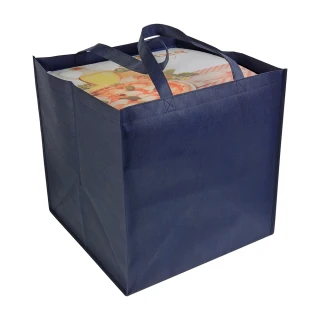
| Material | Rigidity, flexibility, construction and customisation method. | Paper for takeaway bags and some pizza carriers; non-woven fabric for specific pizza carrier bags. |
| Material weight | Material stiffness and feel, not an automatic load rating. | The stated gsm for the chosen model together with its dimensions, base, glued seams or stitching and handles. |
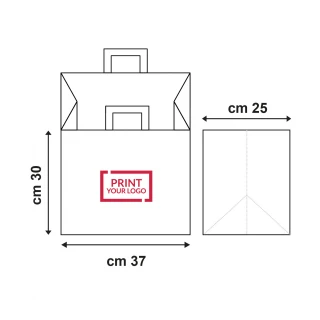
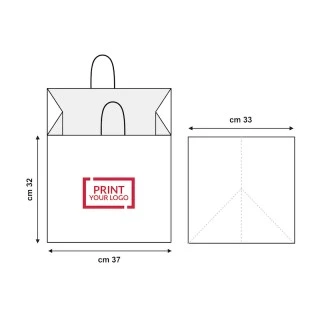
| Base and dimensions | Support for the packs and stability during the journey. | The base required by the largest pack and enough room for insertion and handling. |
| Handles and attachments | Grip and transfer of stress to the structure. | The handle type shown in the specification and its suitability for the actual service. |
| Heat and condensation | Temporary paper rigidity and conditions inside the bag. | Container closure, steam build-up and expected journey time. |
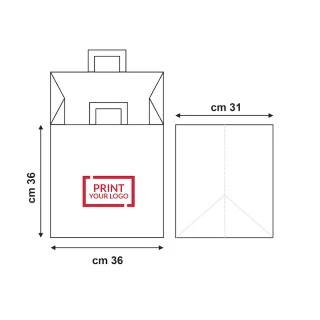
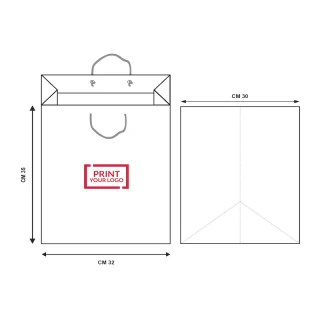
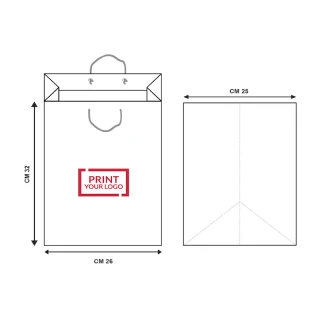
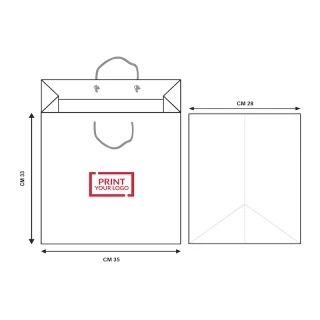
| Print area and method | Artwork coverage, detail, colours and production constraints. | Template, folds, glued or stitched areas, bleed and artwork proof. |
Wide-base paper takeaway bags
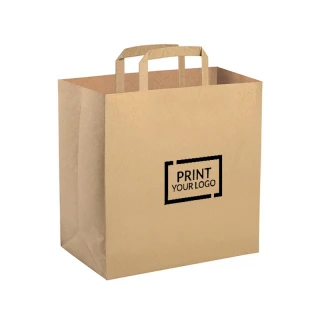
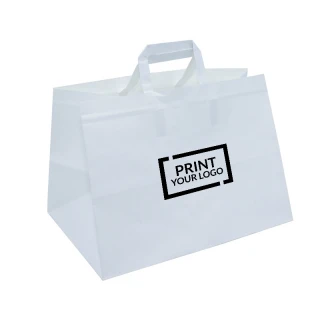
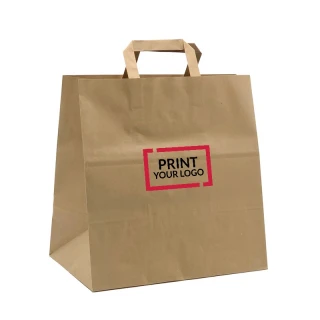
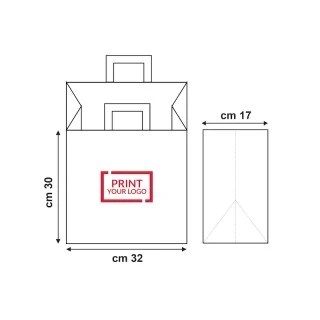
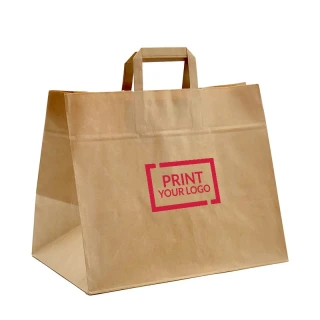
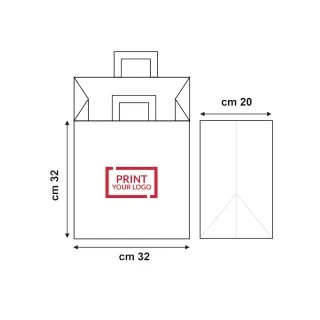
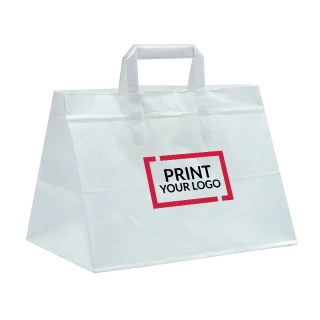
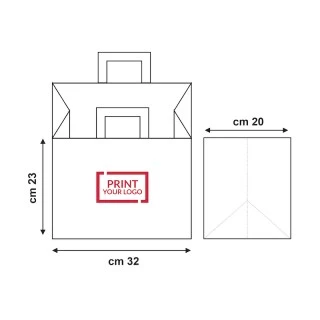
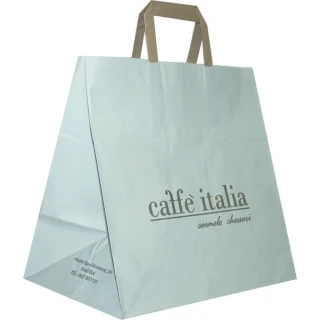
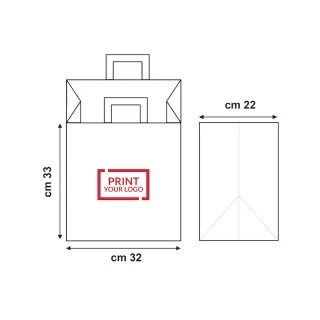
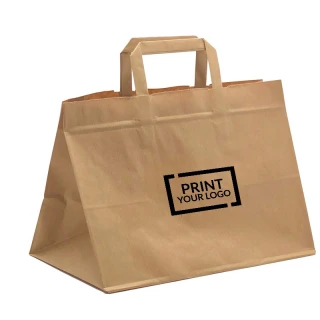
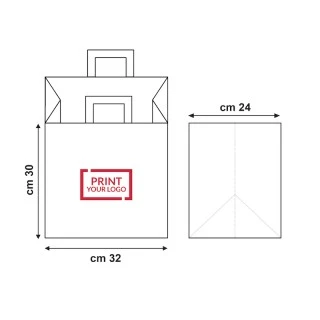
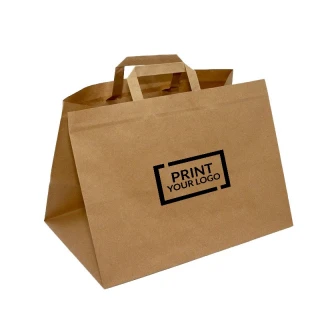
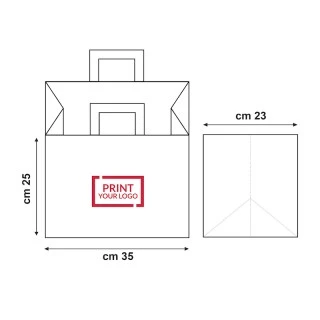
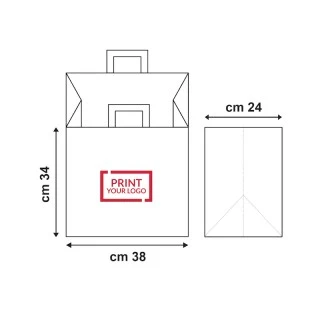
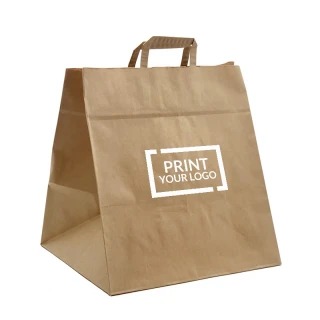
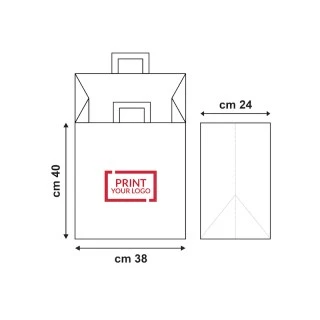
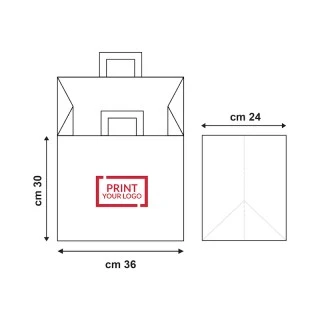
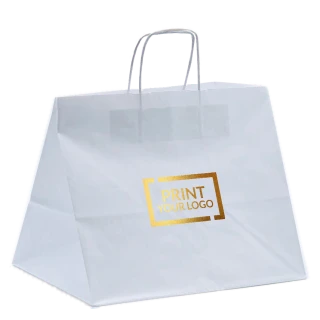
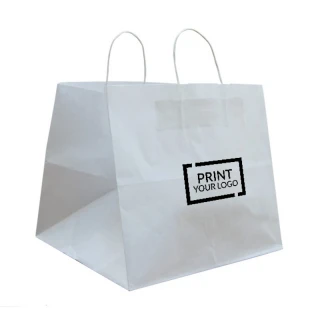
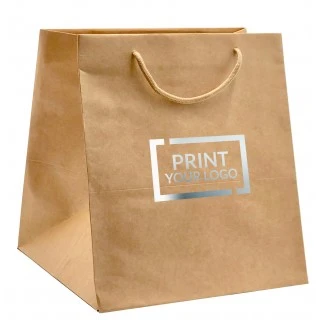
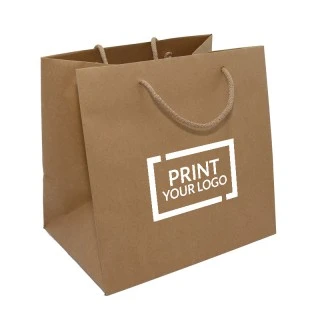
On paper models, a wide base provides a broader support surface for closed tubs and meal boxes. On its own, however, it does not guarantee stability or load capacity. Internal width, depth and height must be compared with the actual packs, taking account of corners, weight distribution and the room needed to grip and remove them.
Pizza carrier formats in paper and non-woven fabric
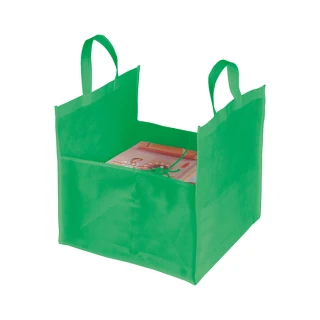
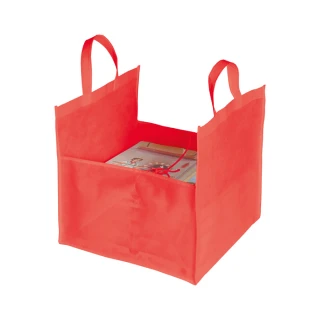
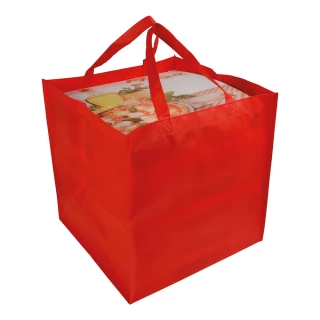
Pizza carrier bags are designed to keep pizza boxes horizontal. The range includes a paper model with an extended base and specific 80 gsm non-woven pizza carriers with short handles and reinforced stitching, as stated in their product specifications. The number and size of boxes and the closure system must be checked for the individual product.
Although this category includes non-woven pizza carriers, it is organised by takeaway use rather than by material. To compare the wider non-woven range, including products not intended for food service, visit Non-Woven Bags.
Behaviour with hot packs and condensation
When hot containers or packs releasing steam are carried, paper rigidity may temporarily decrease. If a journey approaches or exceeds approximately 20–30 minutes, check the container closure, condensation build-up, gsm and bag construction more carefully. This interval is a practical checkpoint, not a universal performance or duration guarantee for the category.
Paper types, gsm and non-woven fabric for takeaway bags
The specifications for paper products in this category include configurations ranging approximately from 90 to 210 gsm; Luxury papers range from 170 to 210 gsm. The non-woven pizza carriers state 80 gsm. These figures express material mass per unit area and help compare consistency and construction, but they are not equivalent to a load capacity in kilograms.
- White Kraft – a light, neutral background, useful when colour contrast and reproduction are priorities.
- Recycled Kraft – recycled paper with a natural brown appearance; recycled content, gsm and certifications refer to the individual product.
- Ribbed Kraft – brown kraft paper with a visible linear surface texture. Ribbing describes its appearance and feel; it does not by itself prove that the paper is recycled.
- Gloss Laminated – a glossy finish available on selected models; printing and disposal depend on the complete construction.
- Luxury – premium models using 170–210 gsm papers, with reinforcements and handles determined by the selected configuration.
- Non-woven fabric – used for the specific pizza carrier bags in this category, with stitching and handles defined by the model.
Environmental options and disposal guidance
The range includes Recycled Kraft models and products whose specifications state environmental characteristics such as biodegradability. FSC® certification, compostability, recycled content and other environmental claims should be used only when supported by the specification or documentation for the particular product ordered.
Disposal depends on the complete construction, not solely on the words “paper” or “non-woven”: lamination, handles, inks, stitching and food residue may change the appropriate waste stream. Follow the product information and local recycling guidance where the bags will be used.
Flat, twisted and rope handles, plus pizza carrier handles
- Flat handles – a practical option for fast counter service and frequent handover.
- Twisted handles – a rounded grip available on compatible paper models.
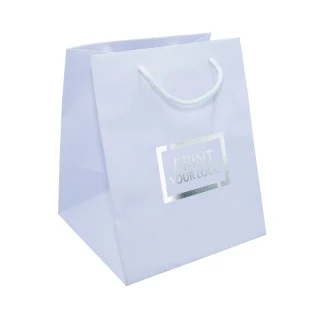
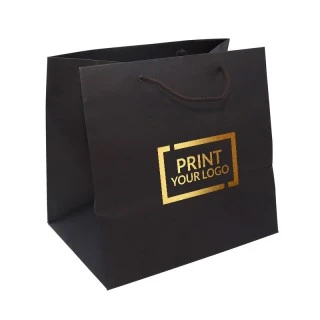
- Rope handles – used on premium presentation models, including selected Luxury options.
- Short handles for non-woven pizza carriers – combined with reinforced stitching and, depending on the product, a fastening tie.
The handle type affects grip and presentation but does not determine load capacity by itself. Handle fixings, material, base, dimensions and weight distribution also matter; the correct configuration is the one stated in the product specification.
Printing and customising takeaway bags
Custom and Elite ranges: all-over printed artwork
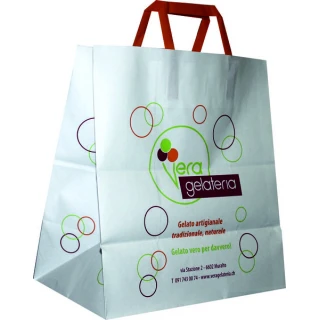
Models in the Custom and Elite ranges can be printed across all printable areas shown on the artwork template, including the front, back and side gussets. Backgrounds, patterns, wording and logos can therefore be coordinated with menus, signage and other packaging elements.
| Range | Main printing method | Printable surface | Artwork options |
|---|---|---|---|
| Custom | Flexographic printing | Front, back and side gussets according to the template | Pantone® colours and, where available by quotation, four-colour process |
| Elite | Offset printing | Front, back and side gussets according to the template | Pantone® colours, four-colour process and finishes available for the model |
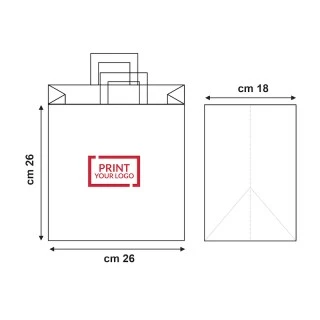
All-over printing is still subject to production constraints. Folds, glued areas, turn-ins, the base, handle attachment points, bleed and tolerances must be considered in the file. Artwork must be prepared on the technical template and checked in the proof before production.
Flexographic, screen, offset and hot foil printing
- Flexographic printing – used for Custom models and other compatible paper bags; suitable for logos and spot-colour graphics.
- Screen printing – available for compatible products when solid colours and strong coverage are required.
- Offset printing – used for Elite models with detailed graphics, custom backgrounds and the finishes stated in the specification.
- Hot foil stamping – a decorative finish available on products for which it can be selected.
- Customising non-woven fabric – number of colours, print area and method must be checked in the specification for the selected pizza carrier.
Print appearance depends on the material, background colour, absorbency, order quantity and level of artwork detail. The available printing method is the one shown in the product configurator.
Food-contact materials and product documentation
Carrying closed food packs and directly containing food are different situations. An outer bag does not automatically become a food-contact material simply because it is used by a restaurant or for takeaway orders.
For products intended for direct food contact and placed on the EU market, the finished product must comply with Regulation (EC) No 1935/2004 and the applicable EU and national rules on food-contact materials. The assessment covers the actual product, including paper, adhesives, inks and intended conditions of use. Requirements may differ in the United Kingdom and other non-EU destinations, so always check the stated intended use, product documentation and the rules in the market where the item will be supplied.
Common mistakes when configuring takeaway bags
- Treating taking leftovers home and ordering takeaway as the same service – the former concerns food left after dining in; the latter is an order prepared for consumption elsewhere.
- Confusing the outer bag with the food container – carrying a closed pack does not demonstrate suitability for direct food contact.
- Selecting by gsm alone – base, dimensions, adhesive bonds or stitching, handles and weight distribution all contribute to performance.
- Choosing dimensions without measuring the packs – tubs, meal boxes and pizza cartons must be checked in their actual transport position.
- Assuming Ribbed Kraft means recycled paper – ribbing describes the surface texture, not the fibre composition.
- Ignoring the material used for pizza carriers – the category contains paper and non-woven options with different constructions and print methods.
- Overlooking heat and condensation – container closure and journey time affect the behaviour of paper.
- Assuming all-over printing has no production constraints – the artwork must follow the template, folds, glued areas, bleed and tolerances.
- Applying environmental claims to the whole range – recycled content, certifications, biodegradability and compostability require product-specific evidence.
Professional uses
- Restaurants, bistros and casual dining venues
- Pizzerias and pizza delivery services
- Delis, food-to-go counters and street-food operators
- Bakeries, patisseries, cafés and coffee shops
- Food trucks, caterers and urban food delivery services
Helping customers take restaurant leftovers home
Giving customers a practical way to take restaurant leftovers home can reduce food waste and improve the dining experience. A branded outer bag keeps the venue visible after the meal, but it must be used with a suitable food container and handled in line with the operator’s procedures. For terminology, local context and practical guidance for English-speaking European markets, read Taking restaurant leftovers home: packaging, rules and good practice.
Coordinated supplies for restaurants, pizzerias and bakeries
Takeaway bags can form part of a coordinated range with custom cardboard boxes for pizzas, cakes and other food packaging, labels and packaging supplies, promotional products for the venue and personalised clothing for front-of-house, kitchen and delivery teams. Logos, colours and messages can be carried across the range, while each item retains its own material, printing method and production requirements.
Takeaway Bags or another range: choosing the right category
Use this category when the main requirement is to carry food containers, takeaway tubs or pizza boxes for restaurant leftovers, takeaway orders or delivery. If material or function is the main selection criterion, use the corresponding specialist category below.
| Primary requirement | Correct category | Semantic boundary |
|---|---|---|
| Food service, takeaway, leftovers and pizza transport | Takeaway Bags | Specialist category organised by food-service use, mainly paper bags plus selected non-woven pizza carriers. |
| Handled paper carrier bags for shops, retail or bottles | Paper Bags | Category organised by material, also including paper takeaway and pizza options within the wider paper range. |
| Lightweight bags for bread and counter service | Paper Bread Bags | Lightweight paper bags without the typical construction of a handled takeaway carrier. |
| Carrier bags made from plastic film | Plastic Bags | Different material, thickness, construction and commercial requirements. |
| Overview of reusable fabric bags | Tote Bags | Parent category for cotton, non-woven, jute and other fabric-based bags. |
| Specialist non-woven shopping bags and carriers | Non-Woven Bags | Category organised by material; non-woven pizza carriers also remain relevant to Takeaway Bags because of their use. |
| Reusable cotton carrier bags | Cotton Tote Bags | Woven textile material for repeated promotional and retail use. |
| Compact bags that fold away after use | Foldable Shopping Bags | Main function centred on compact storage and reuse. |
| Bags made from jute fibre | Jute Bags | Natural fibre and dedicated constructions. |
| Structured bags for grocery shopping and repeated use | Reusable Shopping Bags | Formats and structures designed primarily for shopping and repeated use. |
Useful guides to takeaway, bakery packaging and customisation
- Taking restaurant leftovers home: packaging, rules and good practice
- Personalised bakery packaging: boxes, paper and sticker seals for a coordinated brand image
- Logo printing techniques: how to choose
- Promotional products, clothing and packaging: creating a coordinated branded range
Frequently asked questions about custom takeaway bags
What is the difference between taking leftovers home, ordering takeaway and using a food container?
Restaurant leftovers must be placed in a suitable container before the customer takes them home, whereas a takeaway order is prepared for consumption elsewhere. In both services, the branded outer bag carries closed food containers and is not automatically suitable for direct contact with food.
What is the difference between Takeaway Bags and Paper Bags?
The Takeaway Bags category groups products by food-service use: takeaway orders, food delivery, restaurant leftovers and pizza transport, mainly using paper bags plus selected non-woven pizza carriers. Paper Bags groups carrier bags by material and includes paper takeaway and pizza options alongside models for retail, gifts and bottles.
Does Ribbed Kraft mean recycled kraft paper?
No. Ribbed Kraft describes the linear surface texture of the paper. It does not by itself establish recycled composition, recovered-fibre content, gsm or load capacity. Recycled Kraft is a separate paper type and must be confirmed in the product specification.
Which gsm should I choose for takeaway bags?
Paper models range from approximately 90 to 210 gsm, while Luxury papers range from 170 to 210 gsm. The non-woven pizza carriers in this category are 80 gsm. Material weight helps compare stiffness and construction but is not a guaranteed load rating: dimensions, base, glued seams or stitching, handles and weight distribution also matter.
Are pizza carrier bags available in paper and non-woven fabric?
Yes. The range includes a paper pizza carrier with an extended base and purpose-designed non-woven pizza carrier bags with short handles and reinforced stitching. Dimensions, the number of boxes carried and the closure system depend on the model and must be checked in its specification.
Which handles are available on custom takeaway bags?
Paper models may have flat, twisted or rope handles. Non-woven pizza carriers have short handles and a stitched construction that varies by model. Handle type alone does not determine load capacity: handle fixings, material, base, dimensions and weight distribution also contribute.
Can the full surface of a takeaway bag be printed?
Yes. Custom and Elite models can be printed on the front, back and side gussets, following the artwork template. Custom models use flexographic printing and Elite models use offset printing. Folds, glued areas, the base, bleed and tolerances remain production constraints that must be checked in the artwork proof.
Are takeaway bags suitable for direct food contact?
An outer bag used to carry closed food containers is not automatically suitable for direct food contact. Products intended for direct food contact and placed on the EU market must comply with Regulation (EC) No 1935/2004 and the applicable rules on food-contact materials. Requirements may differ in the United Kingdom and other non-EU markets, so always check the stated intended use, product documentation and destination-market rules.
How do paper takeaway bags behave with heat and condensation?
Steam released by hot containers may temporarily reduce paper rigidity. If the journey approaches or exceeds approximately 20–30 minutes, check container closure, condensation build-up, paper weight and bag construction more carefully. This interval is an operational checkpoint, not a guarantee applying to every model.
Are environmental options available and how should they be disposed of?
The range includes Recycled Kraft models and products with environmental characteristics stated in their specifications. FSC® certification, biodegradability, compostability and recycled content must not be applied to the whole category. Disposal depends on the complete construction and local collection rules at the place of use.
What is the minimum order and how much do custom takeaway bags cost?
There is no single minimum order or price across the whole category. Both depend on the model, material, dimensions, customisation and quantity. The configurator shows the terms for the selected product, and a free artwork proof is provided before production so that logo placement can be checked.
Customise takeaway bags for your restaurant or food business: start with the packs you need to carry, compare paper or non-woven fabric, gsm, base, dimensions and handles, then configure a solution that fits both your service and brand identity.