

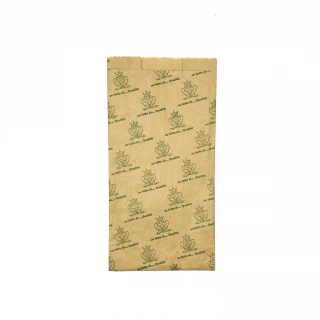
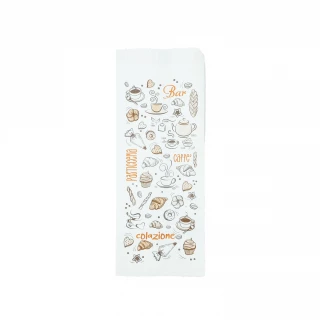
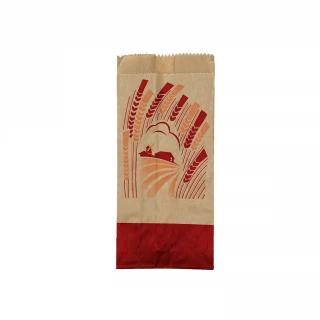
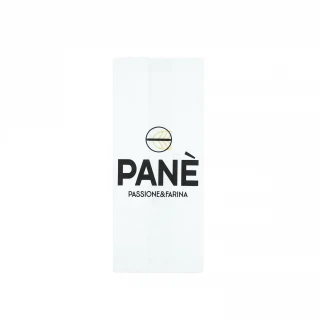
How to choose a paper bag by product, size and personalisation
For a bakery, a shop or a market stall the first requirement is compatibility between the bag and its contents. The contents determine the size; the thickness of the product guides the gusset; the surface and colour of the paper affect how the logo reads; the conditions of use set out which checks are needed. The commercial use shown on the product page helps select the model, but does not replace the technical documentation.
Measure the contents before choosing the size
- Measure the product at its largest, including any primary packaging.
- Consider how the bag is filled and closed: the top is needed for grip and the closing fold.
- Compare width, gusset and height separately: a single dimension does not describe the usable volume.
- Check in the configurator that the combination of size, quantity and colours is available for the chosen model.
A larger size does not guarantee greater capacity, just as a wider gusset does not, on its own, prove greater stability. Behaviour depends on the complete construction, the contents and the conditions of use; where no load figures are published, no maximum load should be assumed.
Size-to-use references shown on the product pages
The product pages give three dimensional references: the smallest size, 8+5x19 cm, is indicated for small items; the intermediate 14+10x30 cm is indicated for packing bread and other foods; the largest, 22+14x50 cm, is indicated for large items. The other six sizes are selectable in the configurator without a published use match: the choice should be made on the dimensions of the real product.
The papers in the range: brown, white and recycled options
Kraft paper is the common substrate across the four options, which differ in surface and declared composition. The two brown models have a ribbed surface; the white kraft is declared as pure cellulose and offers a more even surface with higher contrast for printing; the recycled versions, brown and white, are declared as such on their respective product pages. The colour of the paper alone does not prove composition, fibre origin or environmental characteristics: what applies is the information for the individual model and any available documentation.
Paper weight: how to read the published figure
The product pages publish three paper weights: 43 gsm for the white kraft, 45 gsm for the brown and the recycled brown, 48 gsm for the recycled white. These are the figures shown on the product pages and describe a light packaging substrate. A higher figure does not equal a guaranteed load, durability or barrier performance: how the bag behaves depends on the complete construction, the contents and how it is filled and handed over. If you need a declared load, dimensional tolerances or performance conditions, request the model's technical data sheet.
Comparing the four models
| Model | Paper and weight on the page | Surface | Uses declared on the page | Printing |
|---|---|---|---|---|
| Brown Kraft | Brown kraft, 45 gsm | Ribbed | Bakeries and food shops; homeware, various items and gifts; promotional events, fairs and markets | Flexographic 1–3 colours, both sides and gussets included |
| White Kraft | White kraft, pure cellulose, 43 gsm | Even, high contrast | Pharmacies and chemists; small items and gifts; bakeries and food shops | Flexographic 1–3 colours, both sides and gussets included |
| Brown Recycled Kraft | Brown recycled kraft, 45 gsm | Ribbed | Pharmacies and chemists; gifts and homeware; bakeries and food shops | Flexographic 1–3 colours, both sides and gussets included |
| White Recycled Kraft | White recycled kraft, 48 gsm | Light, even | Boutiques, bookshops, cosmetics, textiles and gift items; dry goods | Flexographic 1–3 colours, both sides and gussets included |
The table shows the uses declared on the individual product pages at the date of the audit; beyond these, the bags serve the non-food retail sectors described below. No combination of paper, weight and size constitutes a guaranteed load or suitability: always check the model's product page for current options and conditions.
Sectors and uses: from the food counter to retail and homeware
The gusseted format originates at the food counter, but the same bag serves different settings, as each product page declares. The distinction that matters is between food-contact uses, which require the model's documentation to be checked, and non-food uses, where only the criteria of size, gusset and print quality apply. On this basis the paper bag is a cross-sector carrier, not an exclusively food article.
Bakery and food. Bakeries and food shops pack bread, baked goods and single portions: brown kraft is the traditional reference, white kraft offers more contrast for artwork. For direct contact with food, the individual model's suitability must always be checked.
Pharmacies and chemists. The white kraft and the recycled brown kraft are indicated on the page for pharmacies and chemists, where the printed bag accompanies the over-the-counter handover of packaged products and small items.
Retail, homeware and gifts (secondary non-food uses). Beyond the food counter, the kraft paper bag is also a widely used over-the-counter carrier across non-food retail: hardware and haberdashery shops, stationers and gift shops, perfumeries and cosmetics, boutiques, bookshops and textile shops, car parts shops and local and street market stalls. In these settings it holds dry, small-format items and is a low-cost way of making the shop recognisable. The product pages indicate dry goods for the white recycled kraft, and various items, gifts and homeware for the brown and white models; in non-food uses the food-contact requirements do not apply and only size, gusset and print quality matter.
Events, fairs and markets. The brown kraft model is also indicated on the page for promotional events, fairs and markets, where the printed bag is a low-cost way to reinforce brand recognition and keeps circulating after the handover.
Damp, grease and barrier performance
The product page for the white recycled kraft describes it as suitable for dry goods and not waterproof. For the other models no barrier performance is published: where damp, grease or liquids are present, the suitability of the chosen configuration must be checked, without assuming protective properties that are not declared.
Flexographic printing: colours, sides and setup
Personalisation uses flexographic printing, indicated on the product pages for continuous runs on paper. The configurator allows one to three colours: the second colour starts at 100 kg and the third at 200 kg. On all models, printing on both sides and on the gussets is included in the price; this is not full-surface coverage, and the print area, registration and graphic limits must be confirmed against the product template. The required print colour or colours are specified in the dedicated field at checkout, and the result is verified in the free artwork proof before production.
The job is set up as New, with the cost of the printing plate, or as Reprint for repeat orders with unchanged artwork, without repeating the plate. Delivery times are 15 working days from approval of the artwork proof.
Ordering by weight and price breaks
The bags are ordered by weight, in kilograms, with a minimum of 50 kg per model and successive breaks shown by the configurator up to 400 kg. The corresponding number of bags is not fixed: it depends on the size selected. Where the product page indicates it, the configurator shows an indicative bag count for the chosen combination: use it as an estimate for planning your supply, not as a guaranteed quantity. Additional print colours require the minimum quantities shown in the configurator.
Mistakes to avoid when configuring
- Choosing the size from a single dimension, without reading width, gusset and height together.
- Inferring a load capacity or durability from the published paper weight.
- Assuming a barrier performance against damp or grease that the product pages do not declare.
- Assuming suitability for direct food contact without the model's documentation.
- Ordering a repeat with unchanged artwork as "New", paying twice for the plate.
Food contact, regulations and packaging
A distinction must be drawn between using a bag in the food sector and direct contact with food. Across the European Union — including Ireland and Malta — food-contact materials fall within Regulation (EC) No 1935/2004, the framework regulation, and Commission Regulation (EC) No 2023/2006 on good manufacturing practice. Paper and board are not covered by a harmonised EU-specific measure, so any applicable national provisions in the destination member state must also be checked. In Great Britain, the corresponding framework and good-manufacturing-practice requirements continue as assimilated law, enforced under the relevant national regulations for England — the Materials and Articles in Contact with Food (England) Regulations 2012 — and their equivalents in Wales and Scotland; Northern Ireland follows the applicable EU food-contact rules under the Windsor Framework. For direct-contact use, appropriate model-specific compliance documentation should be requested; whether a written Declaration of Compliance is legally required depends on the material and the specific or national rules that apply.
Suitability depends on the individual model, the materials and the conditions of use: the product pages in this category do not publish a declaration of compliance, so for direct-contact uses you must request the model's documentation before ordering. External printing alone confers no suitability on the inks. These notes reflect the position at the date of the audit and are indicative only; they do not replace a legal or technical assessment for the market you supply.
On packaging, Regulation (EU) 2025/40 on packaging and packaging waste entered into force on 11 February 2025 and applies in the EU from 12 August 2026; the United Kingdom operates its own packaging and producer-responsibility rules. Check the obligations that actually apply in each market you supply.
For end-of-life disposal, the actual composition of the bag, the printing, any food residues and local collection rules apply. Environmental characteristics such as recycled content, recyclability or biodegradability must be documented for the model and configuration purchased: they are not attributed here to the whole category.
The bag as part of the shop's visual identity
A bag handed over at the counter changes hands many times a day and carries the product out of the shop. With printing included on both sides and on the gussets, the logo stays visible even during handling, and the Reprint option keeps the same artwork from one supply to the next. The choice between a brown and a white surface is above all a choice of finish: the former is warmer and more textured, while the latter provides sharper contrast and definition.
Coordinated supply
The bags can be combined with the other ranges in the catalogue for a consistent shop image: paper carrier bags with handles for purchases to carry, custom cardboard boxes for cakes and shipping, packaging supplies for labels and tissue paper, promotional products for events and fairs and custom clothing for staff. Each item, however, keeps its own techniques, areas and limits.
Paper bags or another category: where to continue your search
| Need | Right category | Semantic boundary |
|---|---|---|
| General comparison across materials and bag families | Bags | Multi-material parent overview, owner of the general "custom bags" intent |
| Pre-formed paper bag with gussets, no handles, for counter service | Paper Bread Bags | This is the specialist topic of this page |
| Paper carrier bags with handles to carry purchases | Paper Bags | Carrier structure with handles, its own weights and constructions |
| Restaurants, takeaway and food delivery | Takeaway Bags | Specialist node for containers and takeaway packaging; does not confer food suitability on this category |
| Bags in plastic film | Plastic Bags | Different material: polyethylene, thickness in microns |
| Fabric bags in cotton, non-woven or jute | Tote Bags | Textile hub with its own materials, seams and techniques |
| Structured bags for the weekly shop and repeated use | Reusable Shopping Bags | Intent focused on the shop, not on single-product counter packing |
| Bags for gift presentation | Gift Bags | Packaging Supplies branch, a presentation function rather than service |
Useful guides
- Kraft paper: what it is, what it is for and why it suits bread bags – general background on the material; technical and food claims must be checked on the individual model.
- Carrier bags and paper bags: the right size for retail
- Logo printing techniques: how to choose
- Coordinated promotional products, clothing and packaging
Frequently asked questions about custom paper bags
What is the difference between paper bags and paper carrier bags with handles?
The bags in this category are pre-formed kraft paper bags with side gussets and no handles, made for packing directly over the counter. Paper carrier bags are carrying structures with handles, made to take purchases out of the shop, with their own constructions and characteristics. The boundary is not only the handles, but the role in service and the type of contents.
Which paper options are available?
Four models: brown kraft with a ribbed surface, white kraft declared as pure cellulose, brown recycled kraft and white recycled kraft. They share the same nine sizes and the same print options; composition, paper weight and declared uses remain specific to each product page.
How do I read the size measurements?
Each size is expressed as width + gusset × height. In the 14+10x30 cm size, 14 cm is the front width, 10 cm the side gusset and 30 cm the height. The nine sizes available on all models are 8+5x19, 10+7x23, 12+8x24, 14+10x30, 14+10x40, 14+10x60, 17+12x40, 19+12x40 and 22+14x50 cm.
Which size should I choose for my product?
Start from the real measurements of the contents, including any packaging, and leave room for filling and closing. The product pages give three references: 8+5x19 cm for small items, 14+10x30 cm for bread and other foods, 22+14x50 cm for large items. For the other sizes no use match is published: the choice should be made on the product's dimensions.
What does the paper weight tell me?
The product pages publish 43 gsm for the white kraft, 45 gsm for the brown and recycled brown, 48 gsm for the recycled white. It is the figure the manufacturer gives for the substrate and describes a light packaging paper. It does not equal a guaranteed load, durability or barrier performance: for performance data you need the model's technical data sheet.
Do the bags resist damp, grease or hot products?
The product page for the white recycled kraft describes it as suitable for dry goods and not waterproof. For the other models no barrier performance is published: where damp, grease or liquids are present, check the suitability of the chosen configuration, without assuming protective properties that are not declared.
Are they suitable for direct contact with food?
Suitability for direct contact depends on the individual model and the conditions of use. In the EU, Regulation (EC) No 1935/2004 and Commission Regulation (EC) No 2023/2006 apply, together with any relevant national provisions for paper and board. In Great Britain, the corresponding assimilated requirements apply under the relevant regulations for England, Wales and Scotland; Northern Ireland follows the applicable EU rules under the Windsor Framework. The product pages do not publish model-specific compliance documentation, so request it before ordering for direct-contact use.
How does printing work and how many colours can I use?
Personalisation uses flexographic printing from one to three colours: the second colour starts at 100 kg and the third at 200 kg. On all models, printing on both sides and on the gussets is included in the price, which is not full-surface coverage. The print area, registration and graphic limits are confirmed against the template and checked in the free artwork proof.
What is the difference between New and Reprint setup?
"New" is selected for the first order of an artwork and includes the cost of making the printing plate shown in the configurator. "Reprint" is used for repeat orders with unchanged artwork, without repeating that cost. In both cases production starts after approval of the free artwork proof, within 15 working days of confirmation.
Why are orders placed in kilograms and what is the minimum?
The bags are sold by weight, with a minimum of 50 kg per model and successive breaks up to 400 kg shown by the configurator. The number of bags depends on the size selected: where the page indicates it, the configurator shows an indicative bag count for the chosen combination, to be used as an estimate for planning and not as a guaranteed quantity.
Can I use them for non-food products?
Yes. Beyond the food counter, kraft paper bags are used in many non-food retail shops — small goods and homeware, hardware shops, haberdashers, stationers, perfumeries, cosmetics, clothing and textiles, bookshops, car parts shops and street market stalls — for dry, small-format items. The product pages declare the reference uses for each model: various items and gifts for the brown; pharmacies, chemists and small items for the white and recycled brown; boutiques, bookshops, cosmetics and textiles for the recycled white. In these uses the criteria of size and gusset apply, without the constraints tied to food.
Configure your custom paper bag: choose the model, check size and gusset against your product's measurements, select the setup and print colours and upload your artwork to receive a free proof before production, with orders by weight from 50 kg.