

In short
- The right bag size depends on the type of product sold and the typical purchase volume in store, not on aesthetic preference.
- Carrier bags and paper bags serve different operational purposes and should not be treated as interchangeable.
- An unsuitable bag size leads to unnecessary material waste, hidden stockroom costs and a weaker checkout experience.
- A small range of well-selected standard sizes is usually more effective than managing many uncoordinated formats.
- A well-proportioned bag is the last physical touchpoint between the customer and the brand: it shapes the final impression of the visit.
Choosing the right size for carrier bags and paper bags is an operational decision that directly affects the customer experience and the efficiency of the shop floor. In retail, branded bags are not just containers: they are the final item the customer takes out of the store and they continue to communicate the brand long after the purchase.
We are writing this guide because the choice of bag size is still too often treated as a low-impact operational task, while in practice it determines stockroom costs, checkout efficiency and the customer's lasting impression of the service. The difference between a well-sized format and an oversized one is not measured at the moment of purchase, but in the quarterly consumption figures and in the customer's repeated experience.
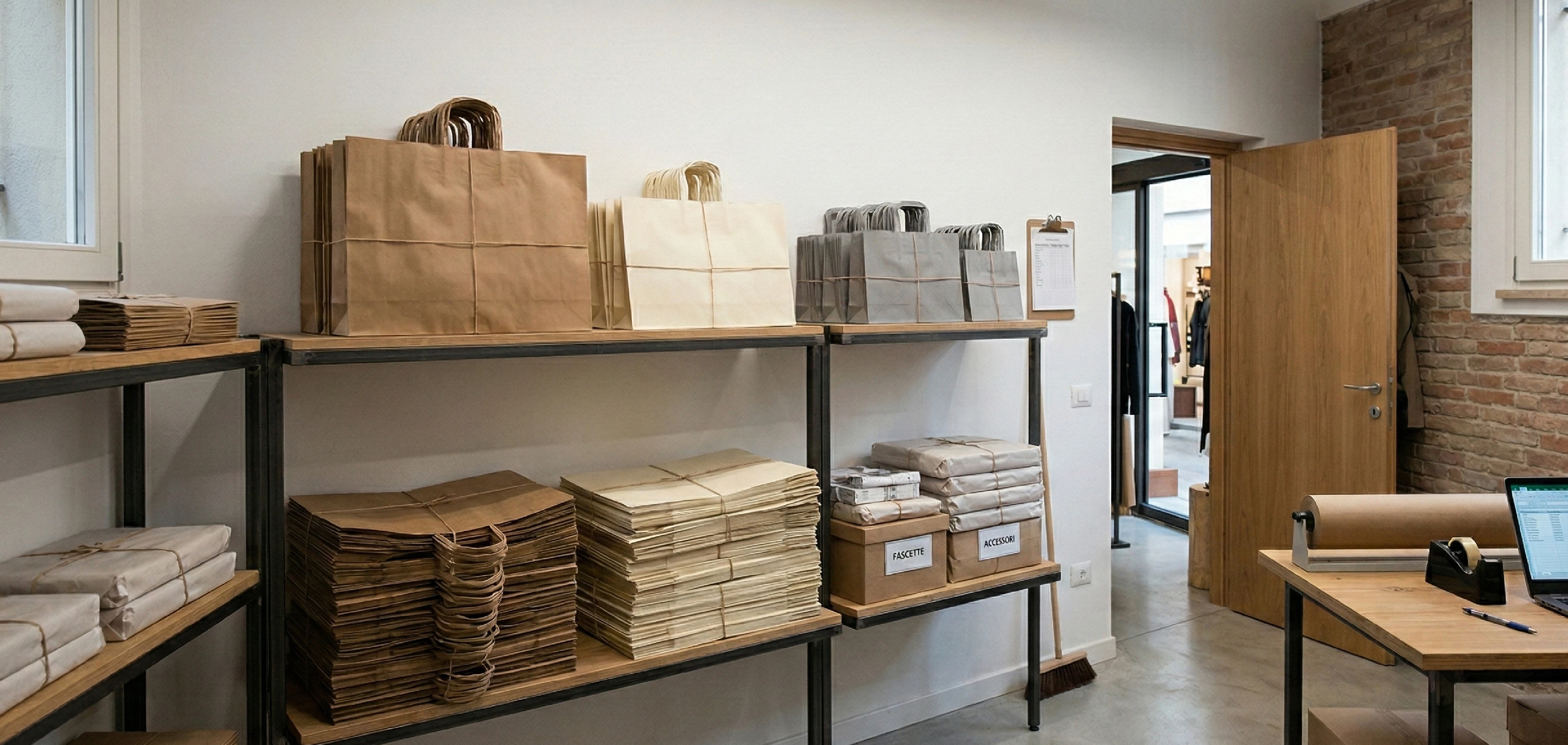
An incorrect size can feel inconvenient, poorly matched to the product or simply disproportionate, with a negative effect on the overall shopping experience. By contrast, the right size improves perceived service quality and helps optimise packaging costs over time.
For this reason, choosing custom carrier bags and paper bags for retail consistent with real purchasing behaviour is a strategic decision, not a routine purchase.
Why bag size matters in a retail store
In retail environments, the bag often represents the last physical touchpoint between the customer and the brand. It is what the customer takes home, evaluates in the minutes after the purchase and — if well designed — reuses in the days or weeks that follow.
A poorly chosen bag size can:
- make products uncomfortable to carry — generating immediate frustration as soon as the customer leaves the store
- create a perception of poor organisation — reducing the perceived value even of high-quality products
- reduce the perceived value of the purchase — affecting the likelihood that the customer will return
A well-proportioned carrier bag, on the other hand, communicates attention to detail, professionalism and brand consistency.
Carrier bags and paper bags: operational differences in retail
In a shop environment, carrier bags and paper bags serve different practical purposes. The decision is not aesthetic but functional: the bag should match real purchasing behaviour and the type of average transaction.
- Paper bags — suitable for quick purchases, lightweight items or small products; they speed up the checkout and reduce material consumption per transaction.
- Carrier bags — ideal for multiple products or bulkier items, thanks to greater strength, comfort and perceived quality.
Types of carrier bags: which one to choose based on usage
In retail, choosing a carrier bag is not only about size, but also about material and structure. Each type responds to different operational needs:
- Non-woven bags — lightweight, cost-effective and suitable for large-scale distribution with high turnover.
- Cotton bags — reusable, versatile and ideal for everyday use, with strong perceived quality.
- Jute bags — more structured, durable and with a higher perceived value, suitable for premium brand positioning.
- Foldable bags — compact and practical for frequent use and easy daily carrying.
The right choice depends on the type of products sold, the frequency of use and the positioning of your retail business.
Carrier bags or paper bags? Choosing according to real purchasing behaviour
- Quick single purchases — lightweight paper bags for speed and convenience at the checkout.
- Multiple or bulkier items — carrier bags for comfort, stability and reliability.
- Frequent reuse — durable carrier bags for visible long-term brand value.
- High checkout turnover — standard paper bags for operational efficiency.
The right choice reduces delays at the checkout, avoids unnecessary packaging waste and improves customer satisfaction.
Bag size and product category
Each product category requires a slightly different approach. Using a single universal bag size for all purchases often leads to unnecessary waste and operational inefficiencies.
- Clothing — vertical formats that allow folded garments to fit neatly without unwanted creasing
- Gift items or small goods — compact paper bags that minimise internal movement and protect the product
- Food products — stable formats designed for safety, leak-resistance and practicality
Practical examples of bag sizing in retail
- Folded clothing — vertically proportioned carrier bags for tidy presentation and a premium perception.
- Small goods — compact paper bags sized to reduce movement and material waste.
- Food purchases — stable bag formats with reinforced bases for safety and convenience.
The correct bag size improves the customer experience and reduces operational inefficiencies on the shop floor.
Bag size as part of the customer experience
The bag contributes directly to the overall shopping experience. Receiving a well-sized bag reinforces the perception of quality, even when the product itself remains the same. When a carrier bag is reused, it also becomes a continuous source of brand visibility outside the store.
For this reason, the consistency between the bag and the product fits within a wider logic of packaging and unboxing that build perceived brand value: the same reasoning around proportion, material quality and visual consistency applies to the entire delivery experience of the product.


Wrong bag size means operational waste
An unsuitable bag format generates unnecessary consumption and costs that accumulate over time, even when each individual unit seems "not that expensive":
- unnecessary material consumption — oversized carrier bags or undersized paper bags trigger more frequent reordering
- higher packaging costs over time — the multiplication of formats inflates the number of SKUs to manage
- less efficient stockroom management — more formats mean more space taken up and a higher risk of stockouts
Choosing a limited range of well-designed sizes is usually more efficient than managing many formats without a clear logic.
When the wrong bag size creates hidden costs
- Oversized bags — more material usage, more storage space and a perception of waste from the customer.
- Bags that are too small — inconvenience for the customer, potential product damage and frequent replacements.
- Too many formats — complex stock management, misaligned reorders and tied-up working capital.
Reducing unnecessary formats improves operational efficiency, stockroom organisation and cost control.
What we have observed since 2006 about retail bag sizing
In our experience supplying retail businesses, the shops that achieve the strongest results are not the ones offering the largest range of formats, but the ones that have standardised 2-3 well-sized formats matched to real purchasing patterns. Shops using a single oversized "one-size-fits-all" format for any purchase tend to generate more waste — both operational and customer-perceived — than shops that have invested time in analysing their average transactions. The difference is made by observing real purchasing behaviour, not by extending the bag catalogue.
How to choose the right bag size for your retail store
Before confirming a supply of custom carrier bags and paper bags, it is worth following 4 practical steps to ensure that every format genuinely matches real purchasing behaviour:
- Analyse typical purchase size: Assess whether most purchases are single lightweight items or multiple bulkier products, to determine whether paper bags or carrier bags are more suitable.
- Match bag size to product category: Clothing: vertical bag formats. Small goods: compact paper bags. Food products: stable and secure formats.
- Consider reuse frequency: If customers are likely to reuse the bag, choose durable and comfortable formats that provide ongoing brand visibility.
- Standardise your bag range: Reduce the number of formats to a small selection of well-chosen sizes to simplify stock management and control costs.
If even one of these four steps is skipped, the bag format risks becoming a hidden cost rather than an investment in the customer experience.
Carrier bags and paper bags within a coordinated retail strategy
In modern retail, bags work best when they are part of a consistent packaging and brand communication strategy. It is no coincidence that the businesses with the most solid retail results are the ones designing carrier bags, paper bags, in-store communication and packaging together as a consistent brand communication system: every element speaks the same language and conveys the same positioning.
For a deeper look at the same reasoning applied to broader retail packaging decisions, our guide to retail packaging and the right size covers the criteria that turn packaging from a cost into a strategic asset.
Frequently asked questions about retail bags
Does bag size influence the customer experience?
Yes. A well-sized bag makes products easier to carry and communicates greater attention to customer service. Even with the same product, a properly proportioned bag increases the perceived value.
Is it better to use many bag sizes?
In most cases, a small number of standardised bag sizes based on typical purchases is more efficient. Too many different formats lead to complex stock management, misaligned reorders and tied-up working capital.
Do carrier bags increase brand visibility?
Yes. When reused, carrier bags continue to promote the brand outside the shop environment. For this reason, it is worth investing in formats and materials designed to be reused.
In short: choosing the correct bag size in retail improves the shopping experience, reduces operational waste and makes packaging management more efficient. A strategic choice — consistent with purchasing behaviour, product type and brand positioning — multiplies the value of every transaction at the checkout.
Why choose Shop for Shop
Shop for Shop is an Italian company operating since 2006 as a direct supplier of promotional products, clothing, shopping bags and packaging for businesses, shops and events. Even when selecting carrier bags and paper bags for retail, the goal is not to offer a catalogue of undifferentiated formats, but to build a targeted supply that respects the type of product sold, real purchasing behaviour and the positioning of the shop. A careful design of carrier bags and custom paper bags becomes a concrete tool for cutting operational waste and increasing the perceived value of every purchase.
Leave a comment