At a glance
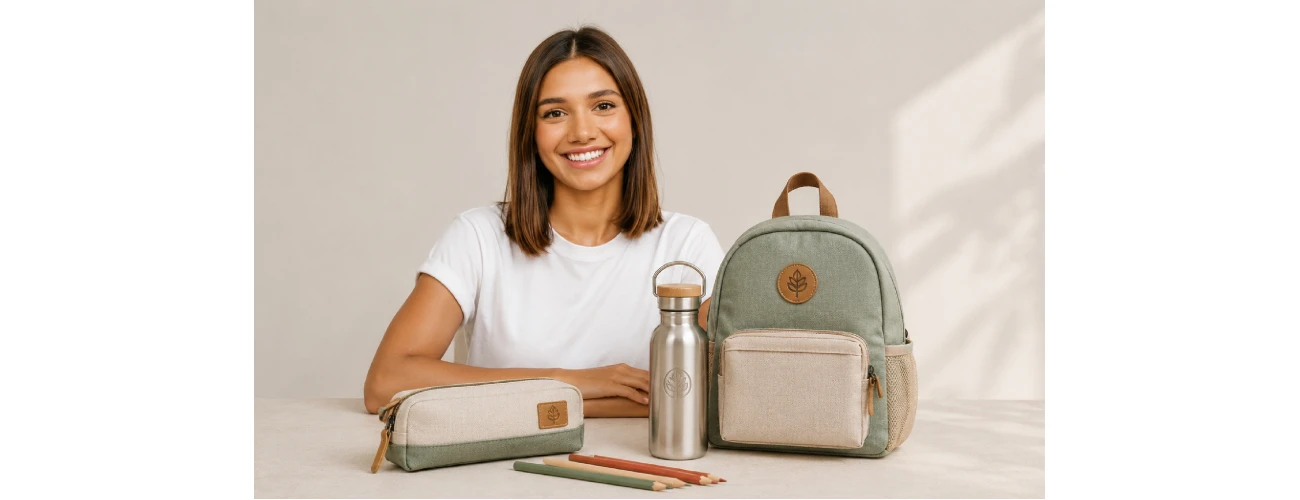
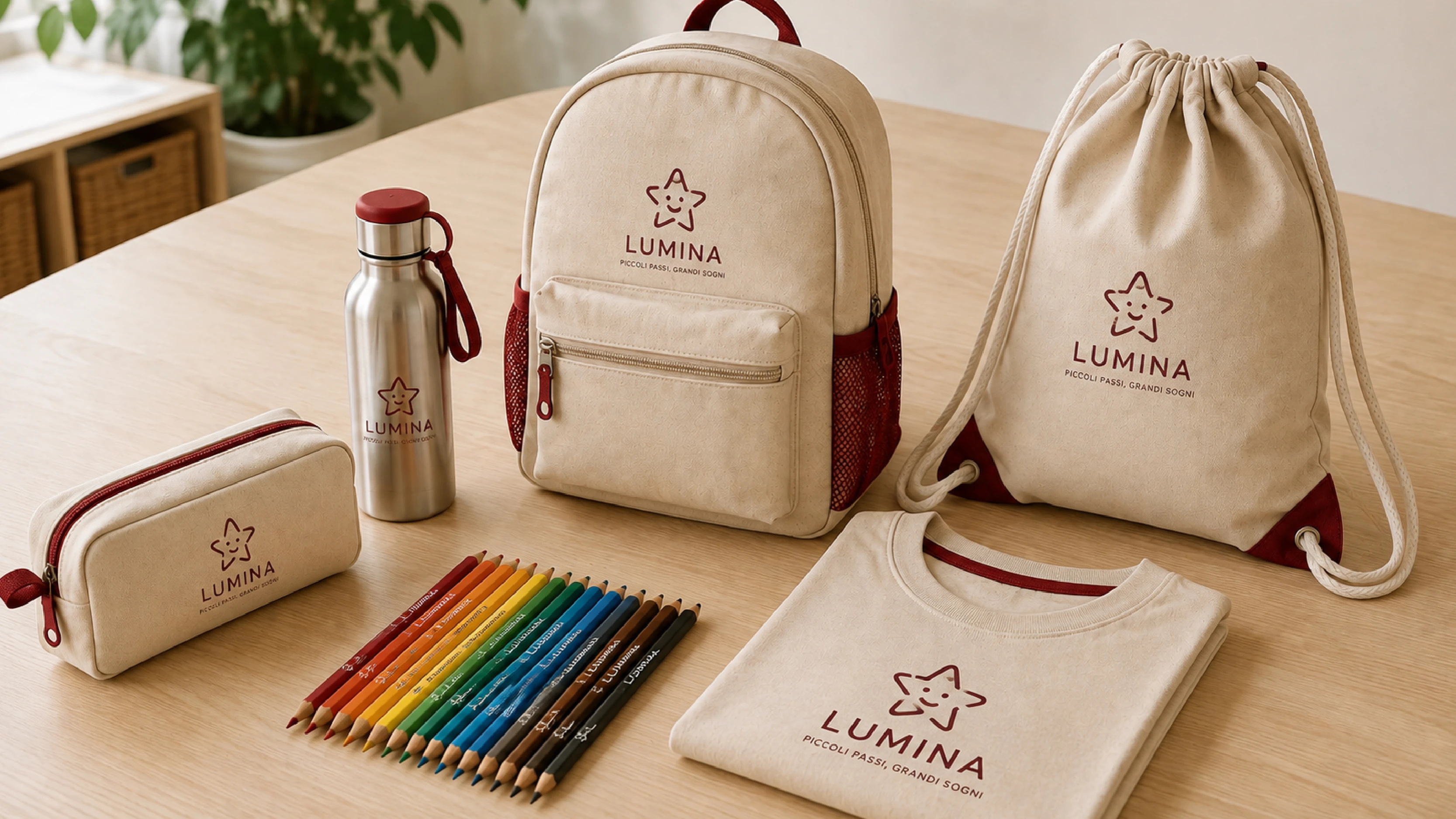
- School promotional products work best when children genuinely use them throughout the year: stationery, pencil cases, backpacks, drawstring bags, reusable bottles and T-shirts should be chosen for real-life use rather than catalogue appeal.
- Nursery, primary school, secondary school and open days have different requirements: size, independence of use, quantities and branding all change with the age group.
- A product intended for children is not automatically a toy and does not automatically require CE marking. If it is intended for play, however, specific toy-safety requirements may apply.
- Ordering deadlines should be calculated backwards from the distribution date, allowing time for artwork approval, production and delivery.
What personalised school supplies are you looking for?
- Stationery for classroom use → pencil cases and pencils and crayons
- Everyday school essentials → backpacks, drawstring bags and reusable bottles
- Clothing for classes, school trips and events → personalised T-shirts
Ordering personalised products for children can look straightforward: choose something colourful, add the school, council, organisation or company logo, and the job appears to be done. In practice, school promotional products involve more variables than many purchasing decisions because the person using the item is not the person placing the order.
A school, local authority running a holiday club, sports association, children’s retailer or company organising a family-focused campaign is buying on behalf of users who are often under eighteen and, in many cases, under fourteen. That changes the purchasing criteria, the way the product should be branded and, in some cases, the documentation it is sensible to request from the supplier.
This guide explains how product choice changes by age group, which personalised school supplies are suitable for regular use throughout the academic year, how to organise quantities and clothing sizes, how far in advance to order and when the nature of a product requires specific safety checks.
Who orders personalised products for children and schools?
The type of buyer shapes almost every decision that follows. Schools often order for complete classes and need products capable of lasting throughout the academic year. Local authorities and public bodies may need to cover several age groups at once — nursery, primary school and holiday clubs — within the same project. Sports and community organisations often focus on branded clothing and recognisable group equipment. Children’s retailers may look for useful branded giveaways that fit their positioning. Companies running family-focused campaigns face another challenge: products may be distributed in large numbers, making suitability and product documentation particularly important.
The common factor is that the purchase is made on somebody else’s behalf. The buyer is not the user, and often not the person who will ultimately judge whether the item was a good choice. In many cases, that judgement will come from a parent or carer.
How school promotional products change by age group
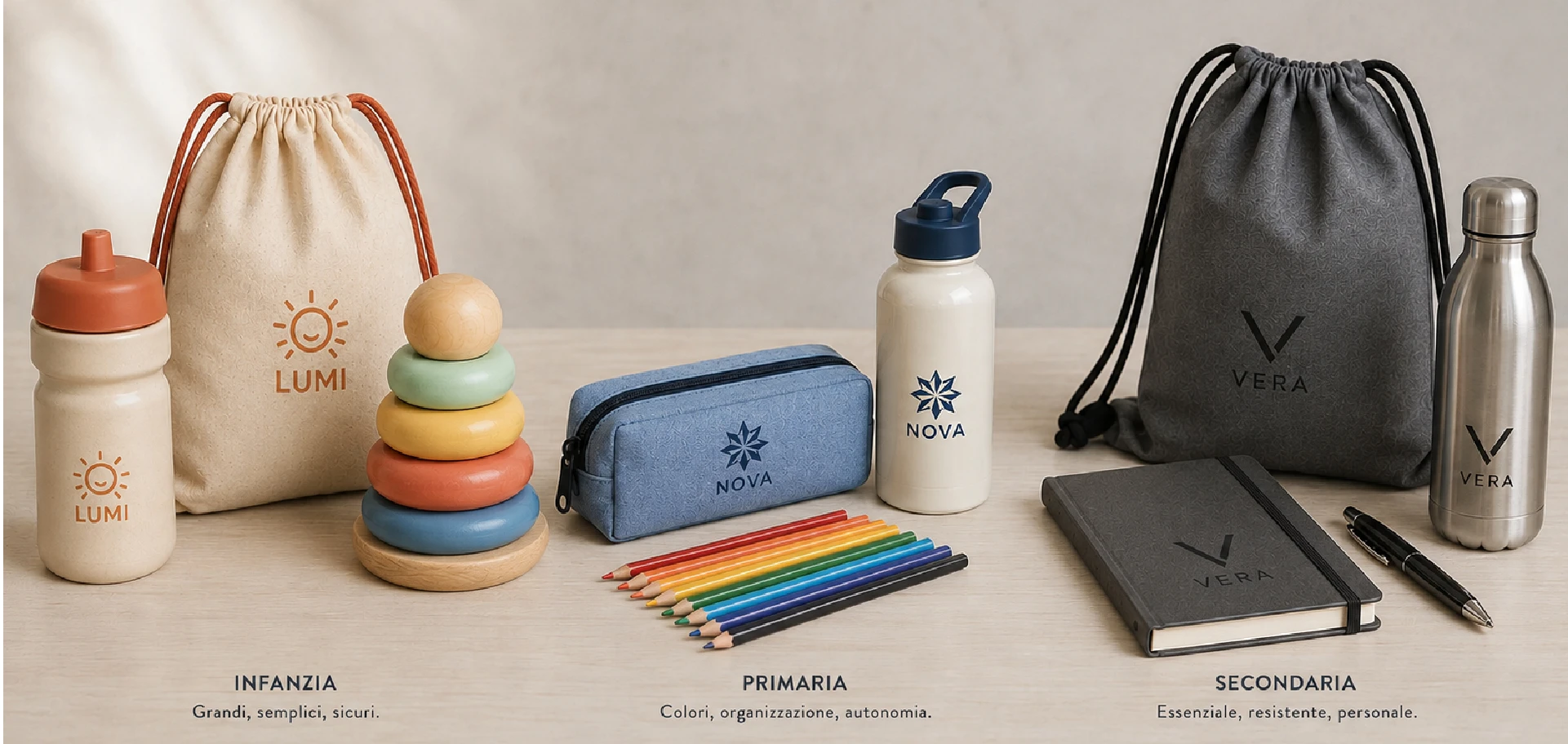
Age is not simply a marketing detail. It determines what is practical, suitable and likely to be used. This becomes especially important when one project covers several age groups, because a single item selected for nursery, primary and secondary pupils will rarely work equally well for all three.
Nursery and early years
This is the age group where it makes sense to narrow the choice: fewer products, larger dimensions and careful consideration of detachable components. Size and construction can be more important than decorative features, particularly where a product may potentially be treated as a toy. Specific warnings exist for toys that are unsuitable for children under thirty-six months. From a purchasing point of view, a useful rule is simple: if a product raises unnecessary doubts for this age group, there is usually a more suitable alternative.
Primary school
This is where useful school supplies can deliver the greatest value because they may be used every day for months. Pencil cases, pencils, notebooks, reusable bottles and T-shirts for school trips or events all have a practical purpose. Durability, washability, print resistance and ease of replacement therefore matter more than visual impact alone. A weak zip, poor stitching or an unsuitable closure can quickly turn a useful school item into an operational problem for staff, families and the supplier.
Secondary school, further education and open days
Older pupils and students decide for themselves whether they will continue using an item. Products that look too childish are more likely to be left behind. Neutral, practical products such as reusable bottles, notebooks, pens, backpacks and drawstring bags generally make more sense, with more understated branding. At school and university open days, the product also acts as a reminder of the institution after the visit, so it is worth choosing something that remains useful beyond the event itself. The same principle applies to branded giveaways for university and school open days.
Which personalised school supplies work best for Back to School?
Stationery and pencil cases
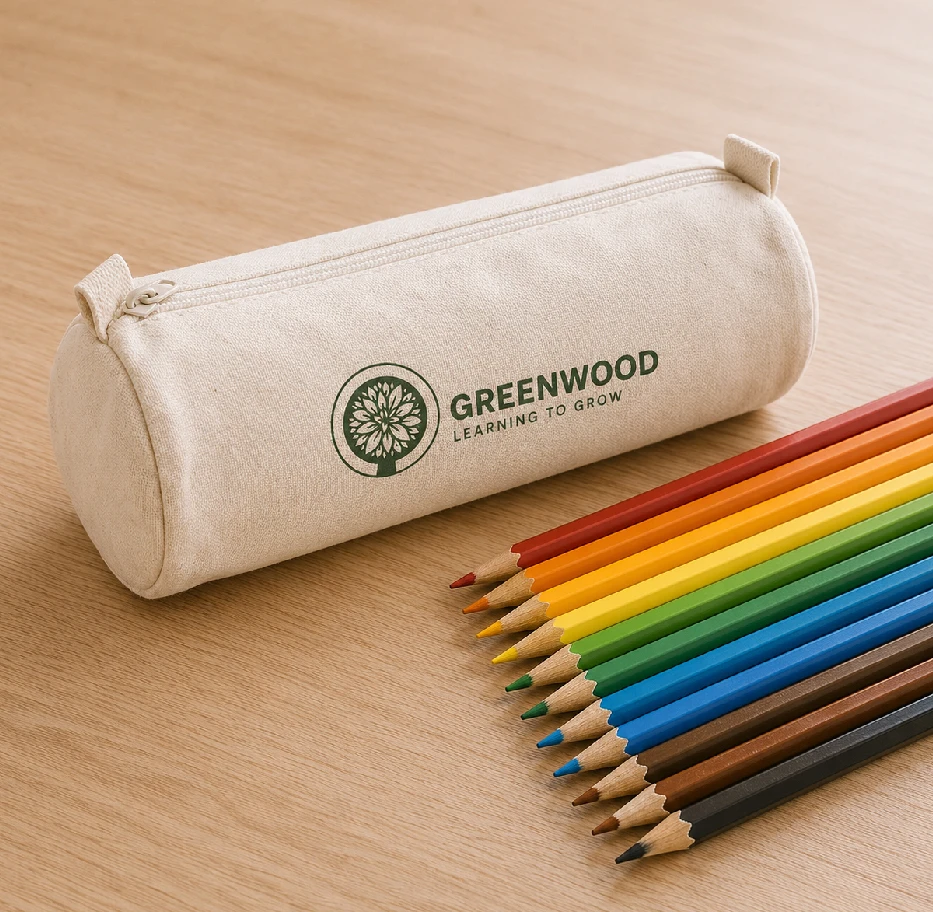
Branded stationery often provides a strong balance between cost, practical use and long-term logo visibility because it can stay on a pupil’s desk for months. Personalised pencil cases should be assessed for zip quality, stitching and capacity, while pencils and crayons should be selected with usability and durability in mind. For class-wide orders, using coordinated branded stationery and office supplies can also make it easier to keep colours and branding consistent across the range.
Backpacks and drawstring bags
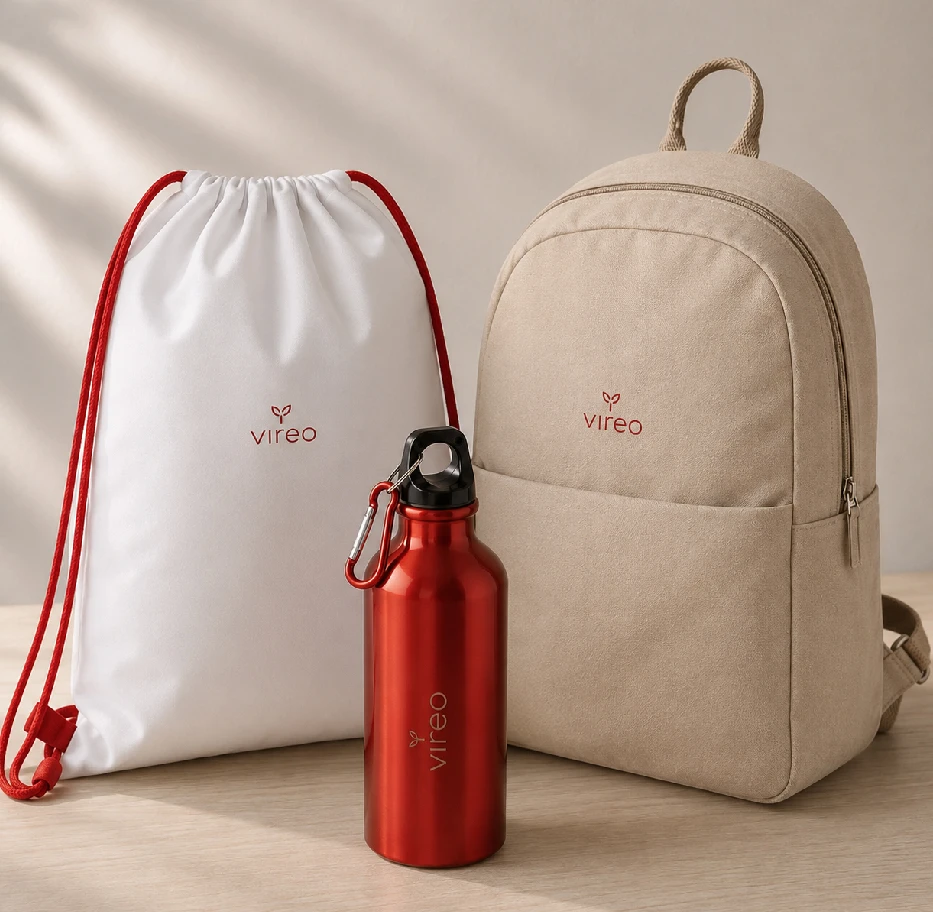
Personalised backpacks usually require a larger budget, but they can also provide longer-term use. Shoulder straps, base construction, zips and closures are therefore important. Branded drawstring bags are often a more cost-effective option for larger school orders: they are easy to distribute and work well for PE kits, school trips, workshops, sports activities and holiday clubs. Where the same project needs to cover several classes, a drawstring bag can provide a useful balance between price, practicality and branding area.
Reusable water bottles
Reusable bottles have become a common choice for schools because they combine everyday use with strong brand visibility. The main points to consider are the bottle and cap materials, capacity in relation to the age group, ease of cleaning and documented suitability for food contact. For broader product-selection criteria, see our guide to personalised water bottles. A bottle chosen for a primary-school pupil will not necessarily be the same model you would select for a secondary-school open day or university event. The full range of personalised bottles and thermos flasks should therefore be assessed by intended use rather than appearance alone.
Personalised T-shirts for classes, school trips and events
Personalised T-shirts can solve two practical needs at once: they make a group easier to identify during school trips or events and provide a keepsake that may continue to be worn afterwards. The critical variable is the size range, which should cover all pupils involved. Because children’s clothing may be washed frequently, the durability of the personalisation matters more than how impressive the garment looks in a product photograph. The same principle applies when choosing materials for customised clothing.
When does a product for children fall under toy-safety rules?
Across the European Union, consumer products must comply with the safety requirements applicable to their specific product category. CE marking does not apply to every product. It is required only where the relevant EU legislation specifically provides for it. Asking generically whether a product “has CE” is therefore not enough: the first step is to establish which rules apply to that particular product.
The current EU reference framework for toys is Directive 2009/48/EC. A toy is a product designed or intended, whether or not exclusively, for use in play by children under fourteen years of age. The words “whether or not exclusively” are important: a product does not have to be designed solely as a toy in order to fall within the definition.
Regulation (EU) 2025/2509, published on 12 December 2025, entered into force on 1 January 2026 and will apply from 1 August 2030, replacing the current directive. It makes the assessment of intended play more explicit by considering whether a parent or supervisor could reasonably regard the product as intended for play on the basis of its functions, dimensions and characteristics. It is not yet the applicable regime in August 2026, but it indicates the direction of future toy-safety requirements and provides a useful additional point of reference when assessing products intended for children.
For toys, conformity may also be demonstrated through the relevant harmonised standards in the EN 71 series, where applicable to the product. A more immediate technical update concerns cobalt: Directive (EU) 2026/192 addresses specific permitted uses of cobalt in toy components, with national provisions applying from 29 August 2026. This is primarily a matter for manufacturers, but it reinforces the importance of obtaining up-to-date documentation relating to the exact product being purchased.
For toys that may be dangerous for children under thirty-six months, the relevant age warning must be accompanied by an indication of the specific hazard. Depending on the product, the warning may appear on the toy, a label or the packaging. Where it affects the purchasing decision, it must also be visible before purchase, including online.
| Product type | Relevant requirements | What to ask the supplier for |
|---|---|---|
| Products intended for play balls, puzzles, soft toys, beach toys |
Toy-safety requirements, CE marking, relevant harmonised standards, technical documentation and declaration of conformity | Declaration of conformity, standards applied, stated age range and required warnings |
| School supplies pencil cases, backpacks, drawstring bags, pen cases |
General product-safety rules and requirements applicable to the materials used | Material composition, construction of seams and closures, available documentation and presence of detachable parts |
| Children’s clothing T-shirts, sweatshirts, caps |
Textile-product rules and fibre-composition labelling, with particular attention to cords, drawstrings and attachments | Composition, fabric weight, print performance after washing and available size range |
| Food and drink containers water bottles, lunch containers |
Food-contact material requirements in addition to general product-safety rules | Documented food-contact suitability, bottle and cap materials and cleaning instructions |
Regulatory note: this guide provides general information and does not replace legal or technical assessment of an individual product. Obligations vary according to the nature of the item, the materials used, the stated age group and the role of each operator in the supply chain. An organisation or company that has a product designed or manufactured and places it on the market under its own name or trade mark may assume the responsibilities of a manufacturer. This should be assessed for the individual project and supply arrangement.
How to build a school kit and organise quantities
A school kit works when the items complement one another and cover different parts of the school day: something used at a desk, something carried between home and school and something worn during group activities. Three products chosen for a clear purpose are often more effective than six items added simply to make the pack look fuller.
Quantities are easier to manage by class or group rather than as one overall number: number of classes, pupils per class and a reasonable reserve for late enrolments, replacements and presentation samples. For clothing, additional stock should be distributed across sizes rather than calculated only as a percentage of the total, because individual sizes are usually the first variable to run out. If the project covers several schools or age groups, dividing the supply into coherent batches is often more efficient than forcing every group to use the same item.
Lead times: how to work out when to order
The school calendar concentrates purchasing into a relatively short period, so the safest way to plan is to start with the date on which the products need to be distributed and work backwards.
After the initial checks, the sequence is generally: artwork approval, followed by production — typically around 15 working days, or around 8 working days where an express option is available — and finally delivery. Before this, time should also be allowed to confirm current stock availability and clothing sizes, which are often the most variable elements. Working backwards through each stage provides the deadline by which the order needs to be confirmed. For products required at the beginning of the academic year, this normally means making the purchasing decision during the summer.
Common mistakes when ordering personalised school supplies
- Using the same product for very different age groups, from nursery through to secondary school.
- Treating an item intended for play like any other promotional product without checking whether toy-safety requirements apply.
- Asking generically for “CE certification” instead of establishing which legislation applies to the product.
- Printing a child’s full name prominently on items carried outside school without considering alternatives such as initials or an internal name label.
- Accepting generic documentation rather than information relating to the exact product model being purchased.
- Calculating the schedule forward from the order date instead of working backwards from the required distribution date.
How to choose personalised school supplies step by step
Five steps, followed in the right order, cover most of the practical work and help avoid the problems that recur most often.
- Start with age and intended use. Define the age groups involved and where the item will be used: classroom, PE, school trip, holiday club or home. Mixed-age projects should be divided into coherent groups rather than forced into one solution.
- Choose products for genuine everyday use. Prioritise items that pupils are likely to keep using for months, considering durability, washability, print resistance and ease of replacement.
- Establish whether the product may be regarded as a toy. Consider its functions, dimensions and characteristics. If it is intended for play, additional requirements and documentation may apply.
- Request documentation for the exact product model. Do not rely on documents referring only to a broad product category. Composition, safety information, warnings and stated age range should relate to the item being ordered.
- Calculate the order date backwards from distribution. Allow time for delivery, production, artwork approval, stock checks and confirmation of the required size range.
Questions to ask your supplier before ordering
These six questions help establish whether the supplier understands the specific requirements of products intended for children and schools rather than treating them like any other promotional order.
- Which age group is this product intended for?
- Is it an everyday-use product or is it intended for play, and which regulations apply as a result?
- Does it contain small parts, cords, drawstrings or components that require specific warnings?
- What documentation is available for the exact model I am ordering rather than for the product category in general?
- Could the branding interfere with functional parts or cover mandatory information?
- What are the current stock availability, size range and realistic lead times for the period in which I need the products?
It is also worth planning the order as a coordinated range rather than as several unrelated purchases. Choosing stationery, everyday school essentials and clothing at the same time makes it easier to maintain consistent colours, branding and quality across the project, following the same principles used for a coordinated branded range. If the objective is to make sure the item is genuinely used, the same criteria discussed in our guide to why promotional products fail apply here as well. For end-of-year occasions, our guide to personalised gifts for pupils provides additional ideas.
Shop for Shop is an Italian company established in 2006 and a direct supplier of personalised promotional products and clothing for businesses, retailers, schools and organisations in Italy and more than thirty European countries. School supplies can therefore be planned as part of a coordinated brand communication system rather than treated as isolated promotional items.
Official sources
- Regulation (EU) 2025/2509 on toy safety — EUR-Lex
- Regulation (EU) 2023/988 on general product safety — EUR-Lex
- Directive 2009/48/EC on the safety of toys — EUR-Lex
- Directive (EU) 2026/192 on permitted uses of cobalt in toys — EUR-Lex
- Toy safety and harmonised standards — European Commission
Frequently asked questions about personalised school supplies
When does a product for children fall under toy-safety rules?
When it is designed or intended, whether or not exclusively, for use in play by children under fourteen. The product’s functions, dimensions and characteristics matter more than the commercial name used to describe it.
Do all personalised products for children need CE marking?
No. CE marking is required only for product categories covered by EU legislation that specifically requires it. Toys are one example. Ordinary backpacks, pencil cases and standard textile garments do not automatically require CE marking simply because they are intended for children.
What is Regulation (EU) 2025/2509 and when will it apply?
It is the new EU Toy Safety Regulation, published on 12 December 2025 and in force from 1 January 2026. It will apply from 1 August 2030, replacing Directive 2009/48/EC, which remains the current reference framework until then.
What does the warning for toys unsuitable for children under 36 months mean?
Where a toy may be dangerous for children under three, the appropriate warning must be accompanied by an indication of the specific hazard. It may appear on the toy, a label or the packaging and, where relevant to the purchase decision, must be visible before purchase, including online.
Which personalised products work best for schools?
Products with genuine everyday use usually work best: pencil cases, pencils, notebooks, drawstring bags, reusable bottles and T-shirts for trips and events. Durability, washability, print resistance and ease of replacement are generally more important than catalogue appearance.
How should quantities and clothing sizes be organised for different classes?
Work by class or group rather than using one overall quantity: number of classes, pupils per class and a reserve for late enrolments and replacements. For clothing, additional stock should be spread across the relevant sizes because individual sizes are usually the first variable to run out.
How far in advance should Back to School promotional products be ordered?
Work backwards from the required distribution date, allowing time for delivery, production — typically around 15 working days, or around 8 where an express option is available — artwork approval and checks on current stock and clothing sizes. For distribution at the beginning of the academic year, purchasing decisions should normally be made during the summer.
What is the difference between a school promotional product and an open-day giveaway?
A school item may be used every day for months and should therefore be selected for durability. An open-day giveaway has a shorter immediate role and is often chosen for visibility and memorability. Materials, quantities and branding requirements may therefore differ, and it can be more effective to manage them as separate supplies.
Leave a comment