At a glance
- Choose summer promotional products according to the job they actually need to do: providing cover, creating shade, improving comfort and making drinking water readily available are different requirements.
- Protection, comfort and access to water should not be confused: a hand fan can provide immediate relief but does not block UV radiation, while a water bottle does not protect the skin from the sun.
- Sunglasses designed to protect the eyes from solar radiation fall within PPE rules in EU and EEA markets, even when they are branded, so their documentation should be checked before ordering.
- Promotional hats, water bottles and hand fans do not become workplace safety equipment simply because they carry a company logo.
- The message printed on the product matters too: measured, supportable wording builds trust, while absolute protection claims can expose a brand to unnecessary risk.
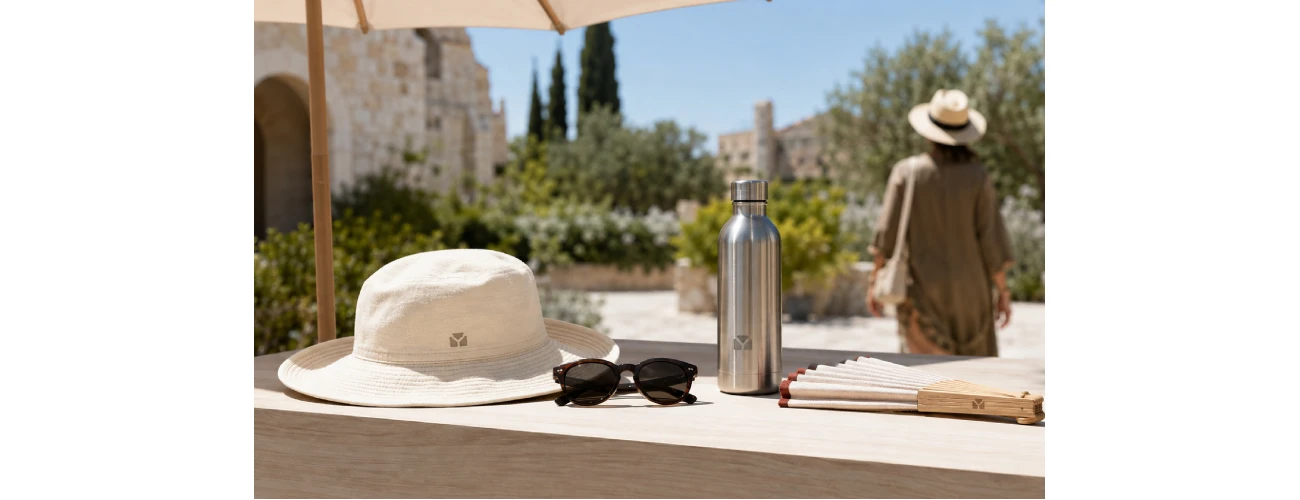
For outdoor staff, summer events and hospitality venues, buyers often consider the same shortlist: hats, sunglasses, hand fans, water bottles and parasols. The more important question comes next: which products genuinely help reduce exposure, which simply make hot conditions more comfortable, and what can a business safely claim when adding its branding?
That distinction is worth making before placing an order. Within our range of promotional products, some items address immediate discomfort while others help reduce exposure to the sun. Their purpose, product requirements and the way they should be communicated are not the same.
Seven product categories to consider first
Match each requirement to the right product
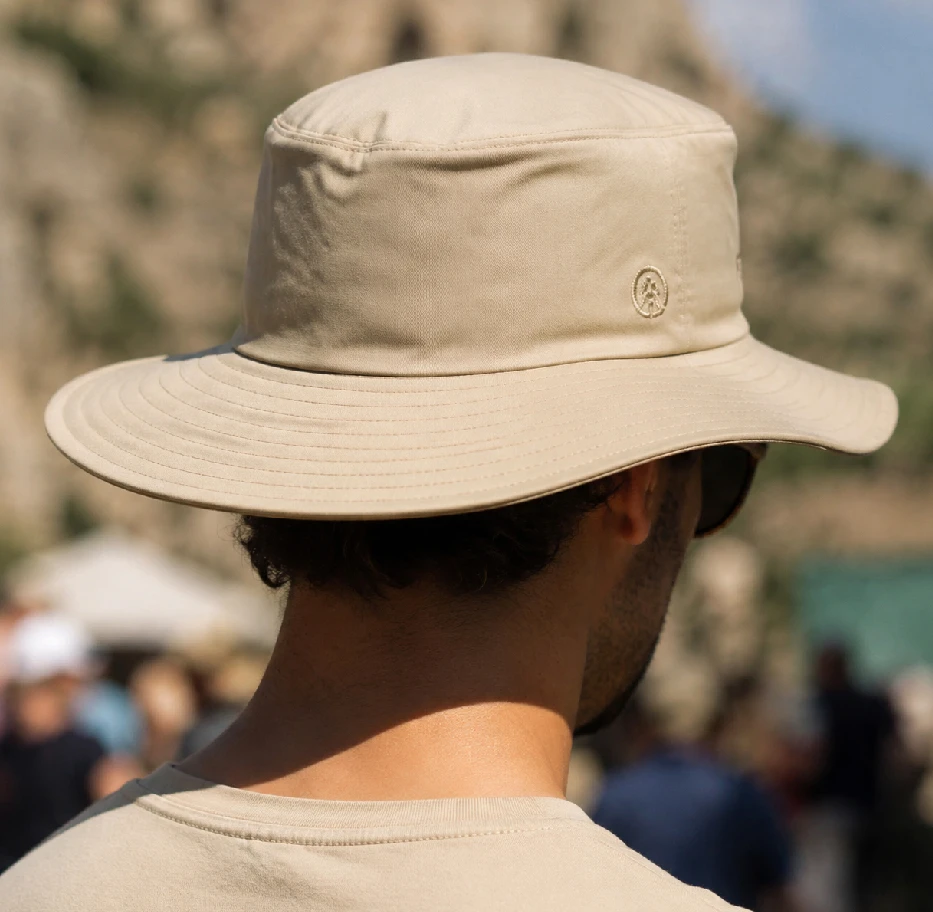
- Cover the head, face and neck → custom hats
- Protect the eyes → promotional sunglasses
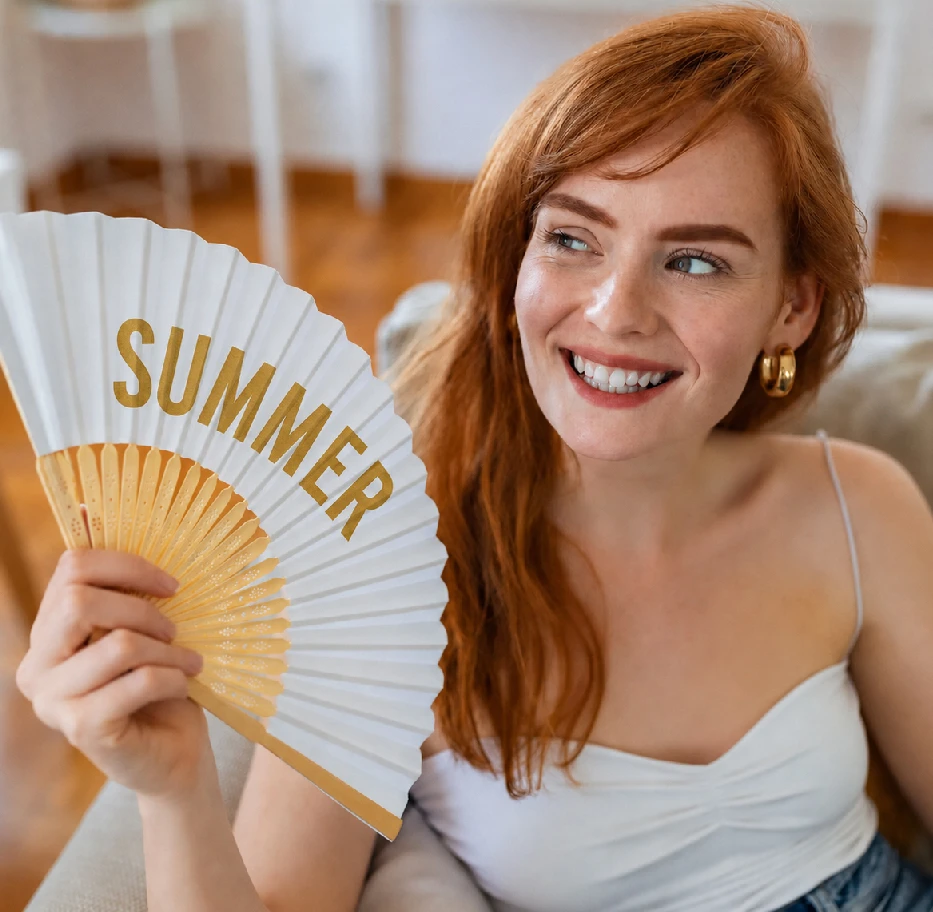
- Provide immediate comfort in queues or seated audiences → promotional hand fans
- Create an organised shaded area → promotional parasols and chairs
- Make drinking water readily available → branded bottles and thermos flasks
- Help shade company vehicles → branded car sunshades
- Build a complete seasonal kit → summer promotional items
Where promotional merchandise ends and safety equipment begins
Branded hats, water bottles and hand fans do not become personal protective equipment simply because they carry a company logo. Sunglasses intended to protect the eyes from solar radiation are different: in EU and EEA markets they fall within Regulation (EU) 2016/425 on personal protective equipment, and the applicable product requirements still matter when the frames are branded.
For businesses employing people outdoors, hot weather and sun exposure also need to be considered within the workplace risk-management framework that applies in the destination country. Promotional merchandise can support sensible arrangements — for example by making water easier to carry or by helping create shaded rest areas — but it does not replace an employer's risk assessment, working procedures or any protective equipment required for the job.
This distinction matters commercially as well as legally. If a role requires certified high-visibility clothing, specialist eye protection or another defined form of PPE, that requirement belongs in a separate purchasing specification. A promotional item should never be presented as an equivalent unless the product itself has been designed, tested and documented for that purpose.
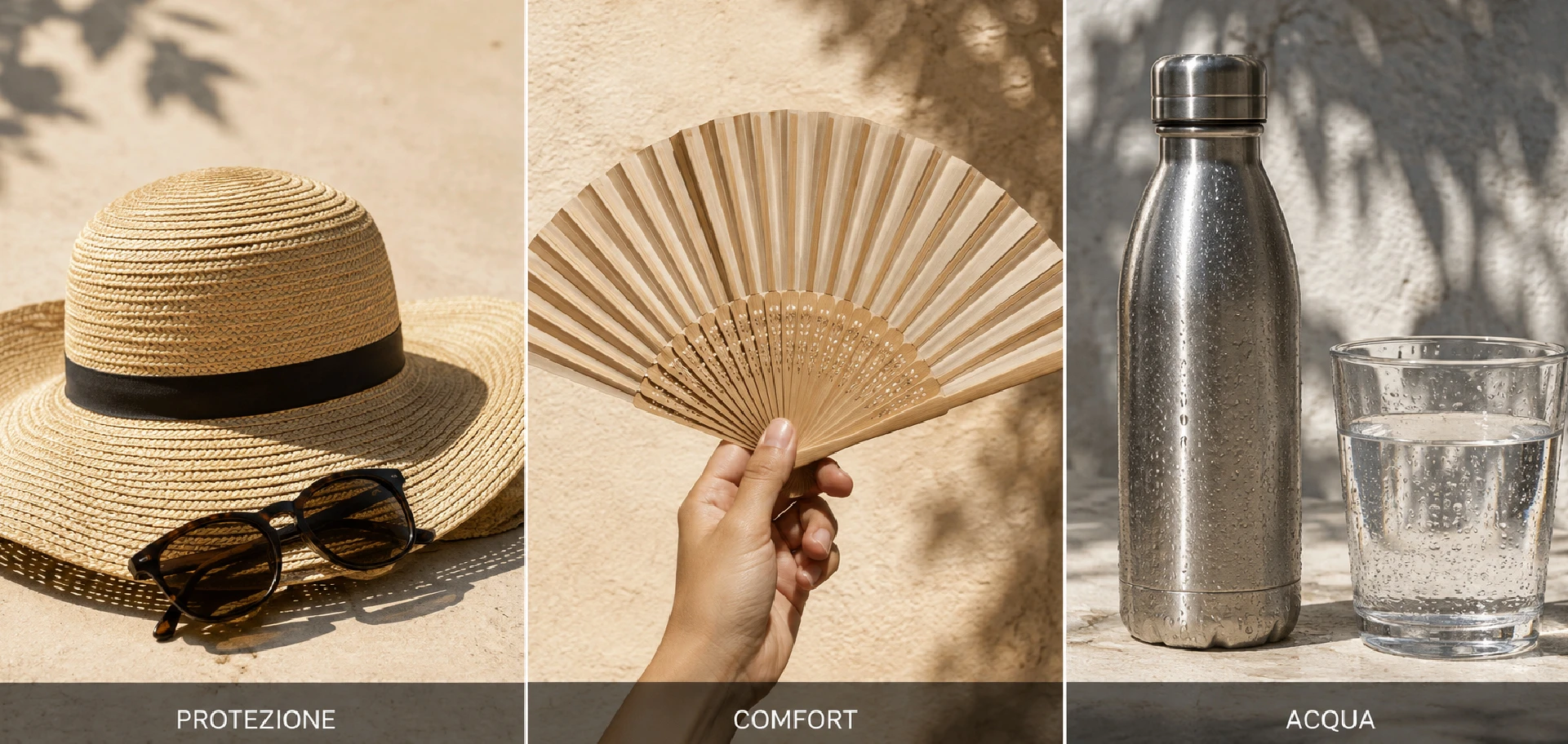
Protection, comfort and access to water
Protection means reducing exposure. Depending on the context, that may involve a wide-brimmed hat that also covers the ears and neck, sunglasses with documented performance, or a parasol that creates a shaded area. Public-health guidance on sun exposure follows the same basic principle: reduce exposure during the strongest sunshine, seek shade, cover exposed skin appropriately and use suitable eye protection.
Shade itself is not a complete barrier. Some UV radiation is scattered through the atmosphere or reflected from water, sand and light-coloured surfaces. This is why different measures complement one another rather than acting as substitutes.
Comfort is different. A promotional hand fan moves air and can make a queue, outdoor reception or summer event noticeably more comfortable, but it does not screen UV radiation. It can still be an excellent event giveaway precisely because it solves an immediate problem — provided it is marketed as a comfort item rather than a protective product.
Access to water is the third requirement. A branded bottle makes it easier for staff or event visitors to carry water, but capacity alone is not the deciding factor. Weight, closure type, ease of cleaning and the ability to refill it at the venue all affect whether it will actually be used. Our guide to custom water bottles looks at materials, sizes and purchasing criteria in more detail.
What to check before placing an order
| Product | Primary purpose | What to ask the supplier |
|---|---|---|
| Hats | Cover | Shape and width of the brim, neck coverage where required and fabric construction |
| Sunglasses | Eye protection | Applicable conformity marking, manufacturer's instructions, filter category, declaration of conformity and any limitations of use |
| Lightweight clothing | Cover | If a specific sun-protection performance is required, ask whether a documented UPF rating is available |
| Parasols and chairs | Shade | Shaded area, wind stability, installation requirements and transport dimensions |
| Hand fans | Comfort | Material, print area, legibility of small text and compatible branding technique |
| Water bottles and thermos flasks | Access to water | Capacity, insulation, closure system, cleaning requirements and practical refill options at the venue |
| Car sunshades | Vehicle comfort | Vehicle compatibility, dimensions, folding system and method of fixing in place |
Outdoor staff, event visitors, hospitality and company fleets
People working outside for most of the day — event set-up teams, outdoor reception staff, information-point teams and promotional crews — need products selected for repeated use rather than for a single hand-out. A wider-coverage hat, properly documented sunglasses and a suitable reusable water bottle are different purchasing propositions from low-cost merchandise handed to visitors for a few hours.
Event visitors generally need lightweight items that can be handed out quickly and in larger quantities. For estimating quantities, distribution points and lead times, see our guide to promotional products for outdoor events and festivals.
Hotels, beach clubs, outdoor hospitality venues and event spaces have another requirement: products such as parasols, seating and branded textiles stay on site and can be seen from a distance. Sales teams and company fleets have a different use case again, focused on vehicles, travel and long periods on the road.
The purchasing implication is straightforward: invest more per item where staff will use the product repeatedly, and control unit cost where merchandise is intended for wide distribution. When both ranges share the same visual identity, colours and branding standards, a coordinated range of promotional products, clothing and packaging can remain consistent even when product specifications and budgets differ.
Branding and personalisation techniques
The branding method should be chosen according to the material, with one additional rule: the decoration must not interfere with the product's intended function. Embroidery is often selected for structured, durable branding on hats, although the finished result should always be checked against the fabric and intended conditions of use. Screen printing works well on suitable textile products for larger runs and simple colour designs, while digital transfer can accommodate multicolour artwork and smaller quantities.
Laser engraving can create a permanent mark on compatible metal surfaces, with the final appearance depending on the base material and any coating. Pad printing or digital printing can be used on suitable plastic, wood and bamboo components, including promotional hand fans and smaller summer items, with particular attention to the legibility of fine text. Sublimation may be considered for specific projects through specialist technical partners where the product and material are suitable.
On sunglasses, branding is normally better positioned on the temple, case or packaging. It must not interfere with the lenses, field of vision or declared performance of the product, and it should never obscure mandatory markings, labels or manufacturer's information.
Responsible branding: what should you print on a summer promotional product?
Personalisation does not have to stop at the logo. A short message can reinforce the practical purpose of a summer item without turning it into an unsupported product claim, provided the wording is clear, appropriate for the audience and suitable for the available print area.
Useful, measured messages
- “Take a break in the shade” — outdoor events, promotional tours and staff teams
- “Protect your eyes and head” — kits combining suitable hats and documented sunglasses
- “Keep water with you” — branded bottles for travel, sport and outdoor events
- A QR code leading to practical information — useful when the available branding area is limited
Avoid: claims such as “total protection”, “heat-proof”, “prevents heatstroke” or “blocks all UV rays”. Absolute statements of this kind will not normally be supported by standard product documentation and should not be used unless the specific claim can be substantiated.
Measured wording does not weaken a brand. It shows that the business understands the difference between promotional communication and health or safety information — a distinction that professional buyers, staff and customers can recognise as a sign of credibility.
Four summer promotional kits for different settings
| Setting | Suggested combination | Main purchasing criterion |
|---|---|---|
| Outdoor staff | Wide-coverage hat, documented sunglasses, insulated water bottle | Repeated use and durability |
| Event visitors | Promotional hand fan, lightweight hat, tote bag or drawstring bag | Low weight and efficient distribution |
| Hospitality and beach venues | Branded parasols, seating, towels and guest water bottles | On-site durability and visibility from a distance |
| Company fleets and sales teams | Car sunshade, travel water bottle and documented sunglasses | Frequent travel and time spent in vehicles |
How to build a branded summer kit in five steps
- Define the audience and length of exposure, separating people who work outdoors for full shifts from visitors who receive the item for occasional use.
- Assign one product to each requirement, rather than buying several items that perform essentially the same job while leaving another need uncovered.
- Ask for the relevant product documentation, particularly where a protective function is being claimed, starting with conformity information, instructions and filter category for sunglasses.
- Choose the branding technique according to the material, and check the result on the actual product when the artwork contains small text or fine detail.
- Agree the message before artwork approval, removing absolute claims and favouring short wording that can be supported by the product's documented characteristics.
Common purchasing mistakes
- Calling a comfort product protective — a hand fan can be extremely useful at a summer event, but it does not screen UV radiation.
- Buying by product category rather than by requirement — three items may solve the same problem while another important need remains uncovered.
- Dropping documentation to reduce unit cost — for sunglasses, product documentation should remain part of the supplier comparison.
- Printing claims the product cannot support — once an absolute statement has been printed on thousands of items, it is no longer easy to correct.
- Ordering solely from expected footfall rather than considering how many people can actually be reached through each distribution point.
Questions to ask before ordering
- Will the recipient be outdoors for a full working shift or only for a few hours?
- Does the product need to reduce exposure, improve comfort or make drinking water easier to access?
- Can the supplier provide the relevant documentation for products with a declared protective function?
- Does the hat cover the ears and neck, or mainly shade the face?
- Can the water bottle be refilled easily at the venue or workplace?
- Can the wording we want to print be supported by the documented characteristics of the product?
Shop for Shop is an Italian company founded in 2006 by Salvo Miciluzzo, who continues to lead the business from Ragusa. We supply branded promotional products, custom clothing and personalised packaging to companies, retailers, organisations and professional buyers in Italy and more than thirty European countries. The criteria in this guide reflect recurring enquiries from businesses, event organisers, hospitality operators and organisations with teams temporarily working outdoors, as well as the purchasing mistakes that tend to recur when summer merchandise is selected on seasonality alone.
Frequently asked questions
Which promotional products are most useful in sunny and hot weather?
It depends on the requirement. Wide-coverage hats, suitable sunglasses and shade solutions can help reduce exposure; promotional hand fans provide immediate comfort; and branded water bottles make drinking water easier to keep close at hand. No single product performs all three roles.
Does a branded cap provide complete sun protection?
No. It only shades the areas covered by its particular shape and brim or peak. A standard baseball-style cap, for example, leaves the ears and much of the neck exposed. Wider brims and neck-covering designs provide more cover, but they should still be considered alongside shade, suitable clothing and eye protection.
Do all promotional sunglasses provide UV protection?
A dark lens alone does not demonstrate the level of protection. In EU and EEA markets, sunglasses designed to protect against solar radiation fall within Regulation (EU) 2016/425. Before ordering, business buyers should check the applicable conformity marking, manufacturer's instructions, filter category, declaration of conformity and any stated limitations of use. Requirements should also be checked for the final destination market.
Can a promotional hand fan protect someone from heatstroke?
No. A hand fan moves air and can provide immediate comfort in a queue, audience area or outdoor reception, but it does not block solar radiation and does not replace shade, water, rest breaks or appropriate working arrangements. It should be marketed as a comfort product, not as protective equipment.
Can promotional merchandise replace workplace safety equipment?
No. Branded merchandise can complement sensible organisational measures, but it does not replace the risk assessment, working procedures or protective equipment required under the workplace safety rules applicable to the activity and destination market.
What wording is suitable for a branded summer promotional product?
Short, supportable prompts such as “Take a break in the shade” or “Keep water with you” can work well, with a QR code linking to further information where appropriate. Avoid unsupported absolute claims such as “total protection” or “blocks all UV rays”.
How many summer promotional products should a business order, and how early?
Estimate quantities according to the number of people you can realistically reach, separating products intended for regular staff use from items distributed more widely, and allow a contingency of around ten per cent where appropriate. Production normally takes around fifteen working days from artwork approval, or around eight working days on compatible products when the express production option is available. Allow additional transit time for deliveries outside Italy.
For a coordinated summer campaign, start with our range of summer promotional items and use our guide on how to plan branded summer promotional products for the season to work backwards from your event or distribution date. Before production, Shop for Shop provides an artwork proof so that the logo, wording and positioning can be checked on the selected product.
Leave a comment