In short
- At an outdoor event an item has to be useful straight away, not just good looking: the crowd is on the move and you have seconds to hand something over.
- The choice changes with the recipient: the crowd, the crew, sponsors and the hospitality area all have different needs.
- Quantities are not calculated on ticket numbers, but on what your collection points can realistically hand out.
- Weight, bulk, transport and lead times affect the outcome as much as the unit price does.
- The printing method follows the material, not personal preference: screen printing, transfer, embroidery and laser engraving are not interchangeable.
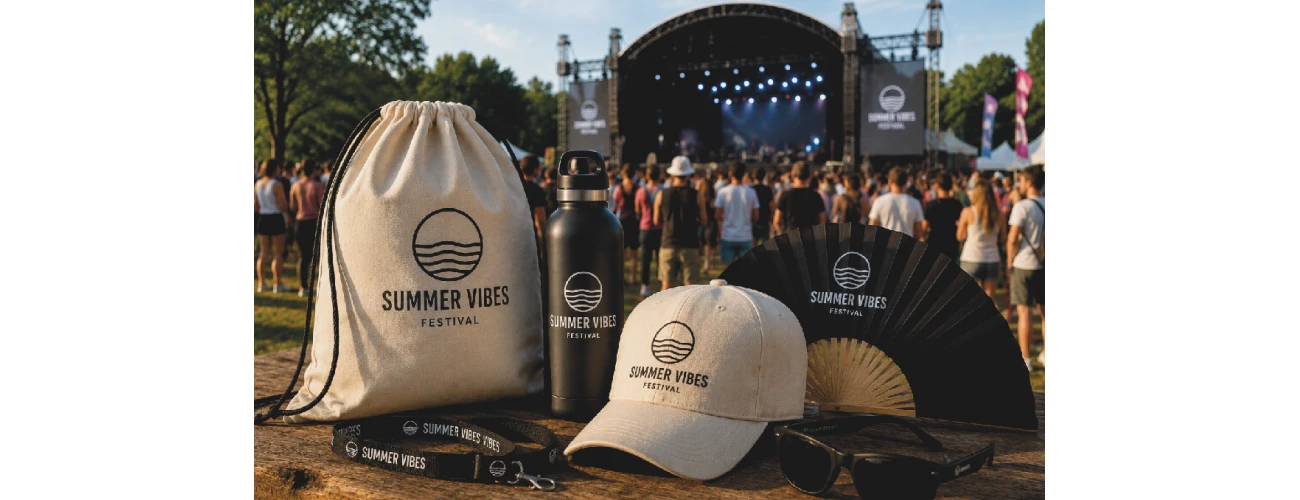
For an outdoor event the choice almost always falls on lightweight items that are useful on the day and quick to hand out: hand fans, caps, tote bags, water bottles. The harder question comes straight afterwards, and it is the one we are asked most often at quotation stage: how many to order, how far in advance, and how to differentiate what the crowd, the crew and sponsors receive. That is where a supply either works or unravels.
An outdoor event is not an indoor trade show, and it is not a summer giveaway either. The flow of people, the weather, the time available to hand items over and the immediate use of the product all change. That does not make the product itself irrelevant: it is precisely the range in the promotional products catalogue that allows you to match the right item to each role. But at a large event the value lies in how it is managed.
Which items suit which role at an event?
- Large crowds → lightweight, immediate items such as hand fans, caps and tote bags → summer promotional items
- Crew and organisers → recognisable clothing and accessories: caps, coordinated garments, belt bags → custom hats
- Sponsors and hospitality → longer-lasting, higher-perceived items: water bottles, notebooks, bags → bottles and thermos flasks
- Coordinated event kit → merchandise + tote or drawstring bag + a crew garment, all following the same visual logic
Why promotional products for outdoor events need different criteria
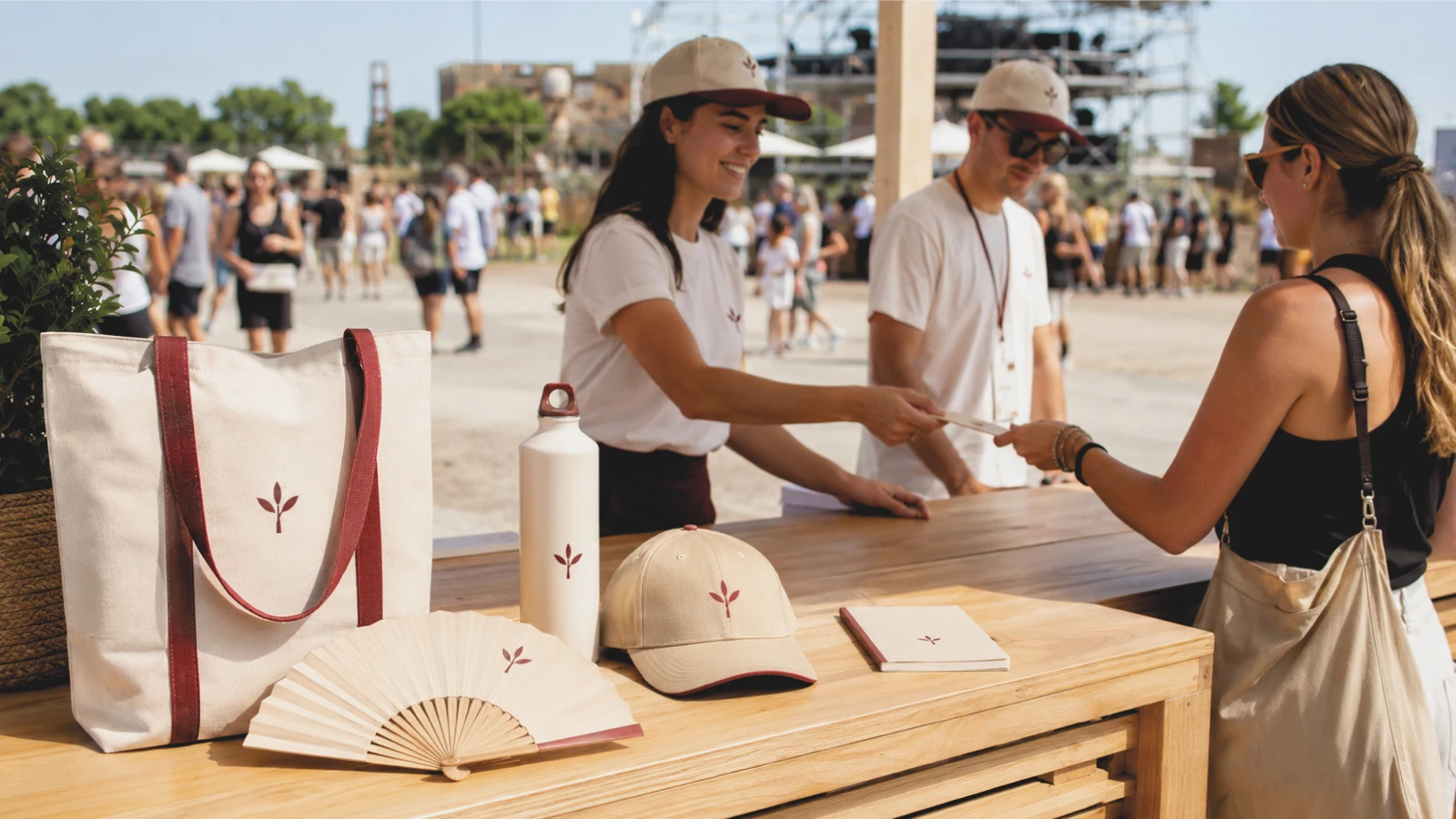
Outdoors and in front of a crowd the conditions change: there is sun or rain, people are moving, handover time is measured in seconds and collection points need staffing. In that setting an item works if it is used immediately, handed over quickly and carries a logo that is visible on site. It is a different logic from a trade show, where the goal is the qualified contact and being remembered after the event, as we set out in our guide to promotional products for trade shows.
Crowd, crew and sponsors: not everyone gets the same item
One of the most common mistakes is treating every recipient the same way. At a well organised event the item changes according to the role.
General public
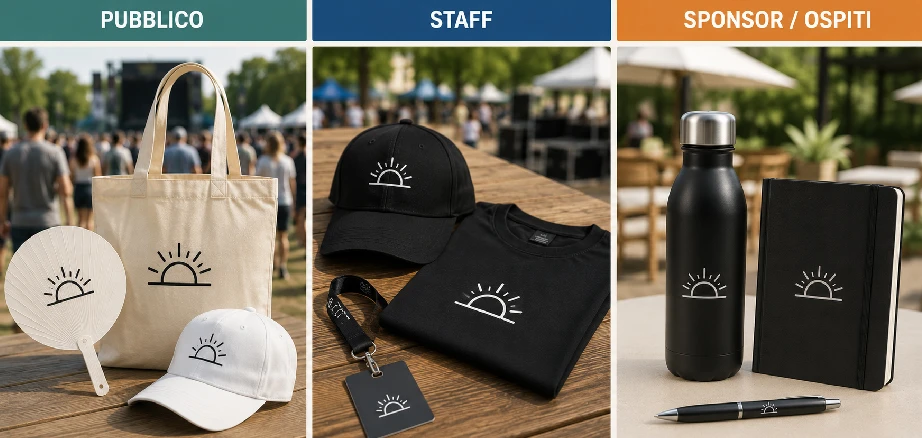
The crowd needs lightweight items that are easy to hand over and useful straight away: hand fans, caps, lightweight tote bags, small accessories, and pens or notebooks where there is a registration desk or a printed programme. Cost per unit and usefulness are what count, because the volumes are high.
Crew and organisers
The crew needs clothing and accessories that make them recognisable and keep them working: caps, coordinated garments, belt bags, drawstring bags or backpacks for equipment. The goal here is not the giveaway but the function, because a crowd that can see at a glance who is running the event finds its way around more easily.
Sponsors, guests and hospitality
For sponsors and guests, choose items that last or are perceived as valuable: water bottles, bags, notebooks, more carefully assembled kits. These are the recipients where it makes sense to invest in something that stays in use after the event.
How many to order, and how far in advance
This question comes before price, and it is almost always framed the wrong way. The calculation does not start from expected attendance: it starts from how many items your collection points can realistically hand out during opening hours, which is always a lower figure. On top of that base you add a share for crew, sponsors, guests and contingencies — in our experience a margin of around 10% covers most situations.
On timing, one rule holds: the larger the run, the more the constraint shifts from availability to production. An event order takes roughly 15 working days from artwork approval, dropping to 8 working days with the express production option selected at checkout. To that you always add time to approve a pre-production sample and time in transit to the venue, which is longer for deliveries outside Italy — these are the two steps most often forgotten when counting backwards from the event date. During the event season demand concentrates into a few weeks and lead times stretch for everyone: planning ahead, as we note in our guide to branded summer promotional items, is what lets you choose the right product rather than settling for whatever is available.
The logistics that often get overlooked
This is where a large event really differs. Beyond the product itself, practical factors that barely register on small quantities start to matter: the weight and volume of the cartons, how easily they store back of house, how quickly stock reaches the collection points, and whether the item is self-explanatory, meaning it needs no explanation to be used. For kits, minimal packaging or a tote that holds everything works best, and it helps to have goods arrive already split by collection point rather than on pallets to be sorted on site.
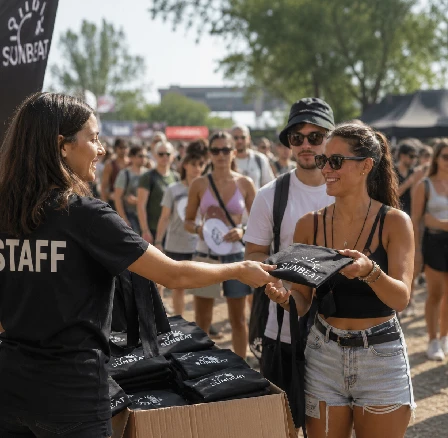
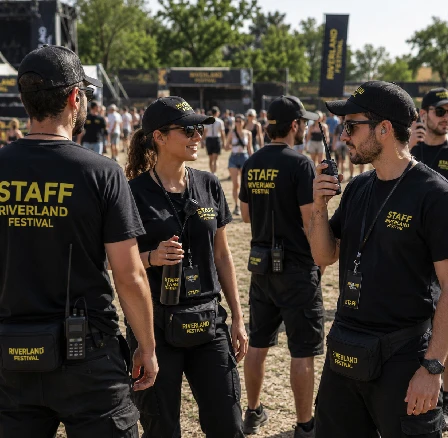
If an item is hard to transport, hand out or explain, it slows the event down instead of working for the brand.
Which promotional products work best at large outdoor events
Rather than an endless list, it helps to think by function: every requirement on site maps to a family of products.
| Function | Suitable products | Why they work | Related category |
|---|---|---|---|
| Heat and sun comfort | Caps, hand fans | Useful immediately and highly visible | Summer promotional items / hats |
| Hydration | Water bottles, flasks | Used during and after the event | Bottles & thermos flasks |
| Carrying materials | Tote bags, drawstring bags, backpacks | Hold kits, brochures and giveaways | Bags / backpacks and drawstring bags |
| Recognisable crew | Caps, clothing | Help the crowd find its way | Clothing / hats |
| Rain or changeable weather | Umbrellas | Immediate use and a large print area | Umbrellas |
Which printing method to choose
This is the question most guides skip, yet it affects finish, durability and cost more than the choice of product does. The method follows the material.
- Cotton (tote bags, T-shirts, drawstring bags): screen printing is the most efficient option for large runs with a few spot colours; digital transfer handles multicolour artwork, gradients and smaller quantities better.
- Caps: embroidery stands up to use and is perceived as higher quality, which is why it suits crew garments; transfer printing remains an alternative on the front panel.
- Stainless steel (bottles, flasks): laser engraving is permanent and survives washing and scratching, but gives a single tone; screen printing allows colour at the cost of durability over time.
- Plastic (pens, hand fans, small accessories): pad printing is the standard on small or curved surfaces.
- Sublimation: assessed on a project-by-project basis, through specialist technical partners.
Two points apply whatever the method: check the available print area before signing off artwork, because on caps and bottles it is smaller than most people expect, and always request a pre-production sample when the run is substantial.
Event kits: when coordinating several items pays off
At large events a simple kit of a few matched pieces often works better — a tote or drawstring bag holding a water bottle, a cap or a hand fan, a programme or notebook, and a garment for the crew where relevant. A kit reduces waste, speeds up distribution and makes the brand more recognisable than items handed over loose. It is the same principle behind a coordinated supply, where merchandise, clothing and delivery materials follow a single visual logic, as part of a consistent brand communication system.
Common mistakes with festival and outdoor event merchandise
- Sizing quantities on expected attendance instead of realistic distribution capacity.
- Choosing items that are too bulky or heavy to transport and store.
- Ordering products that are not used during the event, only once people get home.
- Ignoring heat, rain, dust and transport when choosing materials.
- Making no distinction between the crowd, the crew and sponsors.
- Signing off artwork without checking the actual print area of the product.
- Leaving no margin for contingencies and delays, or starting production too late.
Questions to ask before you order
Before confirming an order for an outdoor event, a handful of questions prevent the most common mistakes:
- How many people will attend, and how many will actually reach the collection points?
- Will the item be handed over at the entrance, at a stand, at the hospitality desk or during the event?
- Should it be used on the day, or remind people of the brand afterwards?
- Who receives it: the crowd, the crew, sponsors or guests?
- How much space does it take up in storage and at the collection point?
- Which printing method suits the chosen material, and what print area is available?
- Is a coordinated kit needed, or will individual items do?
- Do the lead times work with the event date, sample and transit included?
Shop for Shop is an Italian company operating since 2006, a direct supplier of custom promotional products to businesses, events and promotional campaigns in Italy and more than thirty European countries. The company was founded in 2006 by Salvo Miciluzzo, who runs it as managing director. The criteria set out in this guide — quantities sized on real distribution, lead times, and printing methods chosen by material — come from the mistakes that recur most often in event supply, when an order arrives too late or too loosely specified. For an outdoor event the choice does not start with the product, but with the audience, the logistics, the distribution and the real use.
Frequently asked questions
What promotional products work best at outdoor events?
Start with items that are useful on the day and quick to hand out: hand fans, caps, water bottles and lightweight tote bags. Refine the choice around who receives them and the conditions on site, such as heat, rain and the flow of people through the venue.
How many promotional items should you order for an event or festival?
Do not base the figure on total attendance. Start from how many items your collection points can realistically hand out during opening hours, which is always a lower number, then add a margin for crew, sponsors, guests and contingencies. Around 10% covers most situations. Overestimating leaves stock in the warehouse; underestimating leaves the final hours of the event uncovered.
How far in advance should you order merchandise for a festival?
Well in advance. Production for an event order takes roughly 15 working days from artwork approval, or 8 working days with the express production option. On top of that, allow time to approve a pre-production sample and time in transit to the venue, which is longer for deliveries outside Italy. During the event season demand concentrates into a few weeks and lead times stretch for everyone.
How do you choose different items for the crowd, the crew and sponsors?
The crowd receives lightweight, immediately useful items in high volumes. The crew needs practical, recognisable kit such as caps and coordinated clothing. Sponsors and guests are better served by longer-lasting, higher-perceived items such as water bottles, bags and notebooks.
Which printing method should you choose for event merchandise?
It depends on the material. On the cotton of tote bags and T-shirts, screen printing is the most efficient option for large runs with a few spot colours, while digital transfer handles multicolour artwork and smaller quantities. On caps, embroidery lasts longer and looks better. On stainless steel bottles and flasks, laser engraving is permanent. On plastic pens and hand fans, pad printing is the standard.
When is a coordinated event kit worth putting together?
A kit works when you need to hand out several items at once while keeping everything recognisable and orderly. A tote or drawstring bag holding a water bottle, a cap and a programme reduces waste and speeds up distribution, and it strengthens how the brand is perceived on site.
How do you avoid waste when ordering merchandise for large events?
Size the order against realistic distribution capacity rather than attendance, choose items that are useful and self-explanatory, separate what goes to each audience, and favour reusable products. A coordinated kit and a properly planned lead time are what reduce leftovers and unused stock.
1 Comments
Erkunden Sie eine benutzerfreundliche Website mitt hilfreichen Artikeln, praktischen Tipps und interessanten Themen. Durchstöbern Sie verschiedene Bereiche ganz bequem.\r\nDie übersichtliche Gestaltung sorgt für ein komforgables Erlebnis \r\nfür Besucher, die zuverlässige Informationen und hochwertige Online-Inhalte suchen.
Leave a comment