
In short
- A trade show giveaway is not a gift but a tool for extending commercial contact beyond the event.
- Effectiveness depends on genuine usefulness, audience relevance and perceived quality, not on unit cost.
- Distributing fewer, well-chosen items generates stronger leads than handing out hundreds of throwaway objects.
- Promotional products only deliver real value when they are part of a wider strategy linking stand presence, messaging and follow-up.
- A clean, legible personalisation lets the brand be remembered without feeling intrusive or excessive.
Choosing the right promotional products for a trade show means turning a brief conversation into a contact that continues long after the event ends. Trade shows and exhibitions pack dozens — sometimes hundreds — of potential business relationships into a few short hours, and the right branded merchandise becomes a crucial tool for preserving that value.
We are writing this guide because the choice of trade show merchandise is still too often treated as a low-impact operational task, while in practice it determines how many contacts actually become commercial opportunities. The difference between a well-chosen giveaway and a poorly-chosen one is not measured at the moment of handover, but in the weeks that follow.
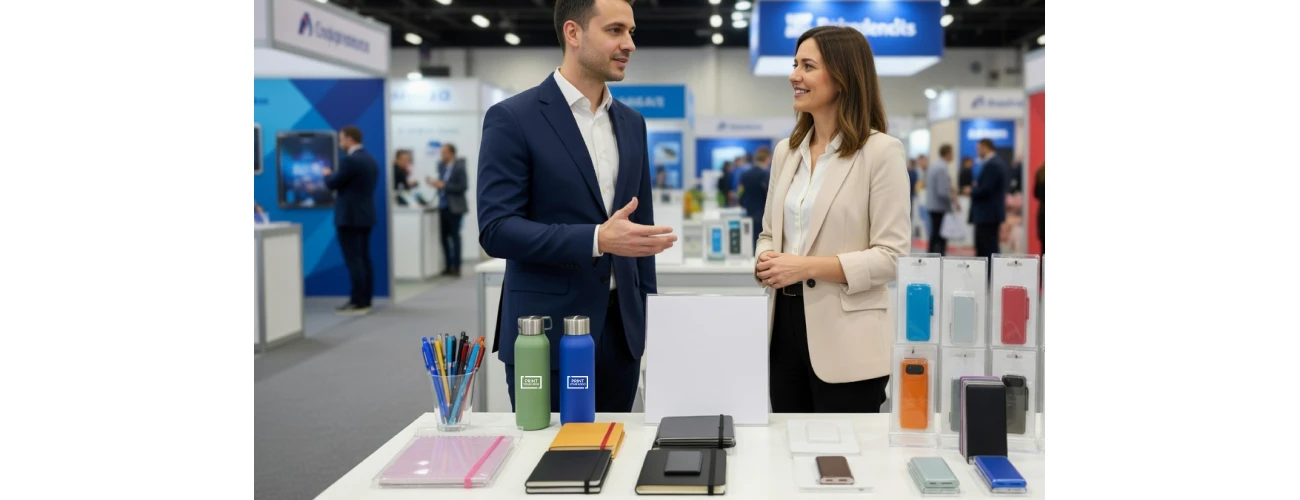
At an exhibition, a promotional product is not simply a freebie. It is a bridge between the stand and the next conversation. Chosen carelessly, it is forgotten within hours. Chosen well, it keeps the relationship alive for weeks or months.
Maximising contact means creating continuity after the handshake — not increasing the volume of items handed out. For this reason, choosing branded promotional products for trade shows aligned with the brand's positioning is a strategic decision, not an operational one.
What makes a trade show giveaway actually work
An effective promotional product does not aim for quantity. It aims for quality of contact. It must be useful, aligned with the brand and easily associated with the encounter that took place at the stand. The right choice depends on three variables:
- the audience of the event — a generalist exhibition calls for different items than a sector-specific trade show
- the commercial objective — brand-building, lead generation or relationship-deepening with already-qualified contacts
- the stage of the relationship — quick first contact or in-depth commercial follow-up
Choosing the right product for your exhibition context
- High footfall stands — simple, immediate items that facilitate quick distribution and broad contact.
- Qualified prospects — more useful, longer-lasting products that boost memorability and support follow-up.
- Sector-specific events — items relevant to the visitor's industry, increasing perceived relevance.
- Brand-building objectives — reusable merchandise that delivers visibility long after the event.
There is no universal answer. The right choice depends on the type of event, the audience and the commercial objective.
The real purpose of trade show merchandise
The primary purpose of exhibition merchandise is not to impress — it is to stay in the recipient's memory. During a trade show, attention is fragmented and time is scarce. The promotional product becomes the element that keeps the brand present in the visitor's mind after the event closes.
A well-chosen item enables three things:
- reinforcing brand recall — a useful object reactivates the memory of the encounter every time it is used
- providing a natural reason for follow-up contact — the visitor naturally associates the object with the trade show meeting
- communicating professionalism and reliability — the quality of the giveaway reflects the perceived quality of the business
Why most trade show giveaways fail
The most common reason is selection based solely on unit cost. Generic or impractical items end up unused, wiping out the return on investment entirely. In these cases, the product does not build a relationship — it simply becomes an expense.
The typical mistake is treating the giveaway as a cost line to minimise rather than as an investment in the value of every contact generated. For a deeper look at why so many promotional products end up forgotten right after the trade show, our analysis on why many promotional products fail covers the most common avoidable mistakes.
When a trade show giveaway becomes a waste
- Handed out without conversation — no explicit connection to the brand or to the discussion at the stand.
- Low utility or too generic — it gets pushed aside quickly and forgotten.
- Poor perceived quality — it creates a negative association with the business that distributed it.
At an exhibition, a promotional product works only when it is part of a genuine interaction — not a random handout.
Usefulness and context: the keys to memorability
A promotional product works when it is contextually relevant. It must address a genuine need in the visitor's working life or daily routine. Items that can be used straight away or in everyday working life are far more likely to be kept and reused over time.
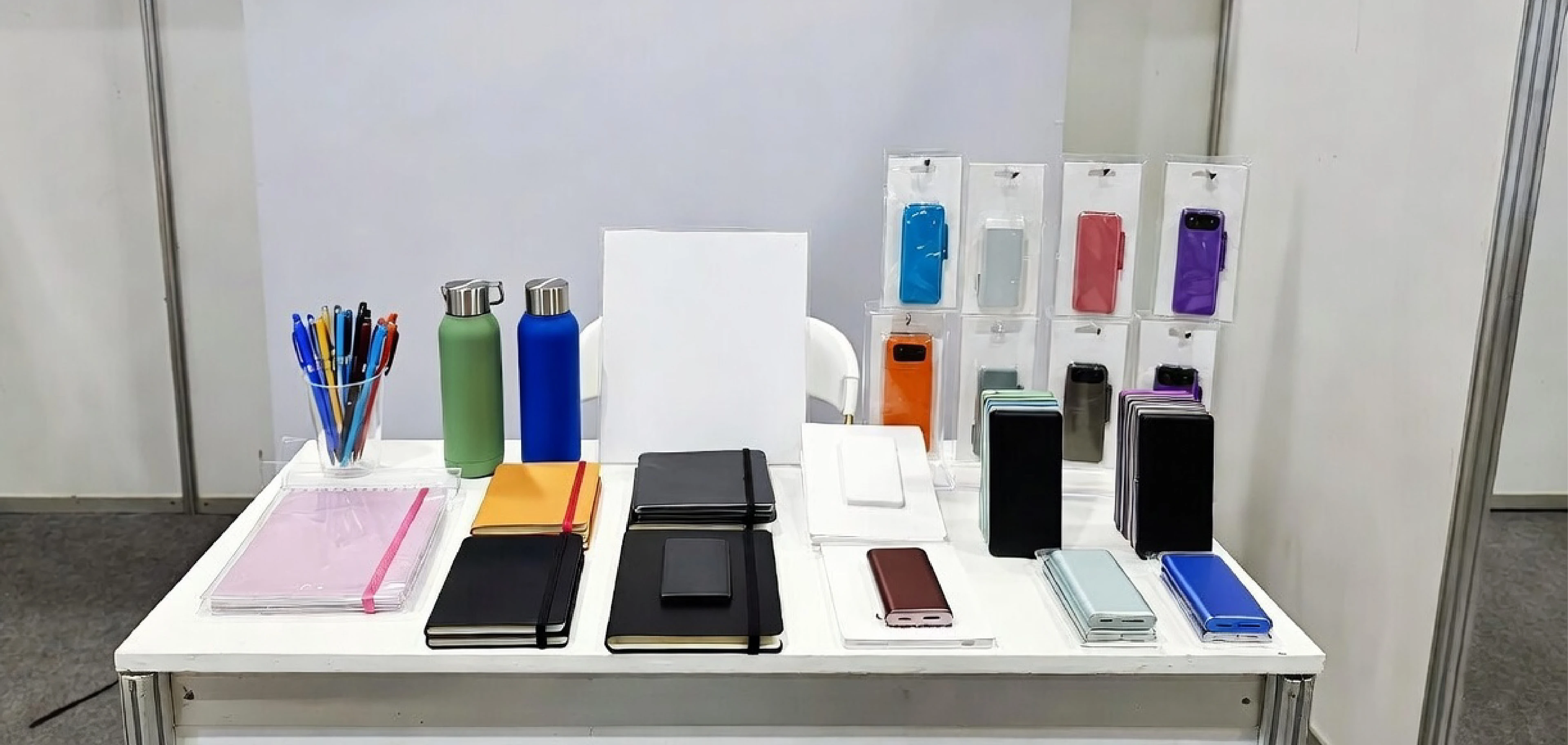
Typical examples of high-reuse giveaways are branded pens and personalised water bottles and flasks: simple objects, but ones that enter the recipient's daily routine. For a focused look at choosing the right water bottle for trade shows, our guide to branded water bottles goes through the practical criteria.
Examples of effective trade show merchandise
- Pens and notebooks — used immediately during the event itself and in the days that follow.
- Water bottles or travel flasks — they accompany the visitor well beyond the exhibition, at the gym or on the desk.
- Desk accessories — they enter the daily working routine and reactivate the brand's memory with every use.
A promotional product works when it becomes part of the recipient's real life — not when it stays in a conference tote bag.


The role of personalisation
Personalisation is not just about placing a logo. It is about making the object recognisable and associated with the brand over time. A clean, legible personalisation allows the brand to be remembered without feeling intrusive or excessive.
An oversized logo or aggressive colour scheme can turn a potentially useful giveaway into an object the recipient prefers not to use in public. Effective personalisation is visible, but does not shout.
Fewer well-chosen items beat a mountain of throwaway merchandise
At a trade show, distributing fewer products — selected with clear intent — improves the quality of every contact made. An effective strategy often involves a tiered selection: a basic giveaway for quick contact and a higher-value item reserved for qualified prospects.
This approach is particularly effective in sectors where perceived quality is essential, such as using tech promotional products for the most strategic leads, while keeping more traditional items for generic first-touch contacts.
Signs you are choosing the wrong trade show giveaway
- You are choosing purely on price — there is no real contact-value criterion behind it.
- You cannot explain why you are giving it away — there is no clear commercial strategy.
- You are distributing in bulk without dialogue — the leads generated stay weak and unqualified.
At exhibitions, it is the quality of the contact that matters — not the number of items distributed.
What we have observed since 2006 about trade show merchandise
In our experience supplying merchandise for trade show stands, the businesses that get the strongest results are not the ones distributing the highest number of items, but those that have clarified upfront who is receiving the product and why. Stands that use two or three tiers of giveaway — a generic item for first contact, a more carefully chosen one for qualified leads, a premium one for active partnerships — generate higher-quality leads than stands handing out a single item to everyone without distinction. The difference is made by contact segmentation, not by the single object.
How to choose the right promotional products for a trade show
Before confirming a procurement order for an exhibition, it is worth following 4 practical steps to ensure every giveaway actually contributes to the quality of the contacts generated:
- Define the objective: Clarify whether the merchandise is intended to reinforce brand recall, facilitate follow-up contact or communicate professionalism to a qualified lead.
- Select based on genuine usefulness: Choose items that address a real need in the visitor's working life, such as pens, notebooks, water bottles or desk accessories, avoiding purely decorative objects.
- Prioritise quality over volume: Distribute fewer items chosen with clear intent, reserving higher-value products for the most qualified contacts.
- Integrate merchandise into the wider exhibition strategy: Link the promotional product to stand design, messaging and post-event follow-up to create continuity beyond the handshake.
If even one of these four steps is skipped, the giveaway risks becoming a cost rather than an investment in the value of the contact.
Trade show merchandise as part of a coordinated brand strategy
Promotional products deliver genuine results when they are integrated into a broader strategy encompassing stand design, messaging and post-event follow-up. It is no coincidence that businesses with the most solid trade show results design their stand as a consistent brand communication system: promotional products, staff workwear, shopping bags and stand materials speak the same language and convey the same positioning.
In this view, the giveaway is not an isolated object but one of the building blocks of a coordinated experience that visitors perceive as professional and consistent.
Frequently asked questions about trade show promotional products
Do trade show giveaways actually work?
Yes, when chosen with clear intent. A useful promotional product extends the contact well beyond the event and reinforces brand recall in the weeks that follow the show.
Is it better to choose cheap items or quality merchandise for trade shows?
Perceived quality matters more than unit cost, as it directly affects memorability and the impression the brand leaves on the recipient. Distributing a few quality items to qualified contacts often generates more value than distributing many generic ones.
Is personalisation always necessary for trade show merchandise?
Yes. Personalisation makes the product recognisable and ensures it remains associated with the brand over time. A clean, legible personalisation is more effective than an oversized or aggressive logo.
In summary: trade show promotional products work when they are designed to create continuity between encounter and relationship. A strategic choice of giveaway — consistent with the audience, the context and the commercial objective — multiplies the value of every contact generated during the event.
Why choose Shop for Shop
Shop for Shop is an Italian company operating since 2006 as a direct supplier of promotional products, clothing, shopping bags and packaging for businesses, shops and events. Even when selecting trade show and exhibition merchandise, the goal is not to offer a catalogue of items to distribute indiscriminately, but to build a targeted procurement that respects the exhibition context, the audience and the company's commercial objective. A careful design of branded promotional products for trade shows and events becomes a concrete tool for cutting waste and increasing the value of every contact generated during the event.
Leave a comment