
In short
- Physical stock is not the same as usable stock: items already allocated, damaged or no longer matching the current logo have to be counted separately.
- The lowest unit price is not the lowest total cost: an attractive price break becomes expensive as soon as part of the order stops moving.
- Not every item stays usable for the same length of time: dates, straplines and edition names shorten its life, a logo on its own extends it.
- The reorder point is not a fixed interval that suits everyone: it has to cover consumption during artwork approval, production and delivery, or for scheduled activity be tied to the dates in the calendar.
Which problem are you starting from?
- Boxes have been sitting there for months and I don't know what to do with them → the section on what goes out of date and what can still be used
- I don't know how many items I actually have available → the difference between physical stock and usable stock
- I want to order better next time → start with the repeat lines: branded pens, water bottles and thermos flasks, shopping bags
Managing a stock of promotional products comes down to three recurring decisions: working out how much is genuinely available, how much to order at a time, and when to trigger the reorder. It looks like a logistics problem, but it starts much earlier, at the moment the quantity is chosen.
The pattern is almost always the same. You look at the price list, you notice the unit price drops as the quantity goes up, and you order the next price break to "save money". Six months later part of the order is still sitting there, the logo has been tweaked in the meantime, and those items can no longer be handed out as current company material. It is the same mistake behind most supplies that don't work — ordering without asking who will use the item and how often — a subject covered in the guide on why many promotional products fail and how to avoid it. Here we look at how to work out what you really have, how much to order, what is worth keeping in stock, how to store it and when to reorder.
Physical stock and genuinely usable stock
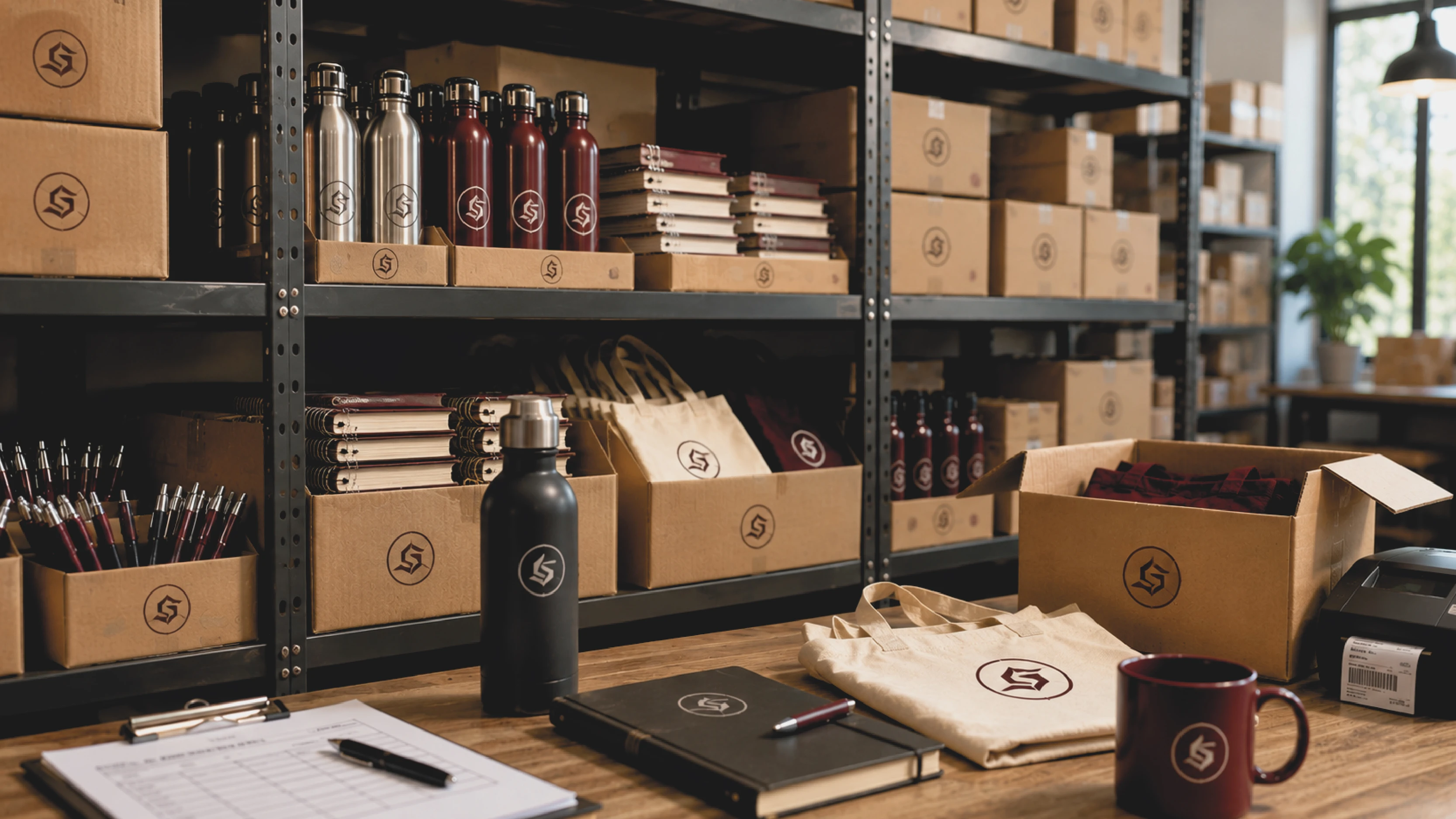
The first mistake is not ordering badly: it is counting badly. A company can hold five hundred pens and still have only forty it can actually commit, because the rest is already allocated, damaged or no longer consistent with the current brand identity. It helps to give every line a simple status.
- Available: intact, current and not allocated to anything.
- Allocated: already earmarked for an event, a site, a sales rep or a kit.
- To be checked: awaiting inspection for quality, packaging, logo or fit with the campaign now running.
- Not usable: damaged, incomplete or carrying information that is no longer current.
- On order: already ordered but not yet received and checked.
The figure you need in order to decide
Usable stock = physical stock − allocated items − items to be checked − items not usable. Anything on order stays in a separate column until it has been received and checked. This figure, not the physical count, is what tells you whether a reorder is needed.
Every issue out of stock should record at least the date, the quantity and the destination. You don't need a stock management system: for a modest holding, a shared spreadsheet with product, available quantity, allocated quantity, site and last movement is enough. The tool matters far less than the discipline of keeping it up to date.
How much to order in practice
The starting point is not the price break but real consumption: the history of what has gone out, or — where there is no history — the dates already in the diary, adding up the quantity expected for each.
Working out the reorder quantity
Quantity to reorder = expected consumption until the next delivery + buffer − usable stock − stock already on order.
On the buffer, for events and open distribution a working figure of around 10% above estimated need can serve as a starting point: it covers damaged items, samples and last-minute requests. It should be calibrated against how predictable demand is, and not applied automatically to named items, seasonal lines or anything with a high risk of going out of date. The criterion is predictability of use, not a fixed rule.
A smaller order reduces the risk of leftovers, but has to be weighed against minimum production quantities, set-up and origination costs, carriage and product continuity: models and colours are not available indefinitely, and separate production runs can show slight variations in shade. The right choice minimises the total cost of the stock actually used, not the unit price and not the number of orders placed.
| Type of stock | Examples | How to plan it | Main risk |
|---|---|---|---|
| Ongoing | Pens, notebooks, water bottles, keyrings, tote bags | Minimum level and reorder based on past usage | Running out without warning |
| Event-based | Giveaways for trade shows, conferences, open days | Quantity per date and expected footfall | Surplus once the event is over |
| Seasonal | Hand fans, beach towels and other summer promotional items | Window of use and cut-off date for handing them out | Left over until the following season |
| Named or selective | Awards, kits carrying names, gifts for specific clients | Order against confirmed recipients | Items that cannot be reassigned |
If the question is the annual spend rather than the single order, it connects to the guide on how to plan a promotional products budget without waste: stock is the part of the budget you only see afterwards, once the items have already been paid for.
What to keep in stock and what not to
Not every promotional product stays usable for the same length of time. What shortens its commercial life above all is the information printed on it: the more dates, editions, straplines or contact details an item carries, the sooner it becomes unsuitable for whatever comes next.
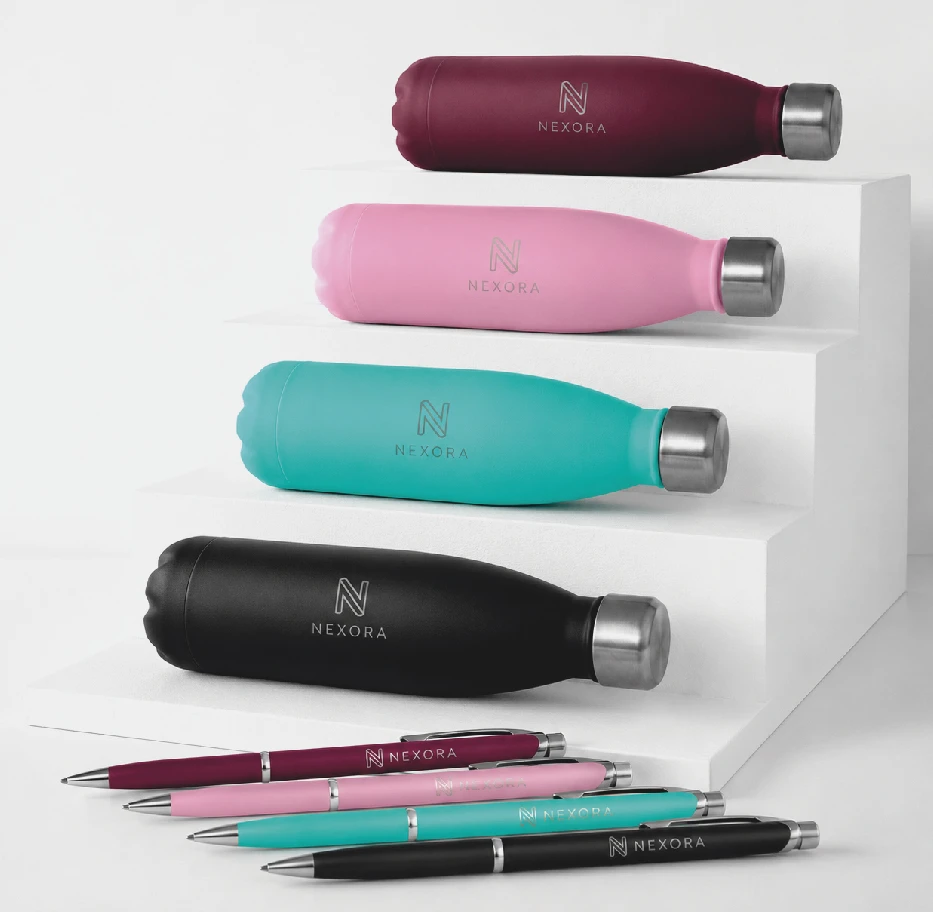
The lines that cope best with being held are the repeat products carrying the logo and nothing time-specific: pens, notebooks, water bottles and thermos flasks, keyrings, shopping bags. They can be handed out in very different settings and are not tied to a single campaign. The risk doesn't disappear altogether — storage conditions and a possible rebrand still apply — but it is far lower.
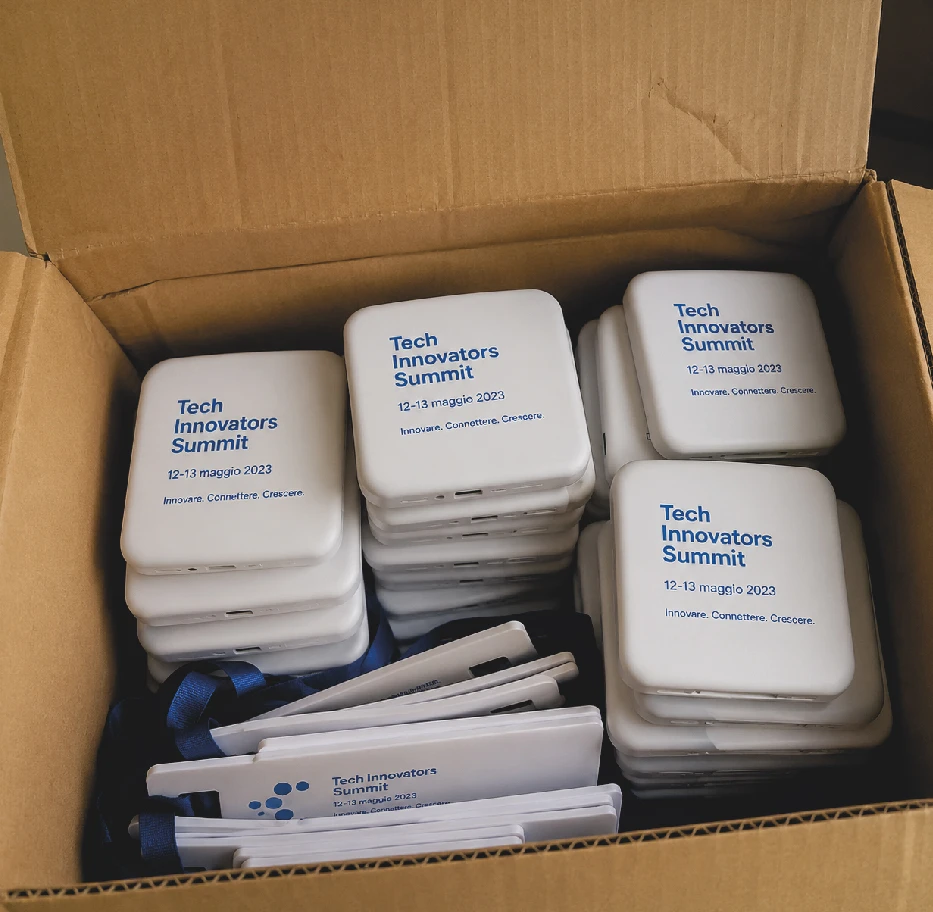
Items that carry a date, an event name, a strapline or a phone number have a practical expiry instead. It is worth separating them physically from the repeat lines as soon as they arrive: the two groups need opposite handling.
On some products it is worth considering buying unbranded, with the personalisation left until the item is actually needed: with no logo applied, the risk of the stock being made obsolete by a change of brand identity falls, and the item can be used more flexibly. Whether the unbranded version is available, and whether it can be branded later, has to be checked product by product and agreed before ordering.
What to do with stock that is already sitting there
If the stockroom is already full, throwing things away is the last resort. Repeat lines carrying the current logo can nearly always be used: welcome packs, a giveaway at the counter, something added to an outgoing parcel. Items tied to a campaign that has ended have fewer routes, but some remain: internal use, training, kit for staff in settings that are not customer-facing. What to avoid is handing them out as though they were current, because a date that has passed says more about disorganisation than the usefulness of the item can make up for.
Storing stock and reordering in good time
How to store promotional products
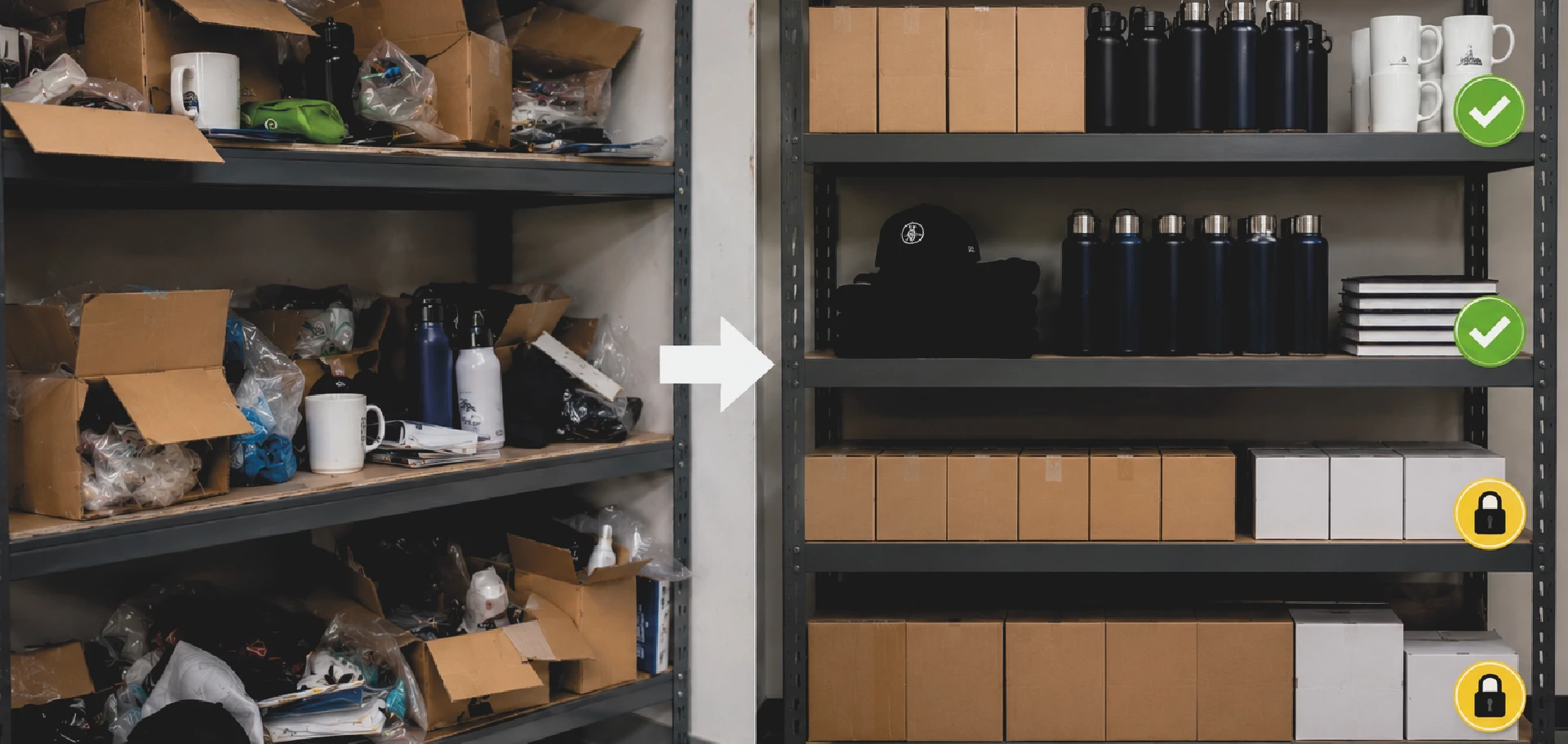
An item that has been damaged in storage is exactly the same loss as one that has gone out of date, with the added problem that you find out the day before the event. The rules worth following are few and apply to almost every category.
- Dry and clean. Damp makes textiles and cardboard undistributable even when the item itself is intact: marks, smell, mould.
- Out of direct sunlight. Sun fades fabric and print, and months later the difference in tone between production runs shows.
- Nothing crushed. No heavy boxes on top of bags, caps or packaging: the deformation often doesn't come out.
- Away from heat sources. On plastics and adhesives, sustained heat affects both shape and how well the print holds.
- Food-contact items kept apart. Mugs and water bottles that come into contact with food or drink should be kept closed, clean and away from strong smells.
Two organisational habits then do most of the work: label every box with product, quantity and date received, and always issue the oldest batch first. It is the simplest rule in stock control and also the one most often ignored.
When to trigger the reorder
The recurring mistake is reordering once stock has run out: by then it is too late, because the lead time sits between the order and the delivery. The reorder point has to be worked backwards and must cover expected consumption during artwork approval, production and delivery, rather than a fixed period applied to everything.
Production generally takes around 15 working days from approval of the artwork; on compatible products the express production option can bring that down to 8 working days and can be selected at checkout. On top of that come the proof stage, internal coordination and transport. An item handed out every week therefore needs a far higher reorder point than one used on only two occasions a year, where it makes more sense to fix the order dates in the calendar instead.
How to manage promotional product stock, step by step
The whole thing comes down to five steps that repeat with every cycle.
- Count the stock and give every line a status. Separate available, allocated, to be checked, not usable and on order: usable stock is what remains once allocated, to-be-checked and unusable items have been taken out.
- Group the items by how they are used. Ongoing, event-based, seasonal or named: each group is planned on a different logic.
- Record what goes out and build the history. Date, quantity and destination tell you what real consumption is and which activities absorb the most stock.
- Set the buffer line by line. It can be reduced where recipients and quantities are confirmed and widened where distribution is open; on named items it should not be applied as an automatic percentage.
- Set the reorder point against the lead time. It has to cover consumption during artwork approval, production and delivery; before ordering, check that the logo and the artwork files are still current.
What we have observed since 2006 about managing stock
In our experience the leftovers that are hardest to clear don't always come from one enormous order: more often they come from small quantities bought at different times, with logos, colours or purposes that no longer line up. What we tend to see is that companies recording the destination of everything they issue reorder more accurately and use up compatible stock before opening a new production run. And one detail comes up again and again: anyone who builds up large quantities shortly before a brand identity review almost always ends up with material they cannot use.
Common mistakes in promotional product stock management
- Counting as available items already allocated to events, sites or sales staff.
- Choosing the quantity by looking at the price break rather than at real usage.
- Holding stock of items carrying dates, straplines or event names, which expire with the campaign.
- Ordering large quantities while the brand identity is under review.
- Storing textiles and packaging somewhere damp or under heavy loads.
- Noticing the shortage when the event is close and there is no time left for proofing and production.
Questions worth asking before you order
Before confirming an order of promotional products destined for stock, a handful of questions head off the most expensive leftovers:
- How many items are physically there, and how many are genuinely available?
- Is anything already allocated, on order, or held at another site and missing from the count?
- Does the item carry dates, straplines or contact details that could go out of date, and is the logo the final version?
- Does the quantity answer a planned use, or only a volume discount?
- Is there suitable space to store it, and does the reorder date leave time for proofing, production and delivery?
Shop for Shop is an Italian company operating since 2006 as a direct supplier of promotional products and branded clothing for businesses, shops and events in Italy and more than thirty European countries.
Frequently asked questions
What is the difference between physical stock and usable stock?
Physical stock is everything materially held in the stockroom. Usable stock excludes items already allocated, items still to be checked and items that are not usable because they are damaged or no longer consistent with the current logo and campaign, and counts separately anything on order until it has been received and checked. It is this second figure that tells you whether a reorder is needed.
How much buffer stock is it worth allowing?
For events and open distribution, around 10% above estimated need can serve as an initial reference, covering damaged items, samples and last-minute requests. The buffer should be reduced or adjusted according to confirmed recipients, how variable demand is, seasonality, the value of the item and whether leftovers can be used again.
Is it worth ordering more to bring the unit price down?
Only if the larger quantity will actually be handed out within a reasonable time. The comparison should be made on the total cost of the stock genuinely used, taking in minimum quantities, set-up costs and carriage: the saving per item shrinks or disappears if part of the order stops moving.
Which promotional products are least likely to go out of date?
Generally those carrying the logo alone, with no dates, editions or time-limited messages: pens, notebooks, water bottles and thermos flasks, keyrings and shopping bags can be used on many different occasions. The risk doesn't vanish — storage conditions and a possible rebrand still apply — but it is much lower.
How should branded promotional products be stored?
Somewhere dry and clean, out of direct sunlight and away from heat sources, with no heavy loads on top of bags, caps and packaging. Items that come into contact with food or drink should be kept closed and clean. Labelling boxes with product, quantity and date makes it possible to issue the older batches first.
When should the reorder be triggered?
When usable stock only covers expected consumption during artwork approval, production and delivery. Production generally takes around 15 working days from approval of the artwork, reduced to 8 on products compatible with the express production option at checkout. The reorder point depends on how fast the individual item is used, not on a fixed period.
To build a stock that genuinely moves, start with the repeat lines in the Shop for Shop promotional products range and think about the quantity you will actually hand out, rather than the one with the lowest price per item.
Leave a comment