In this article, you'll learn how to plan a promotional products budget strategically, avoiding waste and choosing items that are genuinely useful and long-lasting for your brand.
If you're planning branded merchandise for 2026, this is the right place to start.
In short
- Plan based on usefulness, durability and frequency of use — not on unit price.
- Define the role of the order: internal staff, customers, onboarding kits.
- Reason in terms of cost per impression, not cost per piece.
- Allocate the budget progressively, starting from real needs.
Planning a promotional products budget properly is one of the most delicate tasks for businesses, organisations and professionals who want to communicate their brand effectively. Promotional products are often treated as a secondary expense, when in reality they can become a long-term, measurable communication tool.
Poorly planned investments often result in unused items and wasted budget. A more thoughtful approach turns branded merchandise into a strategic asset that continues to work for the brand over time.
First things first: what kind of investment are you making?
Before setting a budget, it's essential to clarify the role promotional products should play in your strategy. Not all orders serve the same purpose.
- Internal staff support → everyday usefulness and long-term durability
- Brand visibility for customers and the public → frequency of use and brand exposure
- Onboarding kits → consistency and brand perception
Identifying the right context from the start helps prevent waste and makes the budget more effective.

Why planning a promotional products budget really matters
The most common mistake is focusing solely on unit cost. A cheap item with little real usefulness is unlikely to be used, resulting in little or no return on investment.
Effective budget planning means evaluating:
- product lifespan
- frequency of use
- relevance to the target audience
A well-chosen promotional item continues to communicate the brand for months or even years, which often makes the investment more effective than many short-term campaigns.
Common mistakes in promotional products budgeting
- Choosing items only on unit price, without considering real usage.
- Buying "just to have something to give", with no defined target or context.
- Treating promotional items as a cost rather than a long-term communication tool.
- Skipping the test order phase before committing to large quantities.
How to avoid waste when choosing promotional products
To reduce unnecessary spending, it helps to start with a few clear questions:
- Who is the order for? Customers, prospects, employees or partners.
- Where will the items be used? Office, home, commuting, events.
- How long should they last?
Answering these questions narrows the selection to genuinely useful items and limits impulse purchases driven purely by price.
Assessing the budget based on long-term return
An effective way to approach promotional products budgeting is to think in terms of cost per impression. A regularly used item can generate many visual impressions over time, often at a lower cost per contact than several traditional advertising channels.
Unlike short-term promotions or discounts, a promotional product doesn't disappear after a few days — it continues to reinforce brand presence in a natural way.
When investing in promotional products makes sense
- When the item is used on a daily basis
- When it fits the target audience and usage context
- When it lasts longer than a single event
When promotional products should be avoided
- When they are chosen just to "have something"
- When there is no real usage strategy behind the order
- When price is the only selection criterion
Which promotional products to choose based on available budget
- Lower budget: branded pens, notebooks, reusable tote bags.
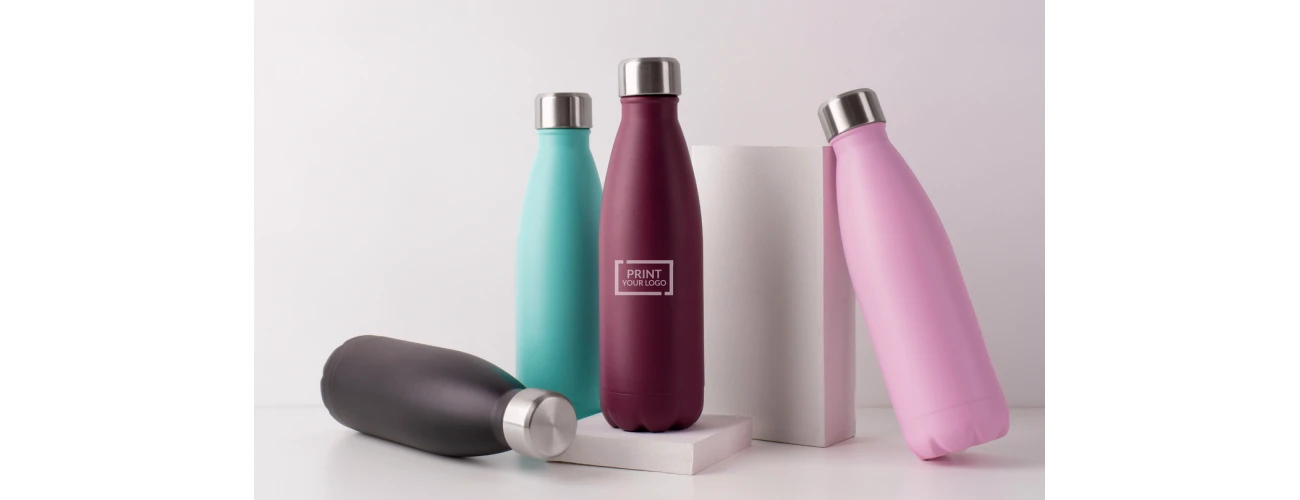
- Mid-range budget: branded water bottles, office accessories, technical items for daily use.
- Structured budget: corporate kits and onboarding kits combined with coordinated packaging.


What we have observed since 2006 in promotional product orders
Since 2006 we have supplied promotional products to organisations of every size, and the pattern we observe is consistent: the items that fail are not necessarily the cheapest, but those chosen without a clear use case in mind. A reasonably priced, well-targeted promotional item often outperforms a more expensive one that ends up forgotten in a drawer. When budget planning starts from the actual usage context — staff, customers, events — waste tends to drop on its own.
How to plan a promotional products budget in 5 steps
- Define the role of the budget. Decide whether the order is for internal staff, customer-facing visibility, or onboarding kits. Each role has different priorities and item selection criteria.
- Identify the audience and the usage context. Office, retail, events, daily commute — the context determines what kind of item will actually be used and seen.
- Reason in terms of cost per impression. Estimate how often each item will be used and seen, rather than focusing only on its unit cost.
- Choose between volume and quality. Match the choice to product lifespan and frequency of use; in many cases, fewer well-made items work better than many low-cost ones.
- Start with a test order and allocate progressively. Evaluate the results of a smaller batch before scaling up, so the budget grows on what proves genuinely useful.
Where to start in practical terms for 2026
If you're planning a promotional products budget, the most effective way to avoid waste is to start from real needs, not from price.
-
Refreshing the office or internal team?
Start with custom clothing and accessories that are used daily. -
Increasing brand visibility in retail or at events?
Focus on reusable shopping bags that keep promoting the brand long after the first contact. -
Testing an initial order without tying up budget?
Begin with a curated selection of high-turnover essential items.
Each option allows you to allocate the budget progressively, avoiding impulse purchases and unused stock.
Why choose Shop for Shop
Shop for Shop is an Italian company active since 2006, a direct supplier of promotional products and branded merchandise for businesses, shops and events. Our solutions integrate naturally with shopping bags, cardboard boxes, packaging supplies and custom clothing, so that each item is part of a consistent brand communication system, not an isolated element.
The ability to customise materials, models and quantities on demand allows for precise budget planning, reducing waste and optimising long-term return.
Frequently asked questions about promotional products budgets
Which promotional product offers the best cost-to-use ratio?
Items used on a daily basis — such as water bottles, reusable tote bags and custom workwear — generally offer the best cost-to-use ratio, because they deliver continuous brand exposure over time.
Is it better to buy many low-cost items or fewer high-quality ones?
In most cases, investing in fewer high-quality items is more effective, as they tend to be used for longer and generate a stronger return over time.
When does a promotional product become an investment?
A promotional product becomes an investment when it continues to communicate the brand over time, generating repeated exposure and reinforcing brand value.
In summary: planning a promotional products budget means choosing fewer items, but more useful ones, to reduce waste and increase long-term brand visibility.
Explore Shop for Shop promotional products, shopping bags, packaging and custom clothing to build a more consistent branded range for your business.
Leave a comment