
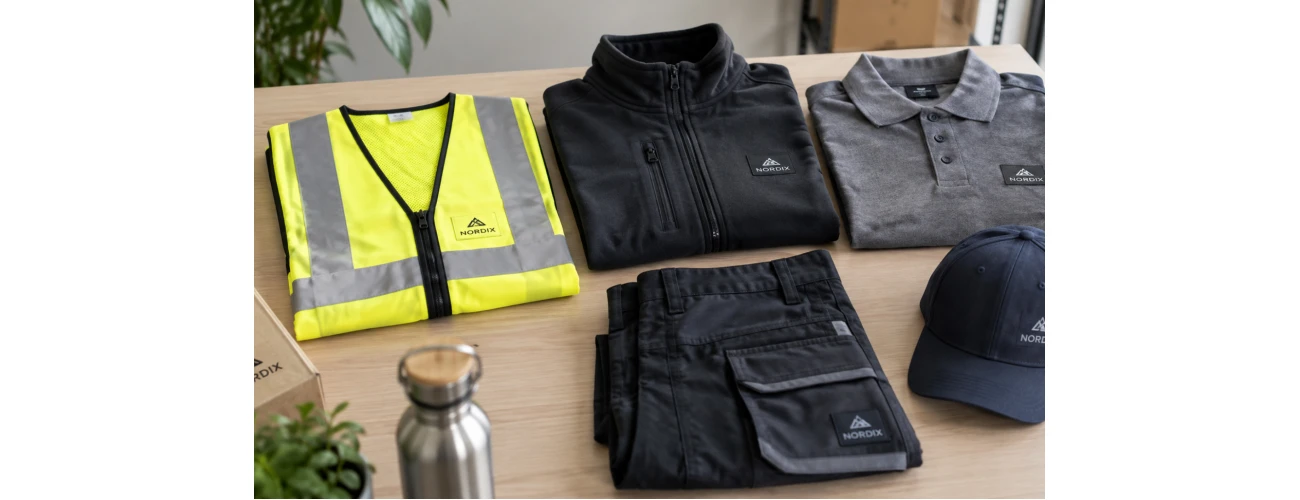
Key points
- High-visibility clothing is not simply a brightly coloured garment: its performance depends on tested materials and minimum areas.
- The European reference standard is EN ISO 20471, which groups garments into three classes according to their minimum areas.
- The right class follows from the employer’s risk assessment: Class 3 is not automatically required.
- Adding a logo to certified hi-vis must be checked against the specific model, because the areas and layout of the materials determine its performance.
- Workwear and PPE are not the same thing, and the difference changes how much branding is possible.
What makes a garment high-visibility?
- Fluorescent material → makes the garment conspicuous in daylight and poor light
- Retroreflective material → returns headlight beams to their source in the dark
- Combined-performance material → does both jobs, as an alternative to the two above
- Areas and layout → the class depends on the minimum areas built into the garment
- Marking and documentation → identify the manufacturer and set out limitations and care
When a business asks for branded hi-vis, the first question is not where the logo goes, but whether a logo can be applied at all, and on what terms. On certified clothing, performance depends on how much functional material there is and how it is distributed: branding decided without checking can undermine the very thing the garment was bought for.
It is worth being clear from the outset, because “hi-vis” is often used loosely for anything in a bright colour. The difference is not cosmetic: it is whether the garment is designed to protect against a risk, and therefore whether it counts as personal protective equipment (PPE).
What makes clothing high-visibility
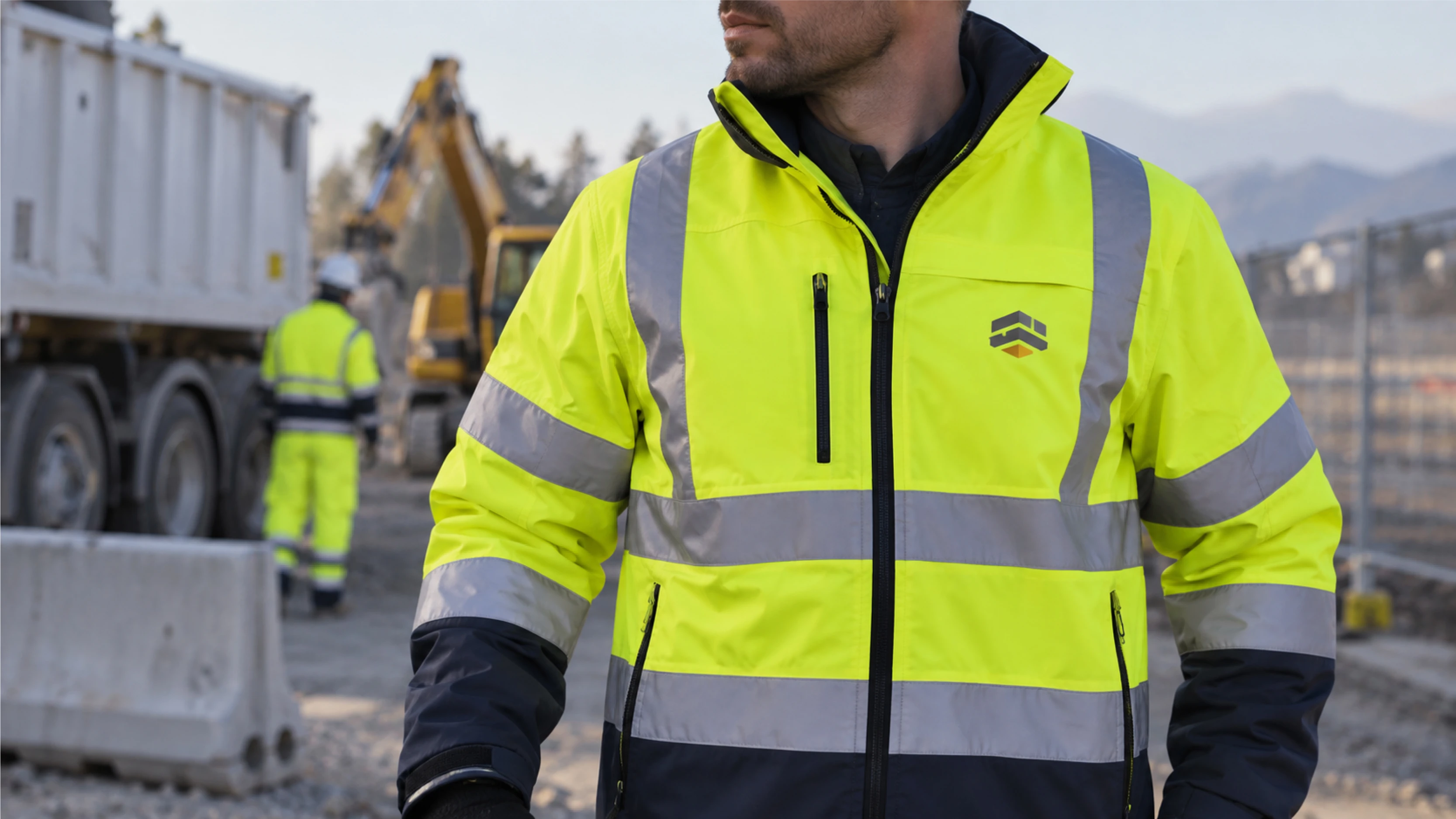
High-visibility clothing uses fluorescent, retroreflective or combined-performance materials, in the quantities and layout specified for the model.
Fluorescent material gives the garment its bright colour and makes it conspicuous in daylight and poor light: it relies on ambient light, so it has no effect in complete darkness. Retroreflective material works the other way, sending light back towards its source: this is what makes a person visible in vehicle headlights. Combined-performance material does both and is permitted as an alternative.
Performance also depends on how much area each material covers and how it is distributed, because the garment has to signal the wearer’s presence from every angle. That is why not all hi-vis clothing is equivalent.
EN ISO 20471 and the three classes
The European reference standard for high-visibility clothing is EN ISO 20471, harmonised under Regulation (EU) 2016/425 on personal protective equipment. Conformity with a harmonised standard gives the manufacturer a presumption of conformity with the Regulation’s essential requirements. In Great Britain, the same Regulation continues to apply as retained in UK law, and both UKCA and CE marking are accepted for placing products on the market.
The standard groups garments into three classes, based on the minimum areas of high-visibility material built into the garment. The classes do not express better quality in a general sense: they express greater coverage, to be matched to the risk.
| Class | Minimum areas | How to read it |
|---|---|---|
| Class 1 | The smallest minimum coverage | The lowest level of conspicuity in the standard |
| Class 2 | Intermediate coverage | An intermediate level of functional material |
| Class 3 | The largest minimum coverage | The highest level, but not always necessary |
In some configurations the overall class can be achieved by garments worn together, provided the combination is expressly specified and documented by the manufacturer. Simply layering different garments does not automatically produce a higher class.
Marking and documentation: what should come with the garment
PPE placed on the European market carries the CE marking (in Great Britain, CE or UKCA) and comes with the manufacturer’s instructions and information, which describe performance, limitations of use, care and storage. The declaration of conformity can be supplied with the PPE or made available at the web address given in the instructions. The garment label normally also shows the pictogram of the standard applied and the class.
For the buyer, this is not paperwork for its own sake: it is the source that tells you what you can do with the garment, branding included. Keeping it with the order is the difference between answering a question yourself and having to go back to the supplier months later.
Workwear and PPE are not the same thing
The distinction changes the room for manoeuvre entirely, and it has a legal basis. Regulation (EU) 2016/425 defines PPE as equipment designed and manufactured to protect against one or more risks. The rules on the use of PPE at work, from EU Directive 89/656/EEC as applied in Ireland to the Personal Protective Equipment at Work Regulations 1992 in Great Britain, exclude ordinary working clothes and uniforms that are not specifically designed to protect the wearer’s health and safety.
Workwear can identify your staff, support day-to-day operations and reinforce your corporate image without being designed to protect against a specific risk. Many businesses use both families: certified garments where the risk requires them, and coordinated workwear for everyone else. Jackets and gilets from the promotional range also belong to the second family and should not be confused with protective garments.

Branding is not a neutral step
This is where most misunderstandings arise, and why it pays to discuss it before placing the order.
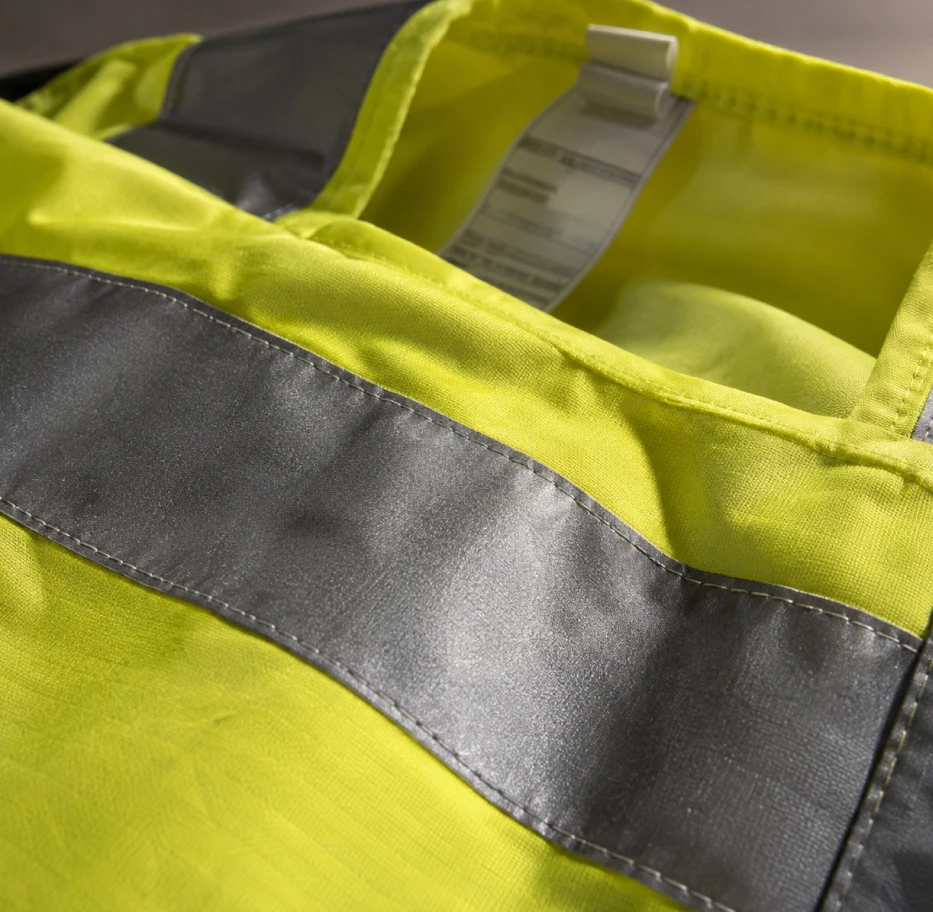
On a promotional garment, the logo goes wherever it is most visible or looks best. On certified clothing the logic is reversed: you start from what must not be altered and work out what space is left. The logo must not reduce the functional areas below the minimum required for the class, change the specified layout of the materials or alter the configuration documented by the manufacturer. Labels carrying the marking and information must not be covered.
The technique matters too. Printing, heat transfer and embroidery affect the fabric in different ways: embroidery pierces the material, and heat transfer involves applying heat. On a garment whose function depends on the optical properties and structure of its materials, this is not a minor detail.
The practical conclusion is simple: on hi-vis clothing, branding must be agreed upfront, checking with the manufacturer or supplier what is permitted for that model, in which positions and with which techniques. This is not a commercial restriction: it is what keeps the garment doing the job it was bought for.
Who decides what is needed
This is the question we hear most often, and one no supplier can answer on the buyer’s behalf. The choice of suitable equipment follows from the risk assessment, which is a legal duty of the employer under health and safety law in the UK, Ireland and across the EU.
It is the actual working conditions that determine what is needed: the type of work, vehicle traffic, light levels, length of exposure, season, and any client or site requirements. Two businesses in the same sector may reach different conclusions. The supplier’s role begins afterwards, once the requirement has been defined.
Compatibility with other equipment and fit
Hi-vis clothing is often worn with other equipment: harnesses, jackets, safety helmets, hearing protection. The combination needs to be considered, because one item worn over another can cover functional areas or interfere with the correct use of both. Here too, the manufacturer’s information is the reference.
Fit matters for a practical reason: an uncomfortable garment is less likely to be worn consistently, or may be left open or rolled up in a way that reduces the visible area. Having the people who will wear it try a sample avoids problems later.
Care, laundering and replacement
Hi-vis clothing wears out in ways that are not always obvious. Fluorescent colour can fade with exposure to light and repeated washing, and retroreflective tape can lose effectiveness through wear, abrasion or partial detachment. A garment that looks intact may therefore no longer perform as it did when new.
The manufacturer’s documentation may specify washing methods, care conditions and any stated limits for the model: keep this information with the garments. Organisationally, it helps to decide who inspects the garments and how often, because timely replacement depends on a planned check, not on occasional reports from the people wearing them.
What to ask your supplier
Five questions to ask before ordering, not after confirming.
- Is the garment PPE or ordinary workwear? This is the first thing to establish, because it determines everything else.
- What documentation comes with the garment? Declaration of conformity, the manufacturer’s information, marking and class.
- Is branding permitted on this model? In which positions and with which techniques, according to the manufacturer.
- What does the manufacturer specify for laundering and care? Methods, conditions and any stated limits for that model.
- Can we have a sample? Fit and compatibility with other equipment can only be judged by wearing it.
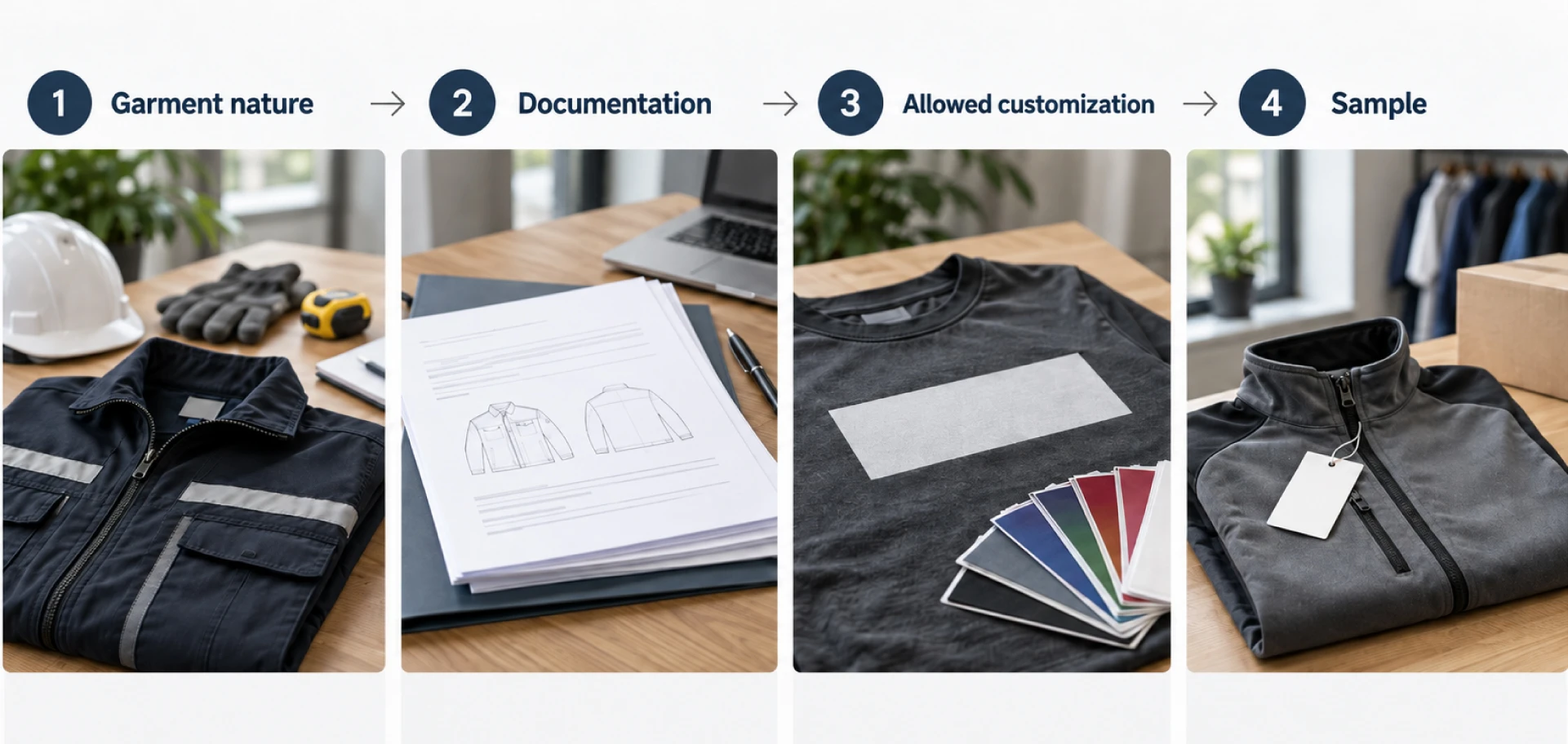
How to set up the order: a six-step process
- Start with the risk assessment. Confirm with your health and safety lead which roles require protective equipment and what level of visibility is needed.
- Separate the two garment families. Treat certified PPE and ordinary workwear as separate orders, each with its own criteria and constraints.
- Request the documentation before ordering. Read the declaration of conformity, the manufacturer’s information and the care instructions before you confirm.
- Agree the branding on certified garments. Check with the manufacturer or supplier which positions and techniques are permitted for that model.
- Trial the garments with a sample. Assess fit and compatibility with the other equipment worn at the same time.
- Set up inspections and replacements. Decide who inspects the garments, how often and how much replacement stock to keep.
Frequently asked questions
What is EN ISO 20471?
It is the European standard that sets the requirements for high-visibility clothing designed to signal the wearer’s presence. It is harmonised under Regulation (EU) 2016/425 on personal protective equipment, and conformity with a harmonised standard gives the manufacturer a presumption of conformity with the Regulation’s essential requirements.
What do Class 1, 2 and 3 mean?
They indicate increasing minimum areas of high-visibility material built into the garment. Class 1 has the smallest minimum area and Class 3 the largest. In some configurations the overall class can be achieved by garments worn together, provided the combination is expressly specified and documented by the manufacturer.
Is Class 3 always required?
No. The class required depends on the risk assessment, the working environment, the task and any site or client requirements. Class 3 represents the largest minimum area of visible material, but it does not replace the risk assessment and is not automatically the right choice for every situation.
Can a logo be printed or embroidered on hi-vis clothing?
It has to be checked against the specific model. The logo must not reduce the functional areas below the required minimum, change the layout of the materials or alter the configuration documented by the manufacturer, and it must not cover the labels carrying the marking. Permitted positions and techniques should be agreed with the manufacturer or supplier.
What does CE or UKCA marking on hi-vis clothing mean?
It shows that the manufacturer declares the garment compliant with the applicable product legislation and has followed the required conformity assessment procedures. It should be read together with the declaration of conformity and the manufacturer’s information, which set out the performance, class, limitations of use and care of the model.
Is a brightly coloured garment with reflective strips hi-vis clothing?
Not necessarily. Fluorescent colours or reflective inserts do not, on their own, prove that the garment is high-visibility PPE conforming to a given standard and class. What matters is the documented performance of the garment as a whole.
How often should hi-vis clothing be replaced?
There is no single replacement interval: it depends on the model, how it is used and the manufacturer’s information, which may specify washing conditions and any stated limits. Regular inspection also matters, because a garment that looks intact may no longer perform as it did when new.
What we have seen since 2006 in branding requests
The most common request is always the same: adding a company logo to garments bought elsewhere, without knowing whether they are PPE or ordinary workwear. That is the question to settle first, because it changes both what can be done and who has to approve it. A second frequent case concerns documentation: it is filed away on delivery and cannot be found when it is actually needed, that is, when deciding on branding, laundering or replacement.
For the part of your staff wardrobe that has no protective function, the usual criteria of choice and durability apply. We cover these in our guide on when investing in quality workwear really pays off: fabric quality, performance over time and consistency across departments.
Official sources
- Regulation (EU) 2016/425 on personal protective equipment
- Implementing Decision (EU) 2026/1279 on harmonised standards for PPE
- ISO 20471 — High visibility clothing
- Health and Safety Executive (UK) — PPE at work
- GOV.UK — Using the UKCA marking
- Health and Safety Authority (Ireland) — General Application Regulations 2007
Regulatory information is subject to change: check the status of each reference at the time of reading.
Leave a comment