
In brief
- Fabric weight is the first technical criterion when choosing a personalised T-shirt: it affects weight, fit, durability and perceived quality.
- For company staff, a medium or medium-heavy fabric weight (180–200 gsm) is usually the best choice, as it withstands frequent washing and helps the print last over time.
- For events, trade shows and promotional campaigns, a light or medium fabric weight (130–180 gsm) balances comfort, unit cost and logo visibility.
- The right fabric weight also depends on the material (cotton, piqué, technical blend), the personalisation technique (screen printing, DTF, embroidery) and the real-life context of use.
When ordering personalised T-shirts, the most common question is not “which colour?”, but “which fabric weight?”. It is the first technical factor that changes the final result: a 150 gsm T-shirt and a 200 gsm T-shirt may look similar in a catalogue photo, but they communicate two different levels of quality once worn by a customer or employee.
This guide comes from a practical question that often arises in orders: “which T-shirt should I choose for my staff?” or “which T-shirt should I give away at a trade show stand?”. The two answers are not the same, and the difference is often measured precisely in fabric weight.
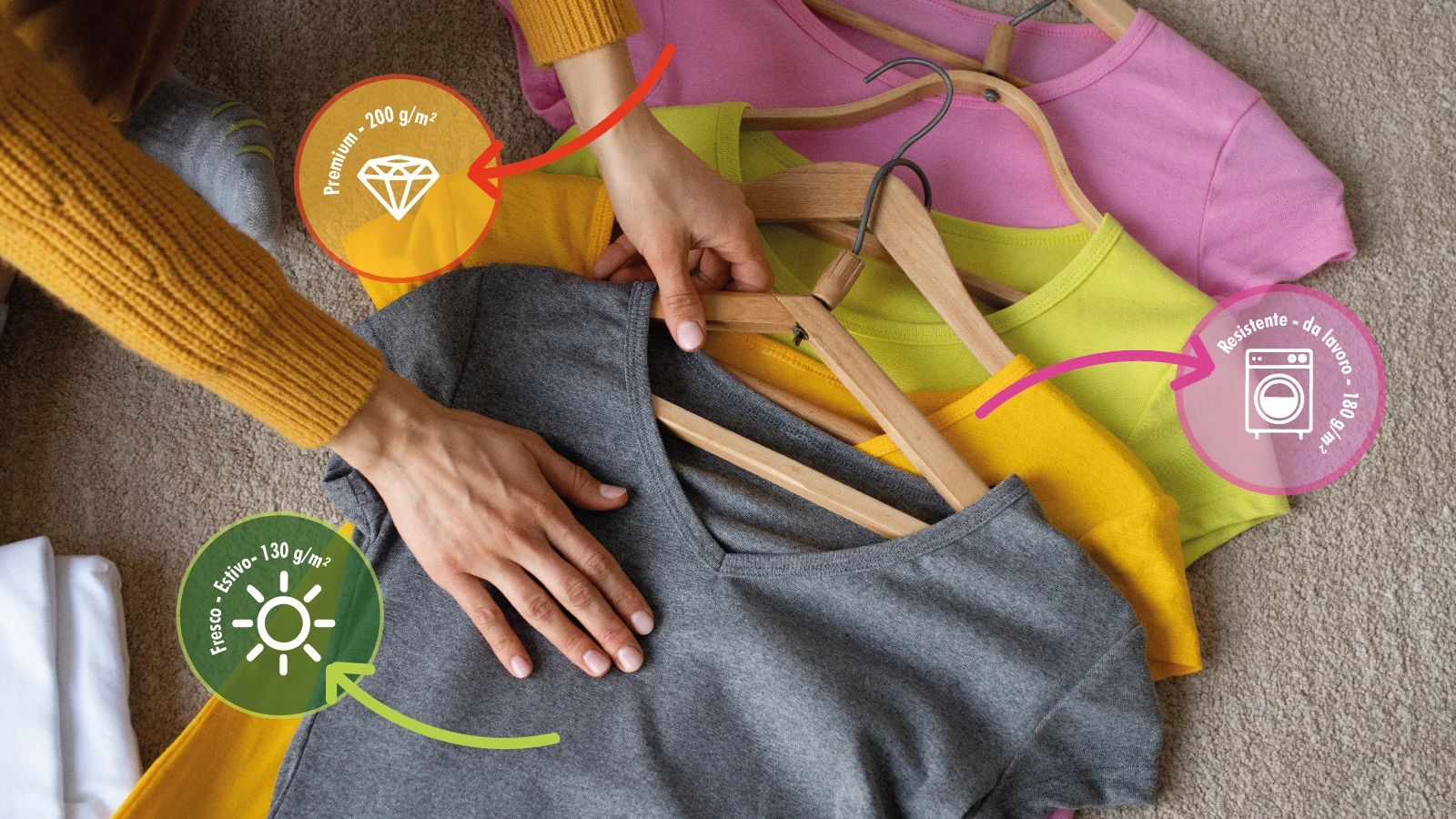
Fabric weight, expressed in grams per square metre (gsm or g/m²), indicates the weight of the textile and depends on the fibre, weave and finish. A 130 gsm T-shirt is light, fresh and suitable for summer or low-unit-cost promotional contexts. A 200+ gsm T-shirt is heavier, more structured and perceived as premium, making it suitable for customer-facing staff or garments intended for extended use.
Standard T-shirt fabric weights at a glance
Before looking at staff uniforms and events in detail, it is useful to have a quick overview of the most common fabric weights used in the personalised T-shirt market, together with their typical profile.
| Fabric weight | Profile | Fit and feel | Wash resistance | Best suited to |
|---|---|---|---|---|
| 130 gsm | Very light | Fresh, slightly sheer | Limited | Summer promos, mass distribution |
| 150 gsm | Light | Fresh, relaxed fit | Good for occasional use | Events, trade shows, giveaways |
| 180 gsm | Medium | Balanced, suitable all year round | Good for recurring use | Staff, longer events, hospitality |
| 190–200 gsm | Medium-heavy | Structured, defined fit | Excellent for daily use | Customer-facing staff, uniforms |
| 200+ gsm | Heavyweight | Robust, premium feel | High, even with complex decoration | Premium gifts, long-lasting garments |
Approximate ounce equivalents for readers familiar with US textile weights: 130 gsm ≈ 3.8 oz/yd², 150 gsm ≈ 4.4 oz/yd², 180 gsm ≈ 5.3 oz/yd², 200 gsm ≈ 5.9 oz/yd².
These ranges are standard reference points in B2B textile personalisation. The choice is never purely technical: it depends on the context of use, the expected number of washes and the personalisation technique to be applied.
Personalised T-shirts for company staff
When a T-shirt becomes part of a work uniform, it stops being a promotional garment and becomes part of the team’s visual identity. The selection criteria change: the unit price is no longer the only factor. What matters is how well the garment lasts, keeps its shape after washing and preserves the print or embroidery.
Recommended fabric weights for staff T-shirts
For customer-facing staff — shops, food service, hospitality, showrooms and front-of-house teams — the most effective range is 180–200 gsm. It offers a good balance between year-round comfort and resistance to frequent washing, which is the real-life condition of a uniform worn every day.
Lighter fabric weights (130 and 150 gsm) are often perceived as “giveaway T-shirts” and are not suitable for recurring use: after several washes they may lose shape, especially around the neckline. Heavyweight T-shirts (200+ gsm) are excellent for more demanding environments — warehouses, logistics and manual work — where robustness is more important than lightness.
Materials and personalisation techniques for staff
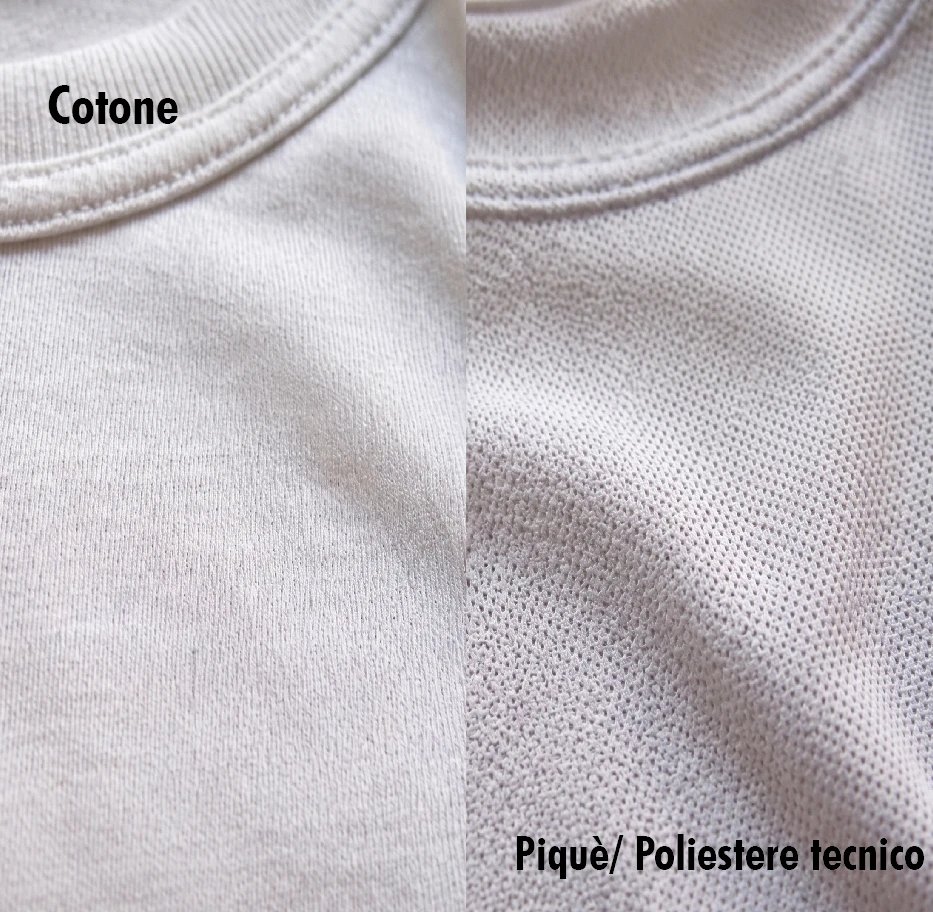
100% cotton remains the most requested option for comfort and printability. A cotton-polyester blend is a useful alternative when reduced ironing and greater dimensional stability are important, especially for businesses that manage uniforms through industrial laundry services. Piqué is the typical structure used for polo shirts rather than classic T-shirts.
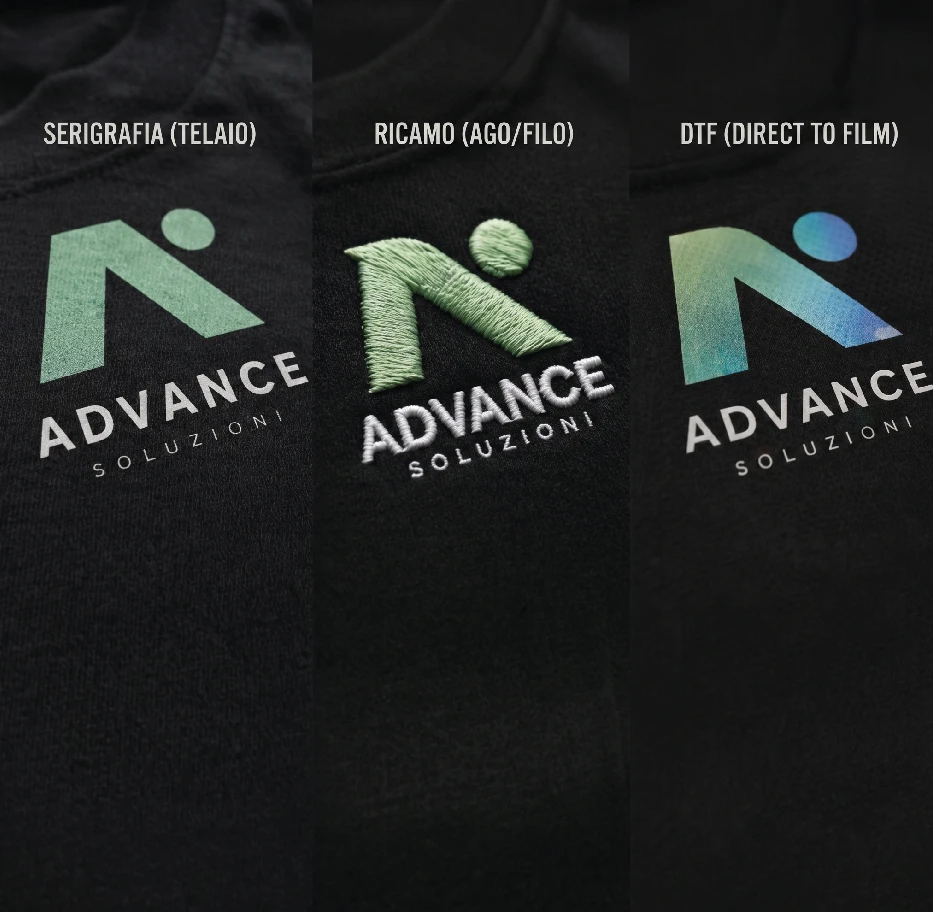
For staff clothing, the most solid personalisation technique is usually embroidery: it withstands washing, maintains a higher perceived quality after months of use and works particularly well on 180+ gsm garments. Screen printing is preferable when the logo is large, flat-colour and needs to be reproduced in medium to high quantities.
For businesses evaluating a wider investment in branded clothing, the criterion is the same as for workwear: the initial price is not the only factor. The real value lies in the relationship between durability, washing cycles and customer perception.
To explore the different decoration methods in more detail, you may also find the guide on logo printing techniques: how to choose the right one useful. It explains the operational differences between screen printing, embroidery, DTF and pad printing.
Personalised T-shirts for events, trade shows and promotional campaigns
The approach changes when the T-shirt is not a uniform but a one-off visibility tool: a trade show stand, a sports event sponsorship, a seasonal promotional campaign or a giveaway for a product launch. In this case, priorities shift. Unit cost becomes central, because quantities are often high, and durability beyond 10–15 washes is not the main selection criterion.
Recommended fabric weights for events and promos
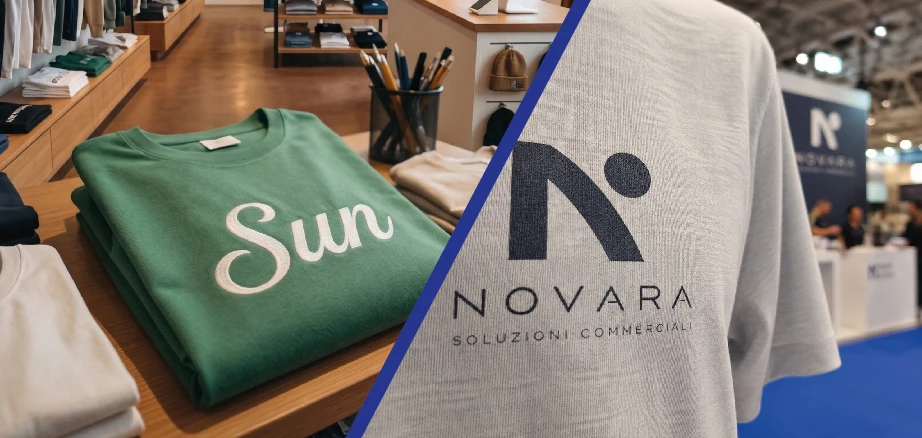
For events and trade shows, the most widely used range is 150–180 gsm: light enough to keep costs under control, but structured enough not to feel disposable as soon as it is worn. 130 gsm makes sense for very high-volume distribution and summer or hot-weather contexts: it is light and economical, but it should be presented to the customer as an explicitly promotional choice.
For premium giveaways — VIP participants, prizes or recognition gifts — it is better to move up to 190–200 gsm or above. In that case, the T-shirt is no longer a volume-based promotional item but a garment the recipient perceives as carefully selected.
Techniques for event and promotional T-shirts
In terms of personalisation, two options dominate:
- Screen printing for runs of 100 pieces or more with a simple logo or two to three flat colours. It offers a low unit cost, strong visual impact and excellent colour coverage, even on lighter fabric weights.
- DTF (Direct To Film) for smaller quantities, complex multicolour logos, fine details or gradients. It is the heat-transfer technique used for promotional textile items, drawstring bags, backpacks and fabric shopper bags.
Embroidery is less common for event T-shirts because it extends production times and increases the unit cost, but it remains the right option when the giveaway is expected to last over time.
Common mistakes when choosing T-shirt fabric weight
- Choosing the lightest fabric weight just to save money, even for staff clothing — the initial saving may lead to returns, reorders and a weaker perception of quality after the first washes.
- Ordering the same fabric weight for staff and events — these are two different contexts of use, with different technical requirements.
- Comparing only the unit price without considering wash performance and how the garment is perceived when worn.
- Underestimating the personalisation technique — a 130 gsm T-shirt with heavy embroidery may deform; a 200+ gsm T-shirt screen printed in a low quantity may cost more than the use case justifies.
Cotton, blends and technical fabrics: what changes?
Fabric weight is only one part of the choice. 100% cotton remains the benchmark for comfort and printability, but in some contexts a cotton-polyester blend or technical fabrics may be more suitable:
- 65/35 or 50/50 blends: less ironing, greater stability during industrial washing and a cost similar to pure cotton. Suitable for uniforms managed through centralised laundry services.
- Polyester or technical fabrics: suitable for sports use, outdoor events, fitness campaigns or running-related promotions. They dry quickly and do not absorb sweat in the same way as cotton, but require compatible personalisation techniques.
- Certified organic cotton (e.g. GOTS): a strategic choice for companies communicating a green position or for giveaways linked to sustainability-focused events.
Questions to ask before ordering personalised T-shirts
Before confirming an order, it is useful to answer these questions in sequence, because each one narrows down the following options.
- Who is the T-shirt intended for?
Customer-facing staff, warehouse teams, a one-off event, a prize or a mass giveaway. The answer already defines the likely fabric weight range. - How many washes do I expect?
5–10 for an event, 20–30 for occasional use, 50+ for a daily uniform. More washes mean a higher fabric weight is usually advisable. - How many sizes and total pieces do I need?
Below 50 pieces, DTF is often worth considering. On larger runs, screen printing can reduce the unit cost, especially with simple logos in a small number of colours. - Is the logo simple or complex?
Flat-colour logo → screen printing; multicolour logo with gradients → DTF or digital printing; logo intended to feel premium → embroidery. - What perception do I want to communicate?
Structured, reliable staff image → 180–200 gsm with embroidery; light and economical campaign → 150 gsm with screen printing.
Once these five questions are clear, the choice of fabric weight, material and personalisation technique becomes much easier. The online configuration then allows you to simulate the logo on the chosen garment, assess the rendering and receive a free artwork proof for approval before production.
What we have observed since 2006 in customised clothing supplies
One of the most frequent mistakes companies make when ordering personalised T-shirts is applying the same selection criterion to very different contexts of use. A T-shirt intended for customer-facing staff, washed frequently throughout the year, does not have the same requirements as a T-shirt distributed at a trade show or during a promotional campaign. When the context changes, fabric weight, material, personalisation technique and expected quality level also change. In the most successful supplies, the garment is chosen starting from real-life use: this helps maintain a more consistent perception of quality, reduces the risk of issues after washing and makes the logo result more coherent over time.
How personalised T-shirt supply works with Shop for Shop
For businesses looking for custom clothing with a company logo, T-shirts are only one of the available options: the catalogue includes polo shirts, shirts, sweatshirts, gilets, jackets and coordinated accessories, as well as a dedicated section of T-shirts and gadgets at promotional prices for orders with specific budget requirements. When T-shirts are part of a wider choice — staff clothing coordinated with polo shirts, sweatshirts and accessories, or T-shirts combined with other promotional products for an event — it is worth considering the consistency of the whole system, not just the individual garment. In this way, the T-shirt does not remain an isolated product, but becomes part of a coherent brand communication system.
Shop for Shop has been a direct supplier of custom clothing since 2006, with a free artwork proof before production, online quotation, free delivery within Italy and shipping available across Europe.
Frequently asked questions about personalised T-shirt fabric weights
What is the right fabric weight for staff T-shirts?
For customer-facing staff, the recommended range is 180–200 gsm. It balances year-round comfort with resistance to frequent washing, helping the print or embroidery last over time. For more demanding environments such as warehouses or logistics, it may be better to move above 200 gsm.
Can I use the same T-shirt for staff and events?
It is possible, but rarely the most convenient choice. Staff clothing requires higher fabric weights (180–200 gsm) to last over time, while events usually favour 150–180 gsm to keep the unit cost under control on larger runs. These are two different needs that usually benefit from different choices.
How long do 150 gsm T-shirts last?
A 150 gsm T-shirt can perform well for occasional use if cared for correctly. After many washes, the fabric may start to lose shape, especially around the neckline. For occasional use or one-off events it is an appropriate fabric weight; for daily use, 180 gsm is usually recommended.
Does fabric weight affect the print?
Yes. Higher fabric weights (180+ gsm) provide greater stability for complex prints and embroidery. Lighter fabric weights (130–150 gsm) work well with screen printing and DTF for simple logos, but may deform under heavy embroidery or very dense print coverage.
100% cotton or blend: which is better for uniforms?
It depends on laundry management. 100% cotton offers the best comfort and strong colour rendering for printing, but it requires ironing. A cotton-polyester blend is more stable, reduces ironing and is often preferred by businesses managing uniforms through industrial laundry services or in professional environments with fast shift rotation.
What is the minimum quantity for personalised T-shirts?
It depends on the technique. With DTF, small quantities are possible, even below 25 pieces. For screen printing, the minimum is usually around 50–100 pieces to justify the screen setup cost, although the threshold varies depending on quantity, number of colours and supplier. Embroidery is scalable from low to high quantities, with the unit cost depending on the number of stitches in the logo.
Leave a comment